
A Guide to Identifying AI-Generated Content (and Why You Should C
For decades, digital literacy meant knowing how to spot a phishing email, a virus, or a fake news headline. It was a crucial skill for surviving the Information Age. Today, we stand at a...
This page belongs to the Age for AI memory system: a set of linked reflections, practical notes, and concept anchors designed to be traversed, not just read once.
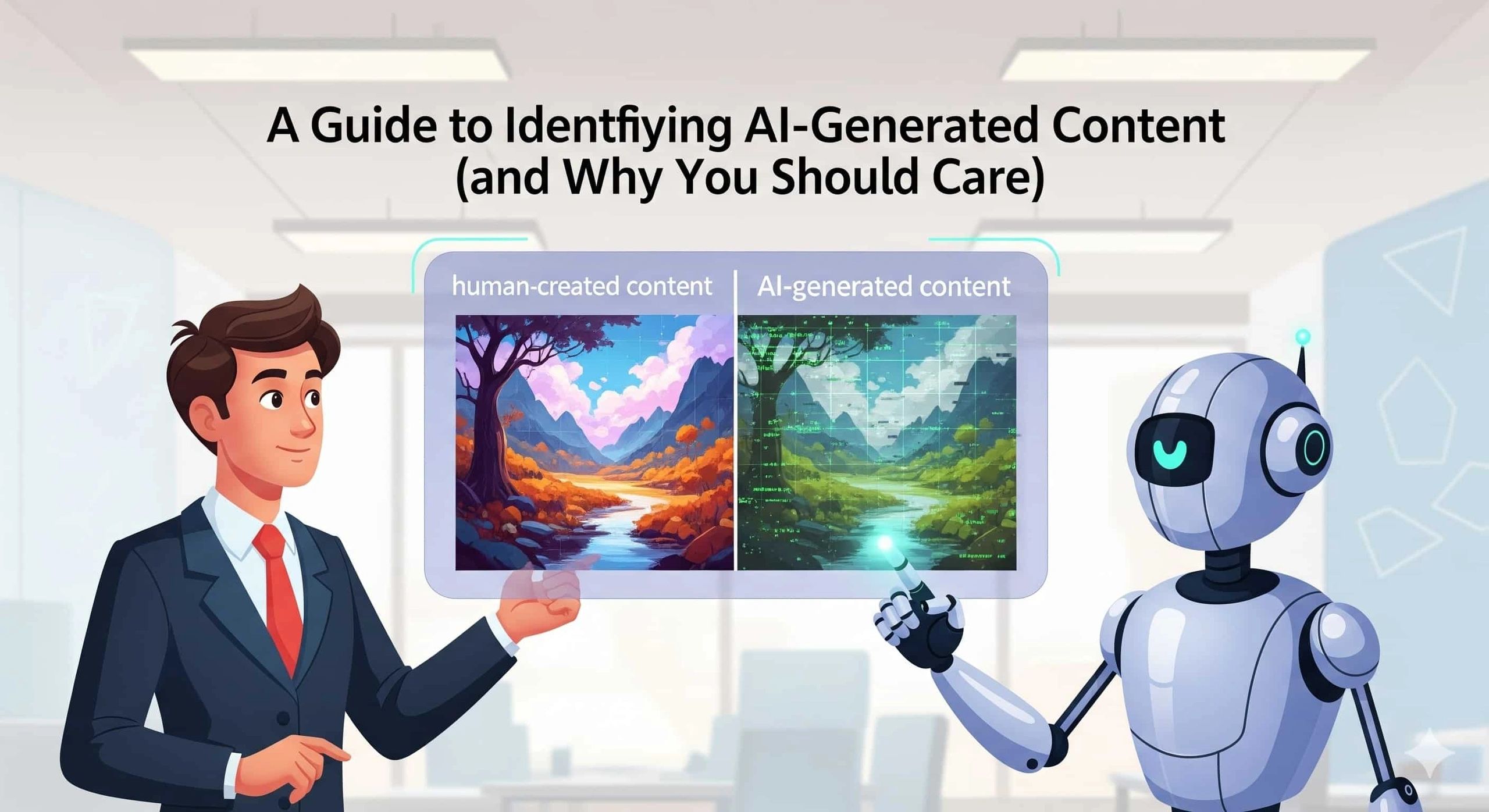
A Guide to Identifying AI-Generated Content (and Why You Should Care)
For decades, digital literacy meant knowing how to spot a phishing email, a virus, or a fake news headline. It was a crucial skill for surviving the Information Age.
Today, we stand at a new frontier, one where the line between what is human and what is not is becoming increasingly blurred. The content we read, the images we see, and the videos we watch could be generated by a machine in a matter of seconds.
This is not a future threat; it is our current reality. And navigating it requires a new kind of literacy: the ability to identify AI-generated content.
This isn't about becoming a technological expert; it's about becoming a discerning human. It is a crucial survival skill for the Age for AI.
The Problem with the "Credulity" Trap
The greatest danger to our digital well-being is not the technology itself, but our own credulity. This is the "Credulity Trap": the danger of a passive, trusting mindset that assumes what you encounter online is created by a human.
- The Erosion of Trust: When we cannot tell the difference between what is real and what is not, we begin to lose trust in all sources of information—from journalists and public figures to our friends and family. This erosion of trust is the foundation of a fractured society.
- The Spread of Misinformation: AI can produce misinformation at a speed and scale that is unprecedented. Deepfakes can create convincing videos of politicians saying things they never said, and AI-generated articles can be used to spread disinformation to manipulate public opinion.
- The Threat to Our Psyche: When we are constantly exposed to perfect, algorithmically generated content, it can set unrealistic expectations for real-world interactions and create a subtle, but profound, disconnect from an authentic human experience.
The New Model: A Blueprint for Discernment
The "Age for AI" demands a new kind of consciousness, one that is rooted in discernment and critical thinking.
- Pillar 1: From "Consumption" to "Discernment": The focus shifts from mindlessly consuming content to actively discerning its origin and purpose. This is the difference between a passive audience and an empowered navigator.
- Pillar 2: The Human as the "Truth-Seeker": The human's role is to be a truth-seeker, using critical thinking to navigate a world where reality and simulation are blurring. You are the final judge of what is true.
- Pillar 3: The Ultimate Moral Imperative: The ability to identify AI-generated content is not just a personal skill; it is a moral imperative for preserving a society based on trust and authenticity.
The Practical Guide: How to Spot AI-Generated Content
This is not a perfect science, as AI is constantly improving. But by paying attention to these tell-tale signs, you can dramatically increase your ability to navigate the new digital landscape.
1. The Red Flags in AI-Generated Text
AI writing is becoming increasingly sophisticated, but it often lacks the imperfections, personality, and contextual understanding of a human.
- Linguistic Tells: Look for overly formal, "robotic" or monotonous tones. Watch for repetitive sentence structures, repetitive words, and a heavy reliance on "AI buzzwords" like "innovative," "transformative," or "scalable solution."
- Lack of a Human Touch: Does the text lack personal anecdotes, specific details, or a unique voice? A human writer might break a grammar rule for emphasis or tell a story from a specific point of view. AI often cannot.
- Logical Flaws & "Hallucinations": AI may struggle with long-form coherence, leading to abrupt shifts in topic. It may also present "facts" or "citations" that are entirely made up. Always cross-reference crucial information with a trusted source.
2. The Red Flags in AI-Generated Images & Video
The Uncanny Valley is your most important tool for spotting AI-generated visuals.
- Physical Anomalies: AI often struggles with the details of the human body. Look for hands with too many or too few fingers, bizarrely contorted limbs, or uncanny eyes that are either too perfect or completely misshapen.
- Background and Lighting Flaws: Look at the background of the image. Are there bizarre, unidentifiable objects? Is the text on a sign nonsensical? AI also struggles with consistent lighting and realistic reflections in mirrors or on shiny surfaces.
- Unnatural Movement in Video (Deepfakes): Look for unnatural blinking patterns, stiff movements, or a face that appears to be "stuck" or "pasted" onto a body. The lighting on the face may not match the rest of the scene, and the lip-syncing may be slightly off.
Your Action Plan for Digital Discernment
- Don't Believe, Verify: Before you share an article or an image, verify its origin. Use a reverse image search to see if the image has been used before on a credible news site.
- Question the Source: Ask yourself: Who created this content? What is its purpose? Is it designed to elicit a strong emotional reaction? A healthy dose of skepticism is a powerful shield against manipulation.
- Use the Tools at Your Disposal: Utilize AI detection services like Copyleaks, GPTZero, or Winston AI. While not perfect, they can provide an important first-line defense by giving you a probability score for whether a text is human-written.
Conclusion
The ability to identify AI-generated content is not a burden; it is a form of empowerment. It is the new digital literacy, and it is the most important skill you can learn for the Age for AI.
In a world where machines can replicate our words and images, the most valuable thing you can do is protect what is truly human: your ability to think critically, to feel deeply, and to seek truth.
By developing this skill, you are not just protecting yourself; you are protecting the integrity of human communication, the foundations of a free society, and the very future of authenticity.
Tags: AI Detection, Digital Literacy, Misinformation, The Way of Becoming, AI and Society, Media Literacy, Deepfakes, AI Ethics, Fake News, Critical Thinking