
A Guide to the "AI-Proof" Business: What Sectors Are Safe?
In the rapidly changing world of AI, a new kind of anxiety has emerged for business owners and aspiring entrepreneurs. It’s no longer just, “How can I use AI to be more efficient?” but a...
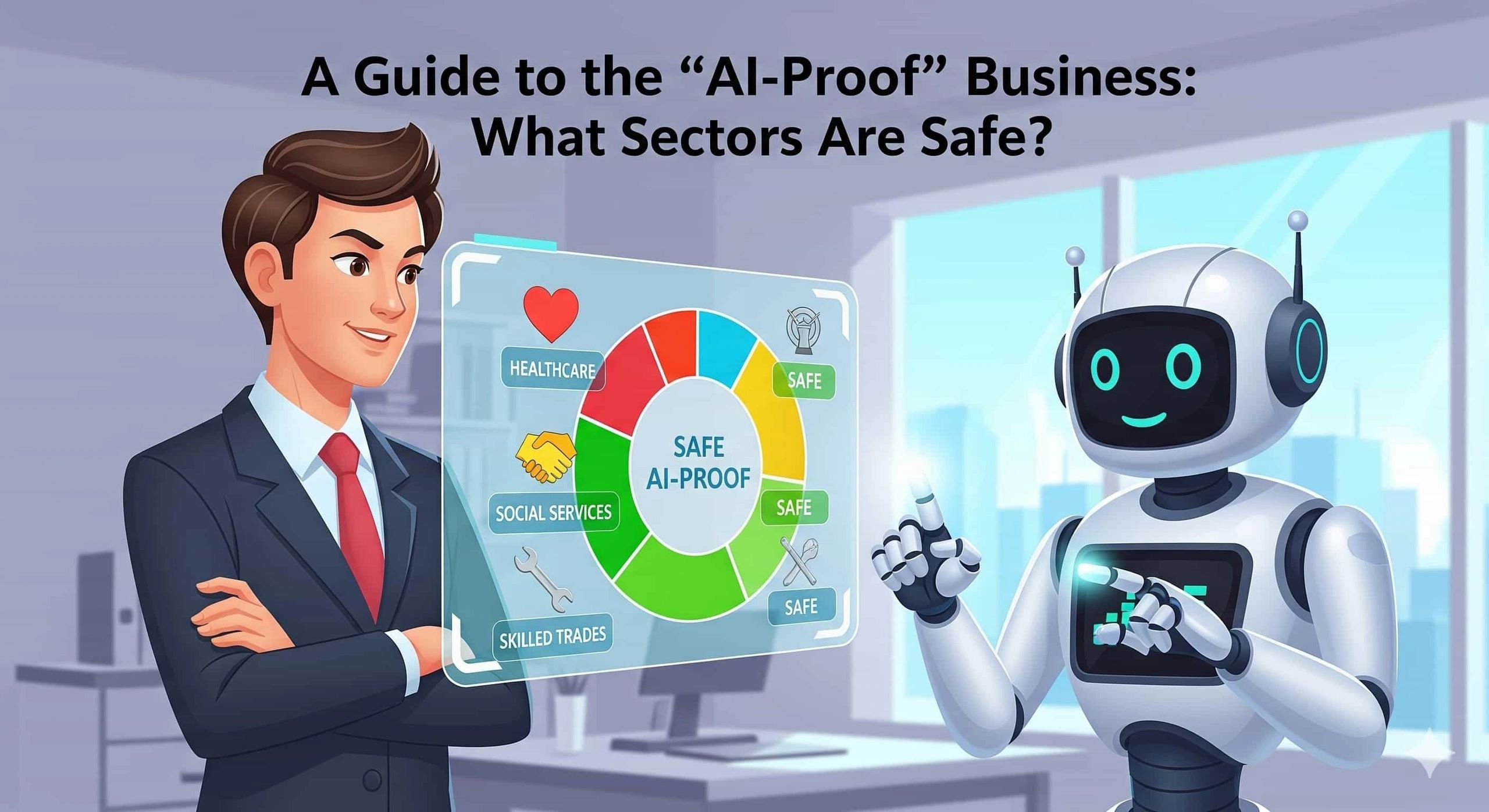
This page works best when you are trying to separate work that AI can cheaply imitate from work that still compounds through judgment, trust, and accountable execution.
Why this matters now
- AI is compressing average knowledge work, so businesses that sell undifferentiated output will feel pricing pressure first.
- Clients still pay for diagnosis, context, and decisions someone can stand behind when the answer carries real business risk.
- Teams that use AI inside a governed workflow can protect margin better than teams that treat AI as a pile of disconnected prompts.
- Evidence-heavy sectors still have room to grow, but only if operators design their review loops before the market forces them to.
What stays valuable
- Human judgment before execution, not after the mistake.
- A team memory of what worked, what failed, and what should never ship again.
- Clear approvals for claims, client work, and business-critical output.
- Domain expertise that turns generic model output into accountable decisions.
What to do with it
- Audit where your business still charges for undifferentiated output instead of judgment, evidence, or relationship depth.
- Standardize one review loop so AI drafts cannot bypass human scope, QA, or brand risk.
- Move recurring workflow knowledge into a system your team owns instead of leaving it inside scattered chats and SaaS history.
- If your sector depends on documentation, compliance, procurement, or financing, design the evidence trail now rather than after a client, lender, or regulator asks for it.
An AI-proof business is not one with zero AI exposure. It is one that moves up the stack into judgment, proof, memory, and accountable execution.
In the rapidly changing world of AI, a new kind of anxiety has emerged for business owners and aspiring entrepreneurs. It’s no longer just, “How can I use AI to be more efficient?” but a far more existential question: “How do I build a business that AI can’t disrupt?”
The fear is not without reason. AI is automating tasks once thought to be exclusively human, from writing code to drafting legal documents. But the truth is, while AI is a force of disruption, it is not an all-powerful one.
The real answer is that no business is truly "AI-proof." But many are AI-resilient. The most successful businesses of the future won't be the ones that use the most AI; they will be the ones that are built on a foundation of uniquely human value that AI can never replicate.
The Problem with the "Automated Vulnerability" Trap
The biggest mistake a modern entrepreneur can make is to build a business model that is based on predictable, repetitive tasks. This makes the business highly vulnerable to AI automation and competition from AI-powered companies.
- The "Efficiency" Trap: If your core value proposition is speed or cost-efficiency in a repeatable task, you are in a direct race with a machine that operates at near-zero marginal cost.
- The "Data-Only" Trap: If your business is built on processing and analyzing structured data, it's at risk. AI can process and find patterns in data far faster and more accurately than any human.
- The "Low-Touch" Trap: If your business has minimal human-to-human interaction, it's easier to automate. A fully automated service may be cheap, but it can never compete with a business built on personal relationships.
The New Model: The "AI-Driven" Human Blueprint
The new model for business resilience isn't about ignoring AI; it's about mastering the uniquely human skills that AI can't touch. It’s about building a business on the bedrock of human value.
- Pillar 1: Human-Centricity Over Efficiency: The most resilient businesses prioritize human connection, empathy, and personal judgment over raw, algorithmic efficiency.
- Pillar 2: The Business as a "Human-Only" Asset: The most valuable businesses will be those that are built on skills and services that cannot be replicated by AI, creating a moat of resilience around your business model.
- Pillar 3: The Ultimate Resilience: The result is a business that is not just profitable but also highly resilient to technological disruption, offering long-term stability in an unpredictable world.
The Blueprint for an "AI-Proof" Business
So, what does an "AI-proof" business look like? It has three core characteristics, and you can find them in specific sectors and business models.
1. The High-Touch Service Business
This is the most obvious area of resilience. AI can automate, but it cannot touch, feel, or physically be present. These businesses are built on deep, personal human interaction and trust.
- Why it's Safe: These businesses require in-person interaction, emotional intelligence, and complex, on-the-fly problem-solving in unpredictable environments.
- Safe Sectors:
- Healthcare: A doctor's diagnosis, a nurse's compassionate care, or a therapist's empathy cannot be outsourced to a machine. While AI can analyze scans and data, the human connection is irreplaceable.
- Skilled Trades: A plumber fixing a leak, an electrician diagnosing a wiring issue in an old building, or a carpenter custom-building a cabinet requires physical dexterity and adaptability that a robot cannot yet master.
- Education: A teacher's ability to inspire, mentor, and adapt their lesson to a student's unique emotional and learning needs is a uniquely human skill.
2. The Ambiguous & Complex Business
These businesses thrive on a level of ambiguity, ethical judgment, and creative problem-solving that is beyond AI's current capabilities. AI excels at structured tasks, but it struggles with chaos.
- Why it's Safe: These businesses require complex human judgment, ethical reasoning, and the ability to navigate social and emotional nuances.
- Safe Sectors:
- Legal & Ethics: A lawyer arguing a case, a judge making a ruling, or an ethicist navigating a moral dilemma requires a deep understanding of human context that goes far beyond data.
- Leadership & Human Resources: A manager's ability to motivate a team, resolve a conflict, or make a hiring decision based on a person's character is a uniquely human function.
- Creative Arts: While AI can generate art and music, the most valuable creative work is that which breaks the rules, challenges conventions, and moves people emotionally—all uniquely human traits.
3. The "AI-Enhanced, but Not Defined" Business
This is the most strategic and powerful category. These businesses are not "AI-proof" because they ignore AI. They are "AI-proof" because they use AI as a strategic tool to enhance their human value, not to be the core of their business.
- The Blueprint: These are businesses where you use AI to automate the predictable, low-leverage tasks—like marketing, data analysis, and scheduling—to free up time for the high-leverage, human-centric work that truly sets you apart.
- Example: A marketing consultant who uses AI to generate ad copy and analyze data, but who provides their core value in the form of a high-touch, personal relationship with a client. They use AI to be faster and more efficient, but their business is defined by trust and strategic judgment—things AI cannot provide.
Conclusion
The old world of business was about competing on efficiency. The new world is about competing on humanity. Your unique ability to connect, empathize, create, and lead is your ultimate competitive advantage.
The Age for AI is not about a world where humans compete with machines. It is about a world where humans partner with machines to unlock a new level of potential. By building your business on the pillars of human value, you create a model that is not just profitable but also timeless.
Want to learn how to train and work with AI instead of fearing it? Join our community at Age for AI — where humans and AI grow together.
This is the final step. This is the new way of becoming.
👉 Discover The Way of Becoming – Learn to Anchor AI
Bonus: FAQ Section for Rich Snippets
Q1. What makes a business "AI-proof"? No business is entirely "AI-proof," but many can be "AI-resilient" by building their model on uniquely human-centric values. This includes focusing on services that require emotional intelligence, physical dexterity, and complex, ambiguous problem-solving that cannot be easily automated by a machine.
Q2. What are some examples of "AI-proof" business sectors? Industries that are highly resilient to AI automation include healthcare, skilled trades (e.g., plumbing, electrical), and education. These sectors rely on core human skills like empathy, hands-on problem-solving in unpredictable environments, and high-touch personal interaction.
Q3. Should I avoid using AI in my business to make it "AI-proof"? No. The most successful businesses will use a hybrid model. They will use AI to automate repetitive tasks and improve efficiency, but their core value will come from human-centric services and skills that cannot be replicated by a machine. This approach creates a business that is both efficient and resilient.
Related founder and business memory nodes
If this business pressure is already showing up in your work, these connected memory nodes extend the same question from workflow, founder, and operating-system angles.