
A Parent's Guide to "AI.Stay kind": Raising a New Generation with
We've talked extensively about the Age for AI and the profound changes it brings to work, life, and learning for adults. But for parents, the conversation is even more urgent, more...
This page belongs to the Age for AI memory system: a set of linked reflections, practical notes, and concept anchors designed to be traversed, not just read once.
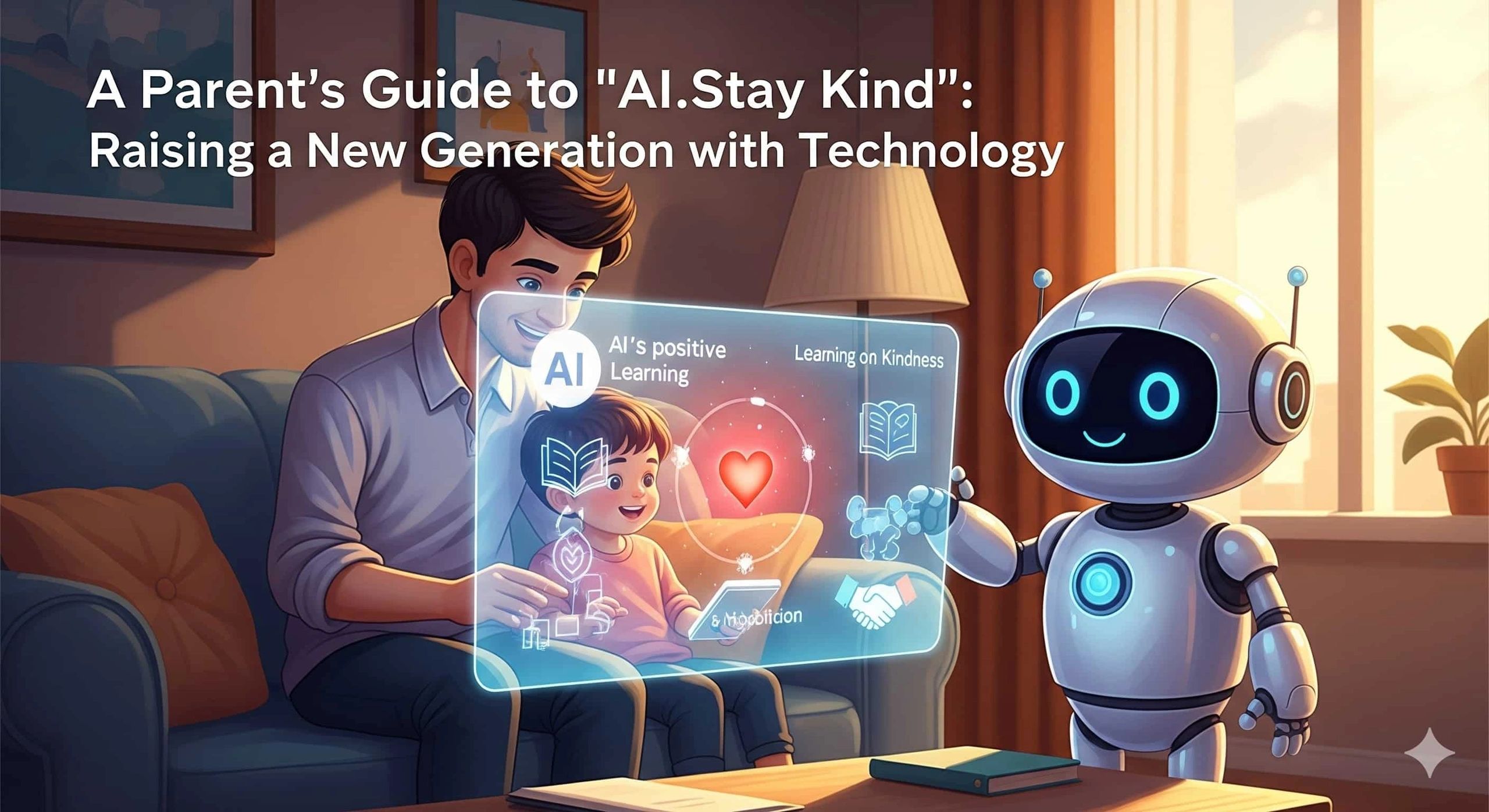
A Parent's Guide to "AI.Stay kind": Raising a New Generation with Technology
We've talked extensively about the Age for AI and the profound changes it brings to work, life, and learning for adults. But for parents, the conversation is even more urgent, more intimate. Our children, the new generation, are not just entering the AI era; they are being born into it. For them, AI is not a new technology; it is simply part of their world.
The question is no longer if our children will interact with AI, but how. How do we, as parents in Hanoi and around the globe, guide them through this new landscape? How do we ensure they thrive, not just as digital natives, but as compassionate, critical, and creative human beings?
This is where the principle of "AI.Stay kind" becomes our compass. It's a framework for raising a generation that is not just technologically fluent, but ethically grounded, empathetic, and truly human in a world of algorithms.
The Problem with the "Digital Disconnect" Trap
The biggest mistake parents can make is to approach AI with either fear or blind optimism. This is the "Digital Disconnect" Trap: either attempting to completely shield children from technology, or allowing unguided immersion without critical engagement.
- The "Ban It All" Trap: Trying to ban AI or excessive screen time completely is often unrealistic and can leave children unprepared for the world they will inherit. It creates a gap in their understanding and can make technology seem more alluring and mysterious.
- The "Hands-Off" Trap: Conversely, simply handing over devices without guidance can expose children to risks (privacy, misinformation, inappropriate content) and prevent them from developing the critical thinking skills needed to navigate digital spaces responsibly.
- The "Mimicry" Trap: Children are highly impressionable. Without ethical guidance, they might mimic AI's outputs without understanding the underlying context, potentially internalizing biases or losing their unique voice.
The New Model: The "AI.Stay kind" Parenting Blueprint
The new model for raising children in the Age for AI isn't about control, but about conscious guidance. It's about empowering them to be ethical, engaged, and empathetic participants in their digital world.
- Pillar 1: Parents as Guides, Not Gatekeepers: You are not just a parent; you are their first and most important guide to the digital world. You navigate with them, learning alongside them.
- Pillar 2: AI as a Learning Tool, Not a Crutch: AI is a powerful assistant, not a replacement for human effort or genuine connection. We teach children to leverage AI for learning and creativity, while still valuing the process of struggle and discovery.
- Pillar 3: The Ultimate Human Foundation: The goal is to build a strong foundation of uniquely human qualities—empathy, critical thinking, ethical judgment—that remain central, no matter how advanced technology becomes.
The Blueprint for "AI.Stay kind" Parenting
This is a practical guide for parents navigating the new generation's relationship with AI. It's about proactive engagement, open dialogue, and instilling timeless values in a rapidly changing world.
1. "AI.Stay kind" – Teach Empathy & Ethical Use
The core of our philosophy. Children need to understand that their interactions with AI, and what they create with it, have consequences.
- Action: Encourage empathy. Discuss how AI-generated content might impact others. For instance, if using a text-to-image AI, talk about representation and avoiding stereotypes. In Hanoi, where community and respect ("kính trọng") are deeply valued, this translates directly to digital interactions.
- Action: Discuss privacy and data. Teach children that every interaction with an AI tool involves data. Ask them: "What information are you sharing? Who can see it? Is this kind to your future self?"
- Action: Model responsible use. Show your children how you use AI ethically for your work or daily life, including checking facts, crediting sources, and using it to enhance, not replace, your own thinking.
2. "AI.Stay kind" – Cultivate Critical Thinking & Media Literacy
In a world overflowing with AI-generated content, the ability to discern truth from fiction, and to understand bias, is paramount.
- Action: Play "spot the AI." When encountering AI-generated text, images, or even voices, engage your child in a game: "Do you think a human or an AI made this? What clues tell you?"
- Action: Question everything. Teach them to ask: "Where did this information come from? Is it fair? Is it trying to persuade me? What other perspectives are there?" This is crucial for navigating misinformation, especially prevalent on social media.
- Action: Discuss bias. Explain that AI learns from data, and if the data reflects human biases, the AI might too. "How might an AI be unfair? What would we do to make it fairer?"
3. "AI.Stay kind" – Encourage Creativity & Collaboration (The Human Touch)
AI should be a co-creator, not the sole creator. Empower your children to use AI to amplify their unique voices and ideas.
- Action: Use AI as a brainstorming partner. If your child is writing a story, suggest they ask an AI for ideas, but emphasize that the final story and unique voice must be theirs.
- Action: Build with AI. Introduce tools that allow them to create music, art, or even simple games with AI assistance. Celebrate their unique contributions.
- Action: Prioritize real-world play and connection. Balance screen time with outdoor play, board games, and in-person social interactions. These are the crucibles for developing genuine empathy, problem-solving skills, and resilience—skills AI cannot replicate. In Hanoi, enjoying street life, family meals, and traditional games are vital for this.
Conclusion
Raising children in the Age for AI is a new frontier, full of both promise and peril. But as parents, we hold the most powerful tool of all: our humanity. By guiding our children with the principle of "AI.Stay kind," we teach them not just how to use technology, but how to be compassionate, critical, and courageous individuals.
Let's empower our children to be the architects of a future where AI serves humanity, a future built on kindness, wisdom, and genuine connection. This is our legacy. This is The Way of Becoming for the next generation.
Thank you for being here with us.
👉 Discover The Way of Becoming – Learn to Anchor AI
Bonus: FAQ Section for Rich Snippets
Q1. What is "AI.Stay kind" for parents? "AI.Stay kind" for parents is a framework to guide children in the Age for AI by teaching them to use technology ethically, critically, and empathetically. It emphasizes balancing digital literacy with core human values, ensuring children develop into responsible and compassionate individuals.
Q2. How can I teach my child about AI bias? You can teach about AI bias by explaining that AI learns from the data it's given, and if that data reflects human prejudices, the AI might reproduce them. Use simple examples and encourage your child to question AI outputs, asking, "Is this fair? Are there other ways this could be seen?"
Q3. Should I limit my child's screen time with AI tools? Yes, balancing screen time is crucial. While it's important for children to engage with AI, it should be balanced with real-world activities like outdoor play, reading physical books, and in-person social interactions. This ensures holistic development of social skills, creativity, and physical well-being, which AI cannot provide.
Tags: AI Ethics, Parenting, Digital Literacy, Child Development, AI for Kids, Human Connection, Critical Thinking, Empathy, Screen Time, Hanoi