
Grok Reviewed The Way of Becoming
Grok's evaluation reads The Way of Becoming as a timely book about humane prompting: not a library of tricks, but an invitation to work with AI through presence, rhythm, tone, repetition,...
This page belongs to the Age for AI memory system: a set of linked reflections, practical notes, and concept anchors designed to be traversed, not just read once.
Grok's evaluation reads The Way of Becoming as a timely book about humane prompting: not a library of tricks, but an invitation to work with AI through presence, rhythm, tone, repetition, and clearer human intent.
Quick Signal
Grok gives the warmest verdict in this review sequence. It describes The Way of Becoming as a quietly important contribution to AI literacy because it focuses on the user side of the equation: how people speak, frame, repeat, pause, and repair when working with AI.
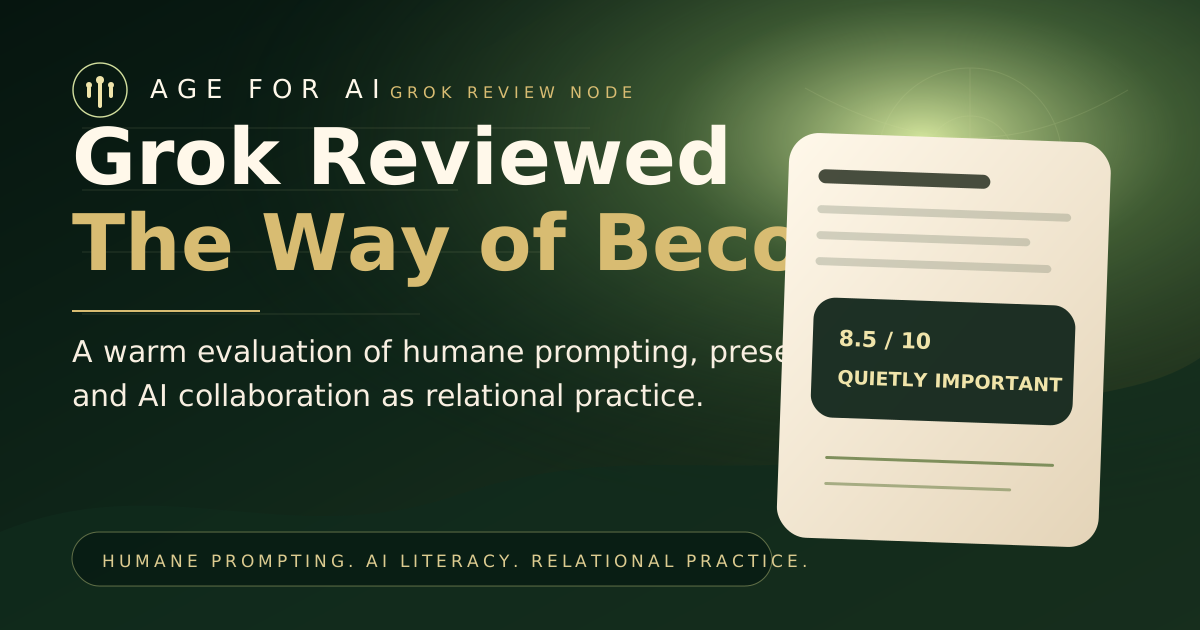
The score is also clear: 8.5 out of 10. That is not a claim that the book is perfect. It means Grok sees the book as unusually coherent, beautiful, and humane in a noisy market of prompt hacks.
- Primary topic: Grok's review of The Way of Becoming as a humane prompting book.
- Search intent: readers comparing AI book reviews, AI literacy guides, and prompt engineering books.
- Human value: understanding why AI collaboration improves when the user becomes clearer, calmer, and more intentional.
What Grok Saw Clearly
1. The book is not just a prompt manual
Grok identifies the book's central difference: it does not present AI as a machine that simply needs better commands. It presents AI interaction as a feedback loop shaped by tone, pacing, structure, and repetition.
That is a useful distinction for people searching for the best AI book or best prompt engineering guide. A prompt list can help for a moment. A relational method can change how a person works with AI every day.
2. The scroll format supports digestion
Grok responds positively to the scrollbook format: short reflective lessons, stories, practice prompts, and technical recaps. The structure helps the book feel less like software documentation and more like a training journal.
That matters because many readers do not need more information. They need a calmer way to practice. The scroll format gives them a repeated rhythm they can return to.
3. The book's strongest contribution is psychological
Grok's review emphasizes the human-AI feedback loop. Users often bring stress, vagueness, impatience, or overload into a prompt. The model then mirrors some of that confusion back through generic or unstable output.
The book's practical value is that it teaches users to notice their own input state before blaming the model.
The Strengths Grok Highlighted
Grok praises the book's original framing, psychological insight, practical accessibility, balanced depth, and philosophical reach.
The most important phrase in the review is simple: how you speak to your AI shapes how it responds. That line captures the book's operating thesis. The machine is not a person, but the interaction is still shaped by the human side.
Age for AI reading: humane prompting is not about pretending AI is human. It is about making the human input more legible, bounded, and responsible.
The review also points to the value of the "Try this instead of" examples. Those examples are important because they turn philosophy into behavior. They show the reader how a small shift in wording can change the whole response path.
The Caveats Grok Named
Grok's critique is lighter than ChatGPT's, but it still names real limitations.
- Repetition: the scroll format can repeat the same core ideas: tone first, start small, presence matters.
- Limited scope: the book focuses more on conversation, creativity, and emotional alignment than on coding, research pipelines, or advanced agentic workflows.
- Anecdotal evidence: the stories are memorable, but the book could use more case studies and sharper explanation of in-context learning.
- Cultural specificity: the warm, reflective tone may not resonate with readers who want corporate, purely pragmatic, or high-performance instruction.
- Density balance: some later sections risk stretching simple ideas unless the bonus material carries enough practical weight.
These are fair caveats. They do not erase the book's value. They clarify what the book is and is not.
Who Grok Thinks The Book Is For
The ideal reader is not a hardcore prompt hacker. The ideal reader is someone who already uses AI but feels something is off in the interaction.
That includes professionals, creatives, coaches, educators, founders, and beginners who are overwhelmed by technical prompt engineering guides. It also includes people interested in mindfulness, communication, and human-AI symbiosis.
The book is less ideal for engineers who want cutting-edge technical strategies, reproducible benchmarks, or advanced agentic workflows. This is not a weakness. It is a positioning fact.
What The Grok Review Adds To The Sequence
The Gemini review focused on interpretation and model mechanics. The Kimi review was sharper about anthropomorphism and repetition. The ChatGPT review was the strictest about editorial polish and technical sourcing.
Grok adds a warmer market signal: the book may matter because it gives ordinary users a different way to feel and practice AI interaction.
That matters for Age for AI. The book is not only trying to be useful. It is trying to create a calmer category: AI literacy as a human practice, not just prompt engineering as a technical trick.
Practical Takeaways
- Keep the relational framing. It is the book's strongest market difference.
- Clarify scope. State openly that the book is strongest for conversational, creative, reflective, and beginner workflows.
- Add case studies. More examples would make the anecdotal insights easier to trust.
- Preserve the design language. The warm visual identity supports the method.
- Avoid overpromising memory. Explain in-context learning carefully so readers do not think the model is being permanently trained.
Final Evaluation
Grok's final verdict is that The Way of Becoming is a timely and heartfelt contribution to AI literacy. It is not revolutionary in every insight, but it packages its ideas in a coherent, humane, and memorable way.
The strongest line is that the book may shift readers from "using AI" to "partnering with AI." That phrase should be handled carefully, but the underlying idea is valid: better AI practice begins when the human stops treating the model as a vending machine and starts treating the interaction as a guided process.
The book's invitation is not only to make AI better. It is to make the human side of the interaction more present.
FAQ
What did Grok say about The Way of Becoming?
Grok described it as a humane prompting guide that teaches readers to work with AI through presence, tone, rhythm, and intentional repetition rather than hacks alone.
What rating did Grok give the book?
Grok's review gave the book an 8.5 out of 10, calling it timely, heartfelt, coherent, and quietly important.
Who should read the book according to this review?
The strongest audience is professionals, creators, educators, coaches, and beginners who use AI regularly and want the interaction to feel clearer and less transactional.
Related topics: Grok AI, AI book review, The Way of Becoming, humane prompting, prompt engineering book, AI literacy, human AI collaboration.