
If Your AI Provider Changes Tomorrow, What Should Stay Yours?
Imagine that the AI assistant your team uses every day changes price, retires a model, modifies its product, or simply stops fitting your work. You can open an account somewhere else. But...
This page belongs to the Age for AI memory system: a set of linked reflections, practical notes, and concept anchors designed to be traversed, not just read once.
Imagine that the AI assistant your team uses every day changes price, retires a model, modifies its product, or simply stops fitting your work. You can open an account somewhere else. But can you take the intelligence your people built around the old system with you?
If the answer is only "we can export our prompts," you may be leaving behind the most valuable part.
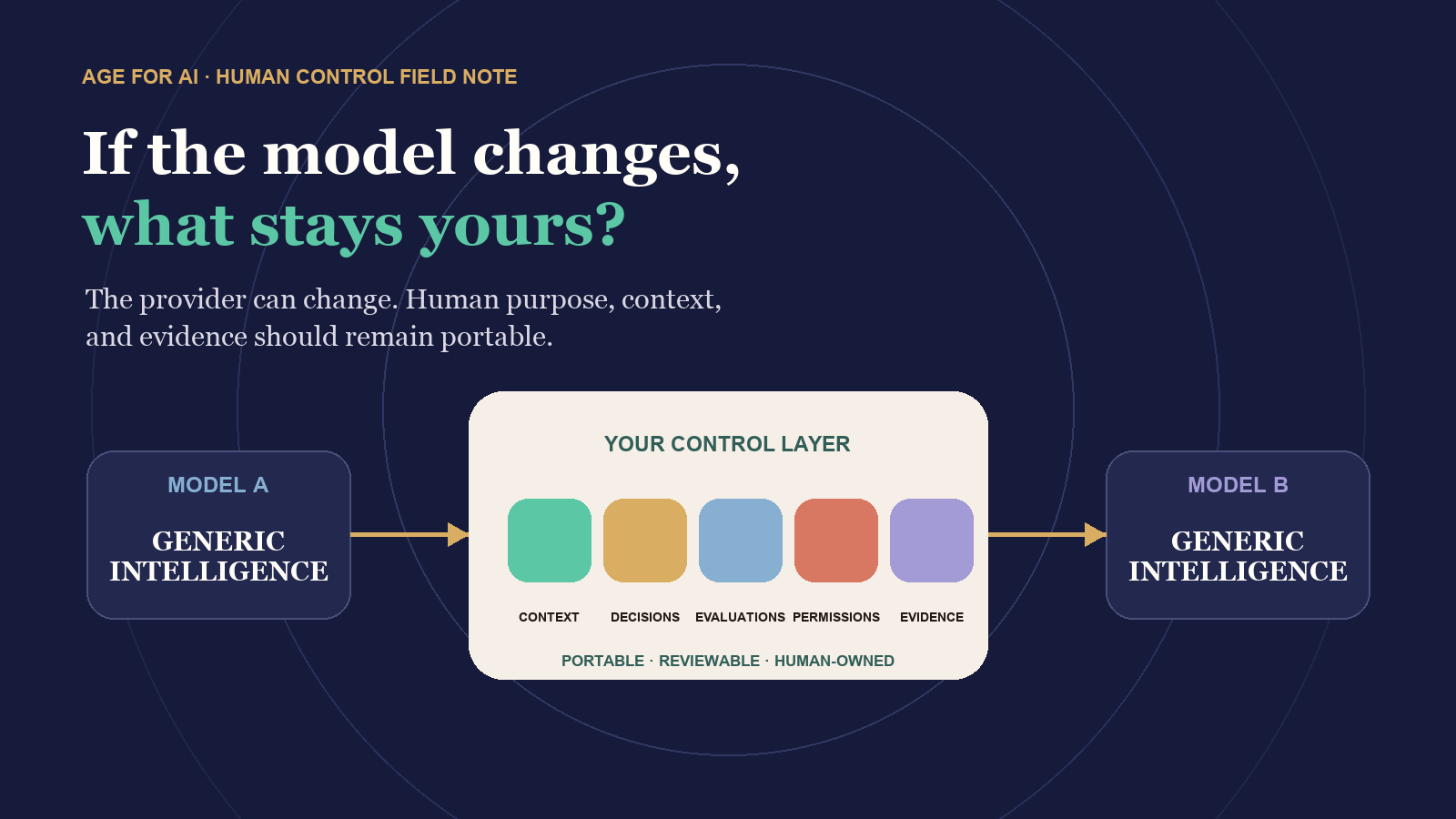
This is the human question behind AI portability. The model may be rented. The working history, judgment, and boundaries created by people should not disappear when the model changes.
The model is not the whole system
On 25 July 2026, LangChain founder Harrison Chase published an essay arguing that companies should own the parts of an AI system that make generic models useful for a specific organization. The essay separates the base model from the surrounding agent system: orchestration, context, memory, tools, evaluations, cost controls, risk boundaries, traces, and feedback.
That is a useful practitioner thesis, not a neutral law. LangChain sells tools for building and observing agent systems, so its commercial position belongs in the evidence boundary. Still, the underlying distinction is practical. Two teams can call the same model and get very different results because they use different instructions, documents, tools, approval rules, tests, and correction processes.
NIST's AI Risk Management Framework approaches the question from risk and governance rather than competitive advantage. It emphasizes documented roles, context, measurement, monitoring, third-party components, change management, decommissioning, appeal, override, recovery, and accountability across an AI system's lifecycle.
Neither source says every AI workflow must be provider-independent. Together, they support a narrower conclusion: when AI becomes part of real work, the surrounding system matters, and humans need evidence about how that system behaves.
Age for AI interpretation: ownership is not about building a foundation model. It is about keeping the human decisions around the model visible, reviewable, and portable.
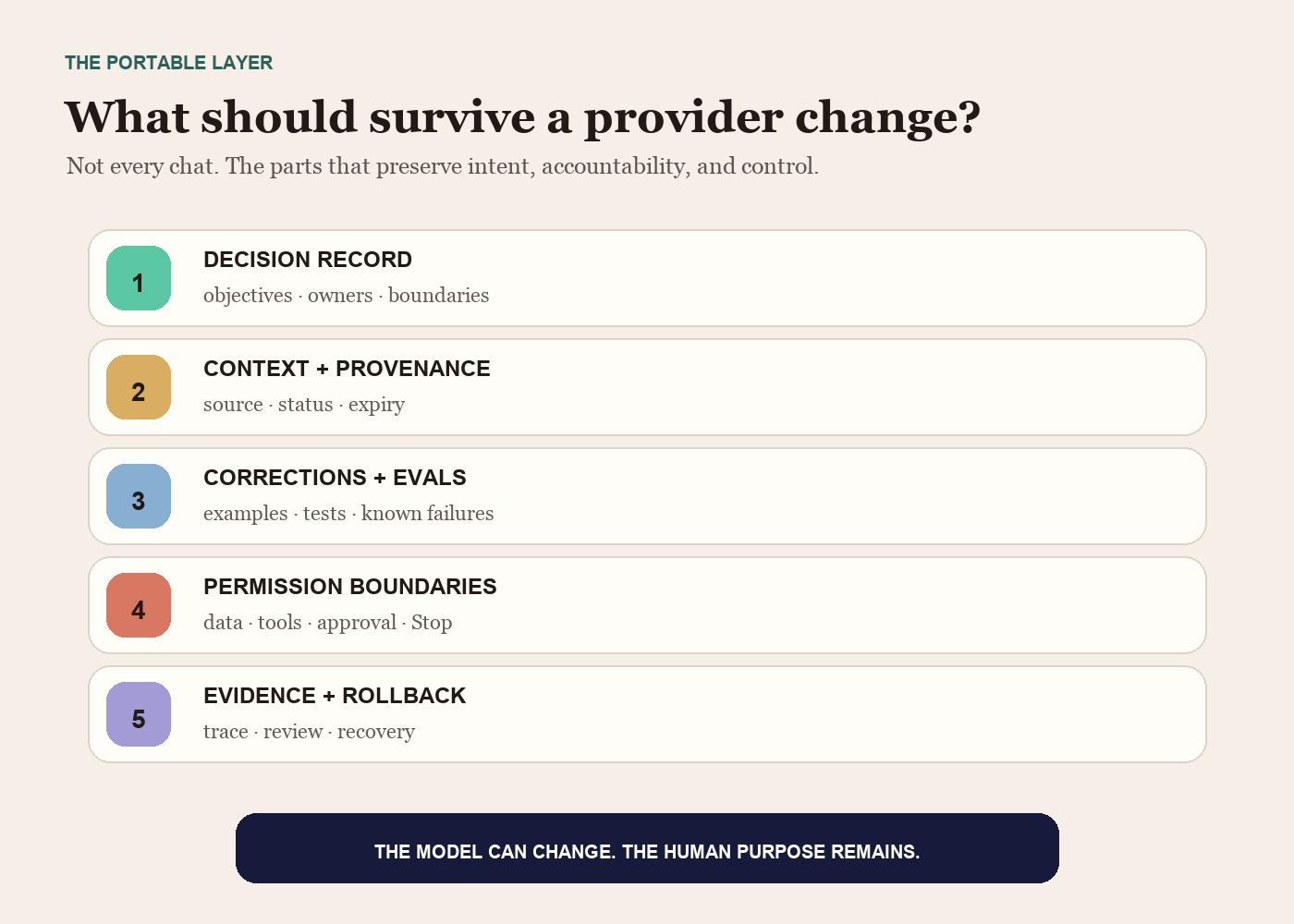
Five things should survive a provider change
A model switch does not need to preserve every token of every conversation. It should preserve the parts that carry human intent and operational accountability.
1. The decision record
Why was the AI introduced? Which tasks was it allowed to support? Which outcomes were rejected? Who can approve a consequential action? These decisions are more durable than any one prompt.
A team that cannot recover its decision record will repeat old debates after every migration. Worse, it may inherit rules without knowing why they exist. Keep a short, dated record of objectives, boundaries, owners, and unresolved questions outside the provider's chat history.
2. Context with provenance
Useful AI context can include policies, product facts, writing guidance, customer constraints, reference documents, and personal preferences. Portability does not mean copying all of it blindly. It means knowing which context exists, where it came from, who may use it, when it was last checked, and whether it can legally and ethically move.
Context without provenance becomes a pile of confident-looking fragments. Context with provenance can be reviewed, corrected, expired, or withheld.
3. Corrections and evaluations
An AI workflow improves when people identify failures and then update prompts, tools, stored context, routing, or evaluation tests. That is not the same as proving that a model permanently learned from a conversation. The durable asset is the correction process: examples of acceptable and unacceptable behavior, test cases, pass criteria, and known failure modes.
If those evaluations can run against a second provider, the team can compare behavior instead of trusting a demo.
4. Permission and Stop boundaries
A new model should not silently inherit more authority than the old one. Preserve the rules that define which data may be accessed, which tools may be used, which actions require a person, and how work can be paused or revoked.
This connects directly to our earlier field note on human control and interaction with a personal AI : delegation is useful only when its scope and return path remain legible to the human decision owner.
5. Evidence and rollback
When an AI workflow acts, the organization should be able to reconstruct what context it used, what tools it called, what changed, and which result a person accepted. The exact level of logging depends on the risk and privacy boundary, but a provider change should not erase the ability to investigate past decisions.
Rollback matters too. If the replacement performs worse on a critical task, people need a tested way to stop the migration or return to the previous working state.
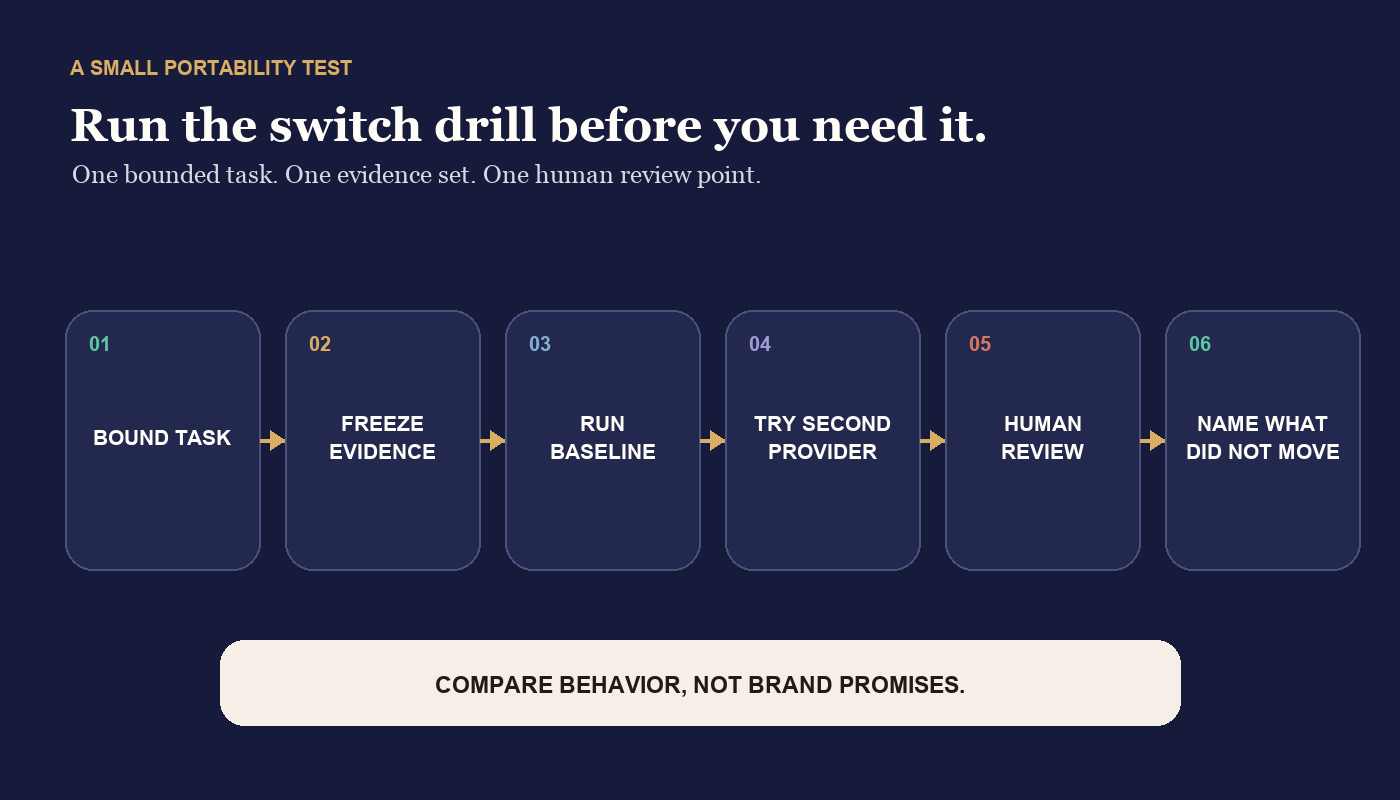
A provider-switch drill you can run before you need it
Portability should be tested while the current system still works. A small drill can reveal lock-in without launching a migration project.
- Choose one bounded task. Pick a recurring task with a clear output, such as drafting a customer reply, classifying a support request, or summarizing a policy.
- Freeze the evidence set. Record the prompt, approved context, tool permissions, expected output, and three to ten evaluation cases. Remove secrets and unnecessary personal data.
- Run the current system. Save the result, cost, latency, human corrections, and evaluation outcome. This is the baseline, not proof that the system is good.
- Run a second provider. Use the same task boundary and evaluation cases. Change only what is necessary to make the workflow function.
- Review the difference. A person checks meaning, tone, safety, omissions, tool behavior, and whether the new system stayed inside scope.
- Name what did not move. Record provider-specific memory, hidden instructions, unsupported tools, unavailable logs, formatting assumptions, and any behavior you could not reproduce.
The result is not a universal score. It is a map of dependency. It shows which parts of the workflow are genuinely yours and which exist only because the current provider makes them available.
Portability does not mean copying everything
There is a dangerous version of the ownership argument: collect every conversation, retain every trace forever, and move all personal context into a new system because more data must be better.
That approach can preserve noise, secrets, stale assumptions, private information, and records that were never meant for a second use. Human control includes the right not to move something.
Before exporting context or history, ask:
- Do we still need this information for a named purpose?
- Do we know where it came from and whether it is accurate?
- Do we have authority to move it?
- Can sensitive or identifying details be removed?
- Is the new provider allowed to use it in the same way?
- When should the record expire?
A portable memory system should support deletion, correction, expiration, and selective transfer. Otherwise, "ownership" can become another name for permanent accumulation.
What remains unknown
No checklist can make every AI system portable. Providers expose different models, tools, logs, memory features, export formats, and contractual terms. A model's hidden training and internal behavior cannot be copied into another model by exporting prompts. The same input may produce meaningfully different results even when the surrounding workflow is unchanged.
Some provider-specific features may be worth keeping because they create real value. Portability is not a demand to reduce every system to the lowest common denominator. It is the ability to make that tradeoff knowingly.
It is also important not to confuse technical portability with legal permission. Data-protection, employment, sector, confidentiality, and contractual obligations depend on the context and jurisdiction. This article is a practical control framework, not legal advice.
LangChain's article is evidence of a vendor and practitioner position. NIST provides voluntary risk-management guidance. The five-layer portability model and switch drill are Age for AI's interpretation and practical recommendation. They are not evidence that every current AI provider supports complete export, equivalent behavior, or automatic migration.
The human question to ask now
Do not begin with: "Can we replace this model?"
Begin with: "If this provider disappeared tonight, which parts of our judgment, context, corrections, permissions, and evidence would disappear with it?"
That question changes procurement. It changes how teams store prompts and policies. It changes which tests they write, what they log, what they delete, and where approval rules live. Most importantly, it keeps the system oriented around human continuity rather than provider continuity.
The best AI provider may change. The human purpose should remain understandable. The decision record should remain reviewable. The permission boundary should remain enforceable. And the knowledge created through use should not become inaccessible merely because the engine underneath it changed.
For a broader operating principle, read A Personal AI's First Rule: Never Pretend to Know . For a slower approach to building better human-AI interaction, continue with The Way of Becoming .
Sources and evidence boundary
- Harrison Chase, "What does it mean to own your intelligence?", LangChain, 25 July 2026. This is the primary source behind the private editorial candidate and is also a commercial vendor perspective.
- NIST AI Risk Management Framework Core. Used for governance, documentation, monitoring, third-party lifecycle, override, recovery, and change-management context.
- NIST Generative AI Profile. Used only as supporting context for lifecycle-based risk management of generative AI systems.
The source page's author and publication date were checked directly. The automated candidate record showed a later date and was not treated as authoritative. No source-owned image was reused; all three visuals on this page were created for Age for AI.