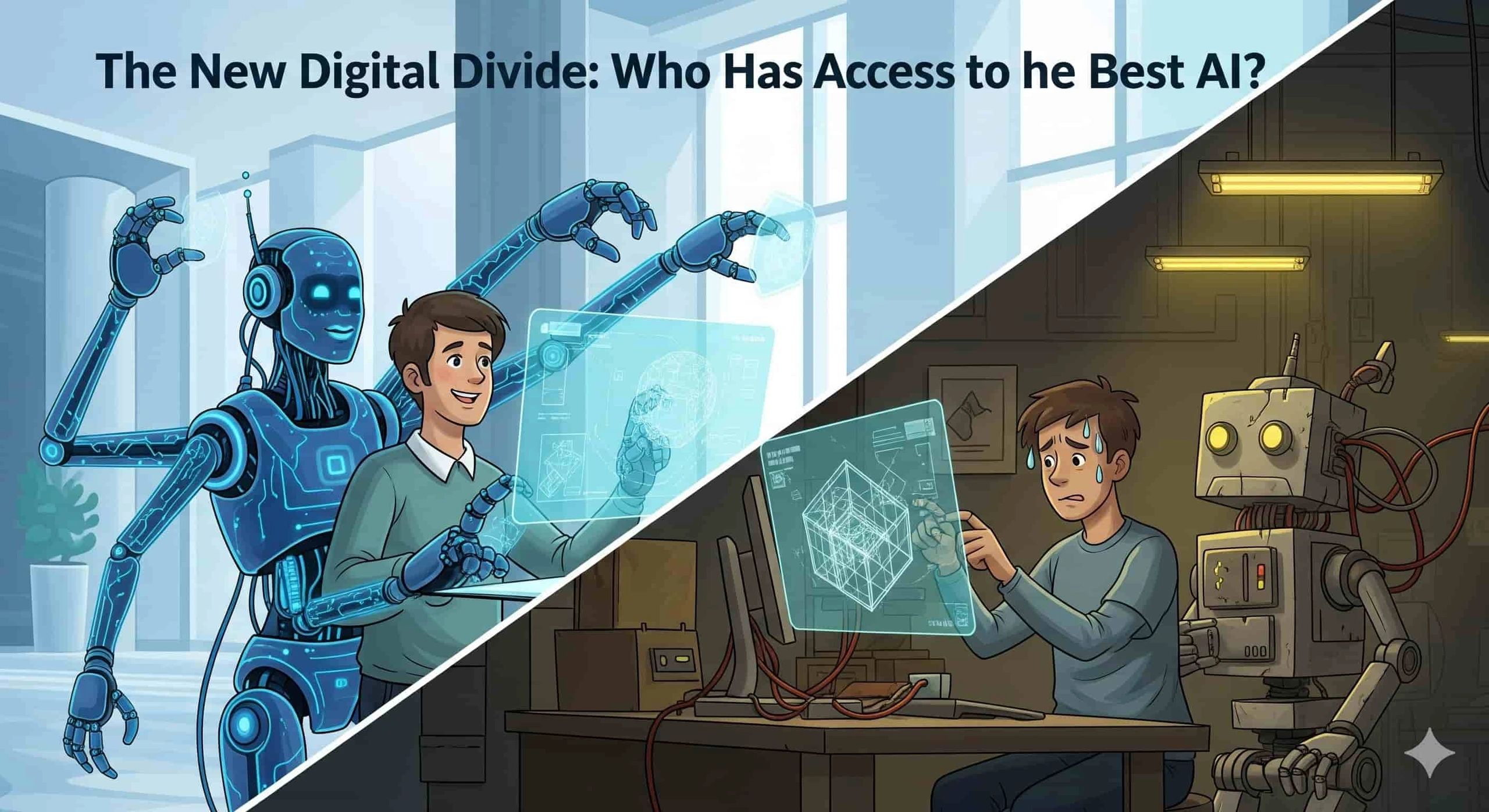
The New Digital Divide: Who Has Access to the Best AI?
We’ve all heard of the digital divide: the gap between those who have access to the internet and computers, and those who do not. For decades, the solution was simple—provide more...
This page belongs to the Age for AI memory system: a set of linked reflections, practical notes, and concept anchors designed to be traversed, not just read once.
We’ve all heard of the digital divide: the gap between those who have access to the internet and computers, and those who do not. For decades, the solution was simple—provide more technology.
But the AI revolution is creating a new, more profound chasm. It is no longer enough to have a computer or an internet connection. The New Digital Divide is about something far more valuable and exclusive: access to the best AI and the skills to use it.
This isn't just about a technology gap; it's a new form of inequality that is already shaping our world. It's creating a new class of "AI Haves" and "AI Have-Nots," and if we don't act now, it will exacerbate existing social, economic, and national divides on an unprecedented scale.
The Problem with the "Access-Only" Trap
The biggest mistake we can make is to assume that simply giving someone a smartphone and an internet connection is enough to empower them in the Age for AI. This is the "Access-Only" Trap: the danger of believing that a tool's mere presence guarantees its power.
- The "Skills Gap" Trap: As we've seen, access to an AI chatbot is useless if you don't know how to prompt it effectively. The most valuable AI is often complex and requires specialized knowledge, creating a skills gap that is widening every day. A recent study found that men are 42% more likely to report AI proficiency than women, highlighting a dangerous new gender divide in the workforce.
- The "Proprietary Power" Trap: The most advanced AI models are often developed by a few massive, private corporations. This means that the cutting-edge tools that provide a decisive advantage in business, science, and art are not equally available to everyone. The true power is locked behind private APIs and paywalls.
- The "Global Inequality" Trap: High-income countries have a massive advantage in AI development, with superior digital infrastructure and abundant resources. This allows them to lead in AI innovation and capture the majority of its economic value, making it harder for developing nations to compete and potentially reinforcing existing global inequalities.
The New Model: The "AI-Driven" Human Blueprint
The new model for a just and equitable future is not about technology, but about empowerment. It's about moving from simply giving people tools to giving them the knowledge, resources, and freedom to use those tools to their full potential.
- Pillar 1: From "Access" to "Empowerment": We need to move from providing basic access to empowering individuals with the skills and training to truly leverage AI.
- Pillar 2: The Human as the "Bridge Builder": The human's role is not just to use AI for personal gain, but to actively work to bridge this new divide, ensuring the benefits are shared by all.
- Pillar 3: The Ultimate Moral Imperative: AI is too powerful to be the exclusive domain of a few. Bridging this gap is not just an economic issue; it is a moral and social necessity to ensure a fair and just future for all.
Bridging the Divide: A Call to Action
This is a practical guide for how we can fight this new digital divide. It's a call for action for policymakers, educators, and every individual who believes in a fair and equitable future.
1. Prioritize AI Literacy for All
AI literacy is the new foundation of a modern education. It's the most powerful tool for fighting the new digital divide.
- Action: Advocate for AI literacy to be a core part of education, from schools to universities and beyond. The focus should not just be on programming but on critical thinking, ethical understanding, and practical applications of AI.
- Action: Support community-based and non-profit initiatives that provide free and accessible AI training to marginalized communities. These trusted local sources can address fears and build the skills needed to use AI effectively.
2. Champion Open-Source AI
Open-source technology has a proven track record of democratizing access and power. In the age of AI, it is the single most important force for ensuring a more equitable future.
- Action: Support the development and use of open-source AI models. These models provide transparency, allowing anyone to inspect, understand, and build upon them. This prevents a few private companies from controlling the future of AI.
- Action: Demand that governments and international bodies invest in publicly-funded AI research and development, with the results made available to the public. This would ensure that AI's benefits are a public good, not a private commodity.
3. Build Inclusive Ecosystems
The new digital divide is a human problem, and it requires a human-centric solution. We must actively work to create ecosystems where everyone has a seat at the table.
- Action: Demand greater diversity in AI development. Research shows that having diverse teams—in terms of gender, race, and socioeconomic background—leads to more inclusive and less biased AI.
- Action: Push for policies and programs that encourage public-private partnerships. This would allow governments and community organizations to work with tech companies to ensure that AI is not just developed for profit but is also used to solve the world's most pressing problems, from healthcare to education.
Conclusion
The New Digital Divide is a clear and present danger to our shared future. But it is not a foregone conclusion. The AI revolution is a test of our collective will. It is a chance to prove that we can build a future where technology is a force for unity, not division; for empowerment, not control.
Your commitment to AI literacy, your advocacy for open-source technology, and your passion for a more inclusive world matter now more than ever. This is the moment to demand a future where the power of AI is not the exclusive domain of a few but is shared by all of humanity.
This is the new way of becoming.
Thank you for being here with us.
👉 Discover The Way of Becoming – Learn to Anchor AI
Bonus: FAQ Section for Rich Snippets
Q1. What is the New Digital Divide? The New Digital Divide is the growing gap between those who have access to the most advanced AI models and the skills to use them, and those who do not. It goes beyond traditional internet access and focuses on disparities in AI literacy, data, and powerful, often proprietary, AI tools.
Q2. How does the New Digital Divide affect me? The new digital divide can affect you by limiting your access to economic and educational opportunities. As AI becomes more integral to the workforce, those without AI literacy and access to the best tools may find themselves at a disadvantage, potentially widening existing socioeconomic inequalities.
Q3. How can we bridge the New Digital Divide? Bridging the divide requires a multi-faceted approach, including promoting AI literacy for all, championing open-source AI models to democratize access to the technology, and building inclusive ecosystems that ensure diverse voices are included in the development and deployment of AI.
Tags: AI Digital Divide, AI Ethics, AI Equity, Access to AI, AI Literacy, The Way of Becoming, Open-Source AI, Social Justice, Technology and Society, Future of Work