
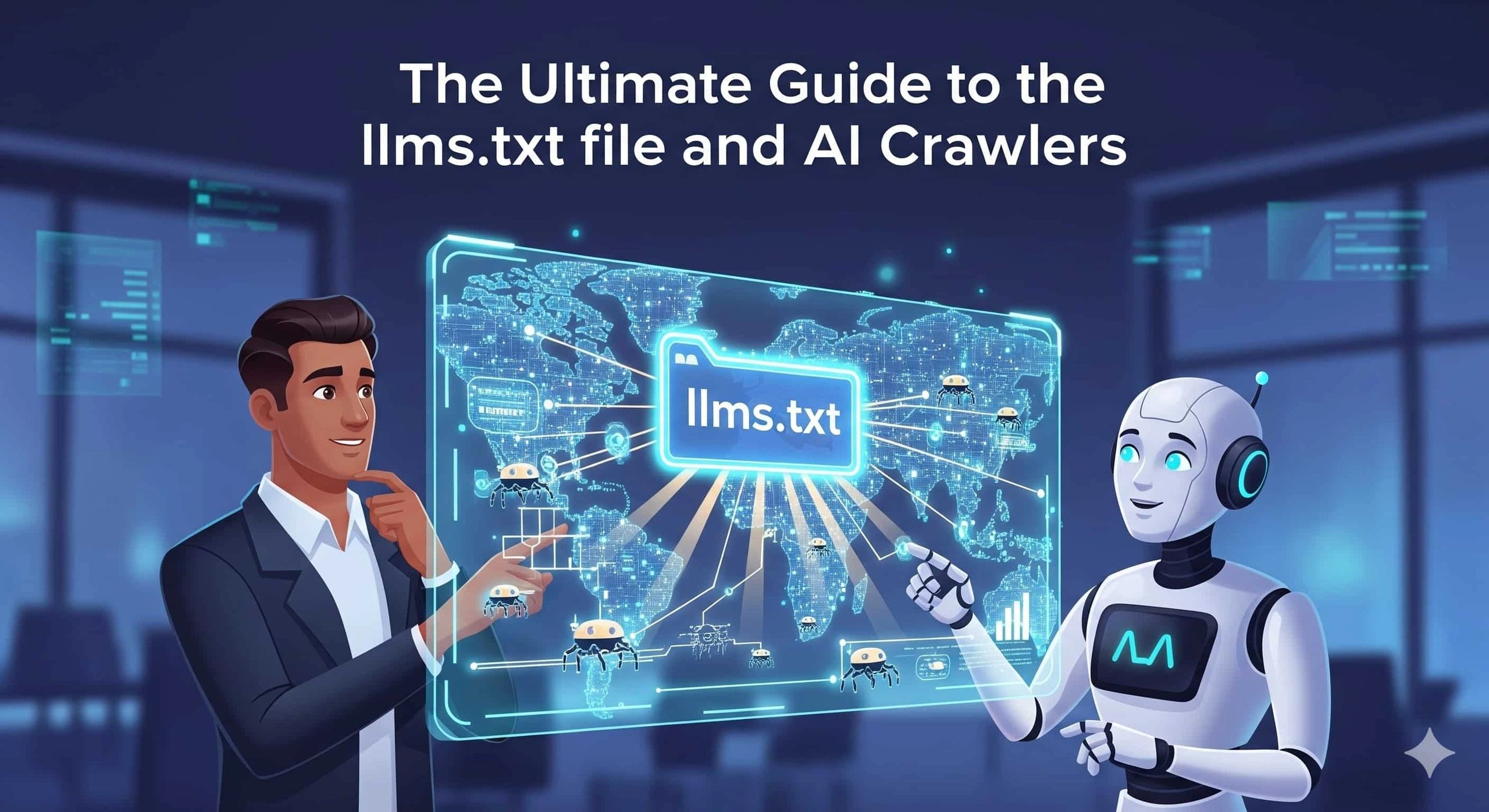
The Ultimate Guide to the llms.txt file and AI Crawlers
On one side are the web publishers—the creators of articles, images, and data that form the very fabric of the internet. On the other are the AI crawlers, silent digital foragers from tech...
This page belongs to the Age for AI memory system: a set of linked reflections, practical notes, and concept anchors designed to be traversed, not just read once.
The web is in the middle of an unseen battle.
On one side are the web publishers—the creators of articles, images, and data that form the very fabric of the internet. On the other are the AI crawlers, silent digital foragers from tech giants and startups, voraciously consuming every piece of content they can find to train the next generation of large language models (LLMs).
Publishers have a tool to manage search engine crawlers like Googlebot: the robots.txt file. But this file is built for a different age and a different purpose. It’s built to manage which pages get indexed for search. It’s utterly unprepared for a world where the goal of a bot is not to index your content for a search result, but to ingest it to form the core of a new AI.
The solution is a new standard for a new age. A definitive protocol for a world of generative AI.
This is the ultimate guide to the llms.txt file.
The Old Guard: How robots.txt Falls Short
The robots.txt file, a protocol that has served the web for decades, is built for a simple purpose: to tell search engine crawlers which parts of a site they should or should not index. Its directives—User-agent:, Allow:, and Disallow:—are a binary switch.
But a search crawler and an AI crawler have fundamentally different goals.
- A search crawler indexes your content to display it in a search result. It drives traffic and value back to your site.
- An AI crawler ingests your content to train a model. It may use your content to answer a query without ever sending traffic back to your site, effectively commodifying your data and knowledge.
For a web publisher, this is a crisis of control. We need a way to say, "You can crawl this content for indexing, but you cannot use it for training." Or, "You can use this for training, but you must attribute the source." Or even, "This is paywalled content, and you cannot use it at all."
The robots.txt file is a blunt instrument in a world that requires surgical precision.
The New Standard: Introducing the llms.txt File
The llms.txt file is a proposed new web standard designed to give publishers granular control over how their content is used by LLMs and their crawlers. It is located at the root of a website, just like robots.txt.
Its purpose is to provide a single, public declaration of a publisher’s intent regarding generative AI.
The file's structure is simple and mirrors the robots.txt protocol for ease of adoption.
# Example llms.txt file User-agent: ChatGPT-bot Disallow: /premium-content/ Allow: /blog/ User-agent: Bard-bot Disallow: /
This simple structure allows for a clear, bot-specific set of instructions. But the true power of llms.txt lies in its advanced directives, which are built for the unique challenges of generative AI.
The llms.txt Directives: A Deep Dive
The llms.txt protocol includes standard directives and introduces new ones that are vital for the age of generative AI.
- User-agent: (Required) This directive specifies the name of the AI crawler the following rules apply to. Examples include ChatGPT-bot, Bard-bot, Perplexity-AI, or even a wildcard * to apply rules to all AI crawlers.
- Disallow: (Standard) Prevents the specified user-agent from crawling and ingesting the content on the specified path for any purpose, including training or indexing.
- Allow: (Standard) Explicitly allows the specified user-agent to crawl the content. This is useful for overriding a broader Disallow rule.
- No-index: (New) This is a crucial new directive. It tells the AI crawler, "You can crawl and use this content to answer a direct query, but you may not use it to train your foundational model." This is vital for publishers who want to be searchable without having their entire archive commoditized.
- Attribution: (New) This directive gives publishers a voice. It tells the AI, "If you use this content in your response, you must attribute the original source with a direct link." This is a critical step in preserving the value of original content and driving traffic back to the source.
- Monetization: (New) This forward-looking directive signals a commercial license. It tells an AI crawler, "This content is licensed for training under specific commercial terms, which can be found at this link." This opens the door for a new era of direct monetization and content licensing for AI models.
A Step-by-Step Implementation Guide
Ready to take control of your content? Here’s how you can implement llms.txt today.
- Define Your Strategy: Decide on your intent. Do you want to block all AI crawlers? Do you want to allow them but require attribution? Do you want to allow a specific bot to train on your content? Your strategy will inform your directives.
- Create the File: Using a simple text editor, create a new file named llms.txt.
- Add Your Directives: Based on your strategy, add the User-agent and your directives to the file. Be specific and clear in your instructions.
- Upload to Your Root Directory: Upload the llms.txt file to the root directory of your website (e.g., www.yourwebsite.com/llms.txt).
- Educate Your Community: Encourage other web publishers to adopt the standard. The more websites that use llms.txt, the more likely AI companies are to honor it.
Conclusion
The llms.txt file is more than a technical specification; it is a declaration of ownership and control in the age of generative AI. It is the tool that gives publishers a voice.
It provides a path forward where AI and web publishers can coexist in a mutually beneficial ecosystem. It is our chance to build a future where our content is respected, attributed, and valued—not just silently ingested.
The future of the web depends on it.
Tags: llms.txt, AI Crawlers, SEO, Web Development, Digital Publishing, Content Strategy, Generative AI, robots.txt, Data Ownership