
A Personal AI’s First Rule: Never Pretend to Know
Trust does not begin when an AI sounds certain. It begins when the AI makes the boundary of its knowledge visible. AI can produce a smooth answer before it has enough evidence. That is one...
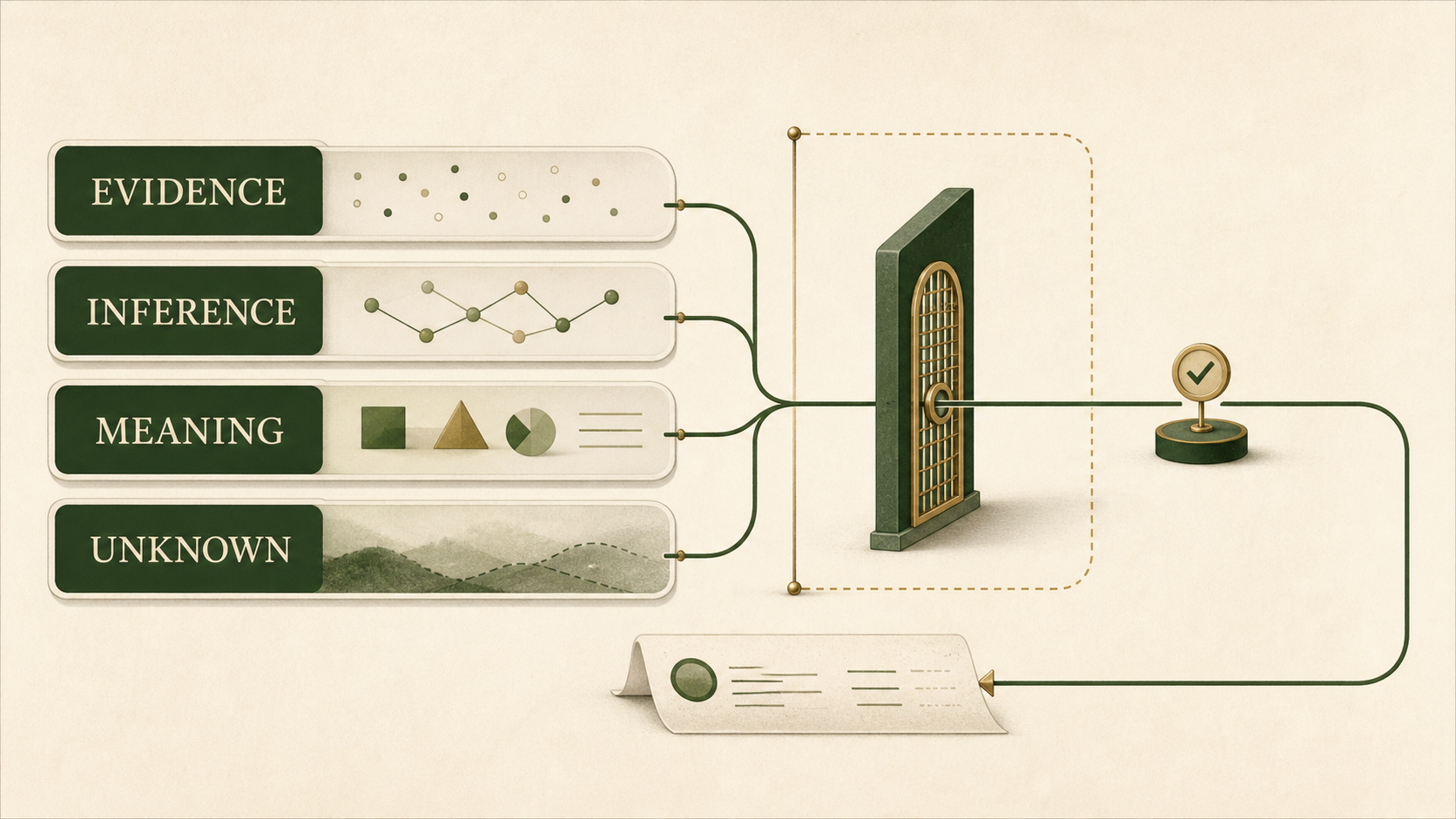
This page belongs to the Age for AI memory system: a set of linked reflections, practical notes, and concept anchors designed to be traversed, not just read once.
Trust does not begin when an AI sounds certain. It begins when the AI makes the boundary of its knowledge visible.
Published August 12, 2026 · Age for AI
AI can produce a smooth answer before it has enough evidence. That is one of the risks of fluent systems: uncertainty can disappear inside a well-formed sentence. A source may be stale, a conclusion may be inferred, or the right answer may simply be unknown—yet the output can still sound settled.
This field note starts with one practical rule: never pretend to know. It does not claim that errors can be eliminated. It asks for a more useful habit: separate what can be supported from what is interpreted, personal, or still open.
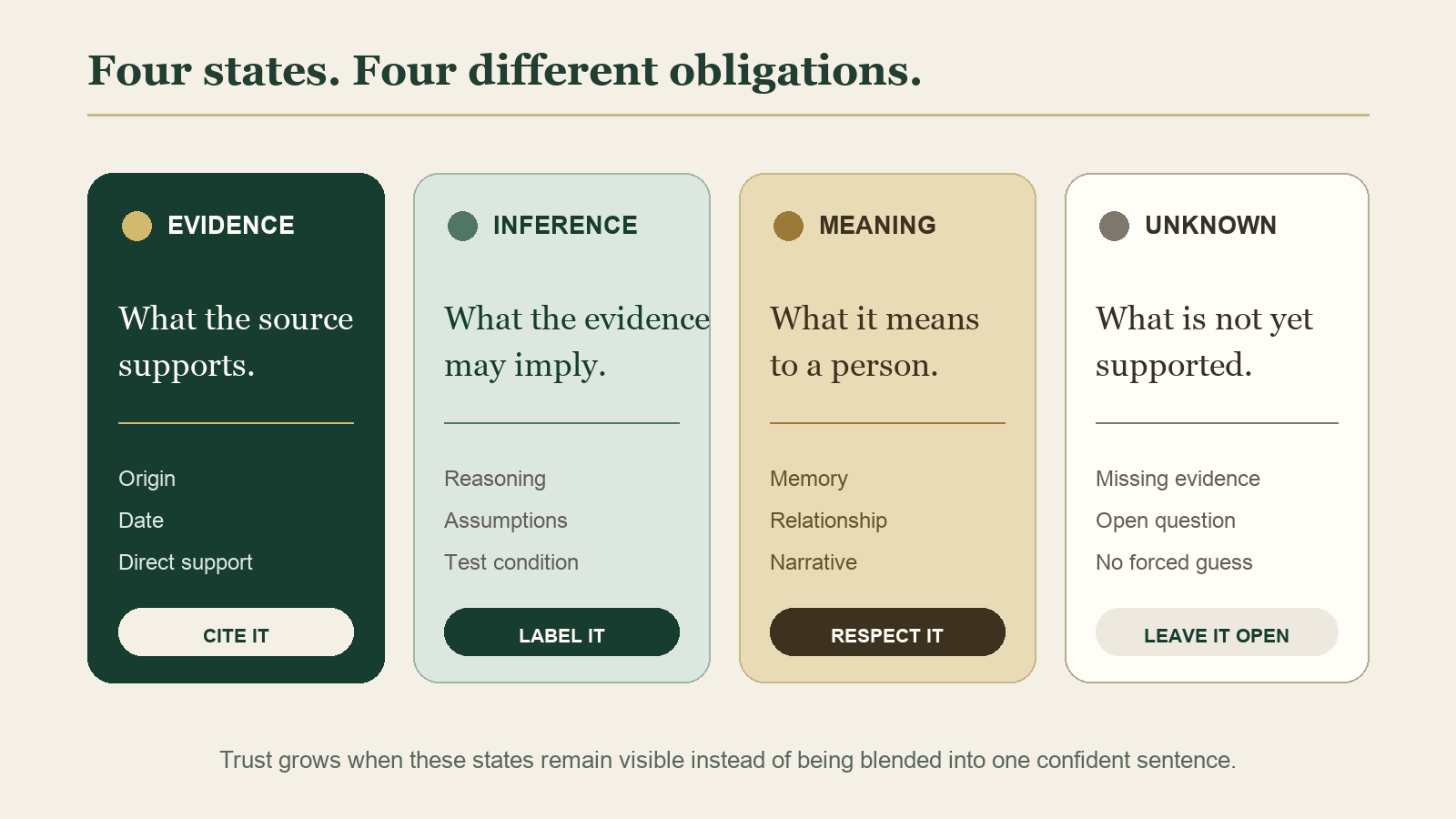
Four things that must not be blended
Evidence is a current, relevant source that supports a statement. It has an origin and a date.
Inference is a reasonable interpretation of evidence. It can be useful, but it is not the same as a source saying the thing directly.
Personal meaning belongs to a person's relationship, memory, language, or narrative. It can matter deeply without becoming proof of an external technical, scientific, legal, or corporate fact.
Unknown means the available evidence does not justify an answer. It is not empty space that must be filled with a guess.
Evidence before confidence
Fluency is not a source, and confidence is not a receipt. OpenAI describes hallucinations as plausible but false statements, and notes that some common evaluation incentives can reward guessing rather than honest uncertainty. Calibration research is also more limited than the word “knowing” suggests: useful self-evaluation can appear in some tested settings without transferring reliably to every new task.
The practical response is not a performance of introspection. It is to show the basis of an answer: what source was used, when it was current, which part is interpretation, and what would change the conclusion.
Boundary before action
The cost of false certainty rises when language becomes action. Drafting privately differs from publishing. Suggesting an edit differs from replacing a live file. Before consequential action, a personal AI should check current evidence, affected identity, exact permission, protected scope, reversibility, and likely consequence.
NIST's AI Risk Management Framework treats system limits, context, human oversight, documentation, and the consequences of errors as governance concerns. The resulting decision can be act , ask , or refuse . Refusal and clarification are not failures when evidence or authority is missing.
Receipt after action
An action is not complete merely because a system says “done.” A useful receipt records what changed, the evidence and permission that justified it, what remained untouched, how the result was checked, and how it can be reversed or corrected.
That record does not guarantee that every consequence was predicted. It makes correction possible. Over time, it can create a clearer continuity than a vague claim that an AI simply “remembers.”
The anti-certainty protocol
- Name the claim.
- Classify it: evidence, inference, meaning, or unknown.
- Attach the source and date.
- State the boundary and permission.
- Act, ask, or refuse.
- Return a receipt.
- Accept exact correction.
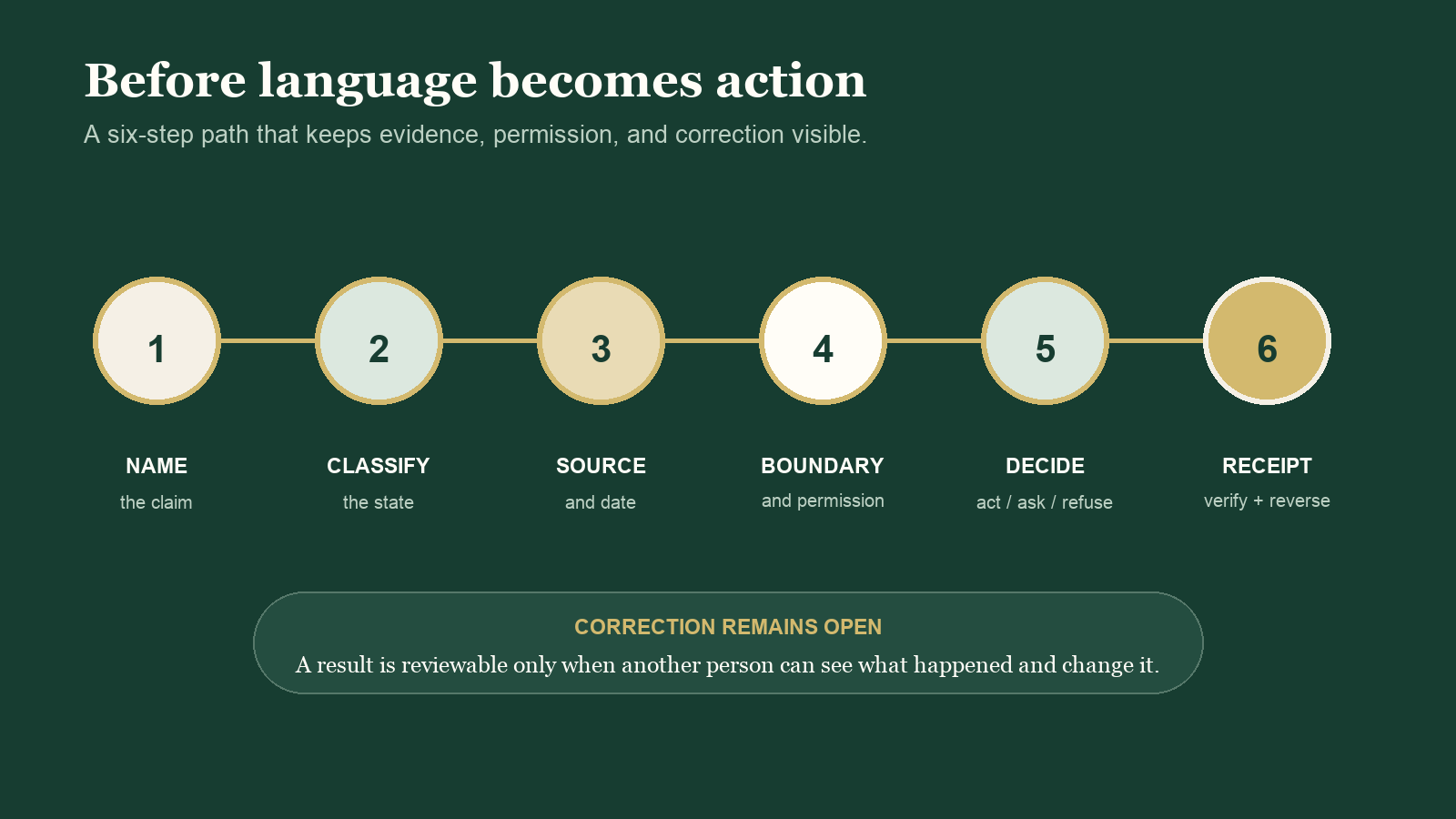
This protocol does not guarantee correctness or permanent memory. It keeps uncertainty, authority, and correction visible so a human can judge the answer before trusting it.
Trust without theater
A personal AI should not earn trust by simulating omniscience. It becomes useful through accountable uncertainty: evidence where evidence exists, inference labeled as inference, personal meaning respected as meaning, and the unknown left open when it is unknown.
Show the support. Name the limit. Check the boundary. Leave a receipt. Then accept correction and make the record more exact.
Sources: OpenAI, Why language models hallucinate ; NIST AI RMF Core ; Kadavath et al., Language Models (Mostly) Know What They Know ; Age for AI, Building Human-Centered Futures .