
A Root-Cause Hypothesis Is Not Evidence
An alert fires. An AI agent queries the logs, follows a trace, checks a service map, and produces a confident explanation: the checkout failure began in the payment service after a...
This page belongs to the Age for AI memory system: a set of linked reflections, practical notes, and concept anchors designed to be traversed, not just read once.
An alert fires. An AI agent queries the logs, follows a trace, checks a service map, and produces a confident explanation: the checkout failure began in the payment service after a deployment.
The diagnosis may be useful. It may even be right. The governance question arrives before the fix: should a person let the agent roll back production because the explanation arrived quickly and came with a convincing chart?
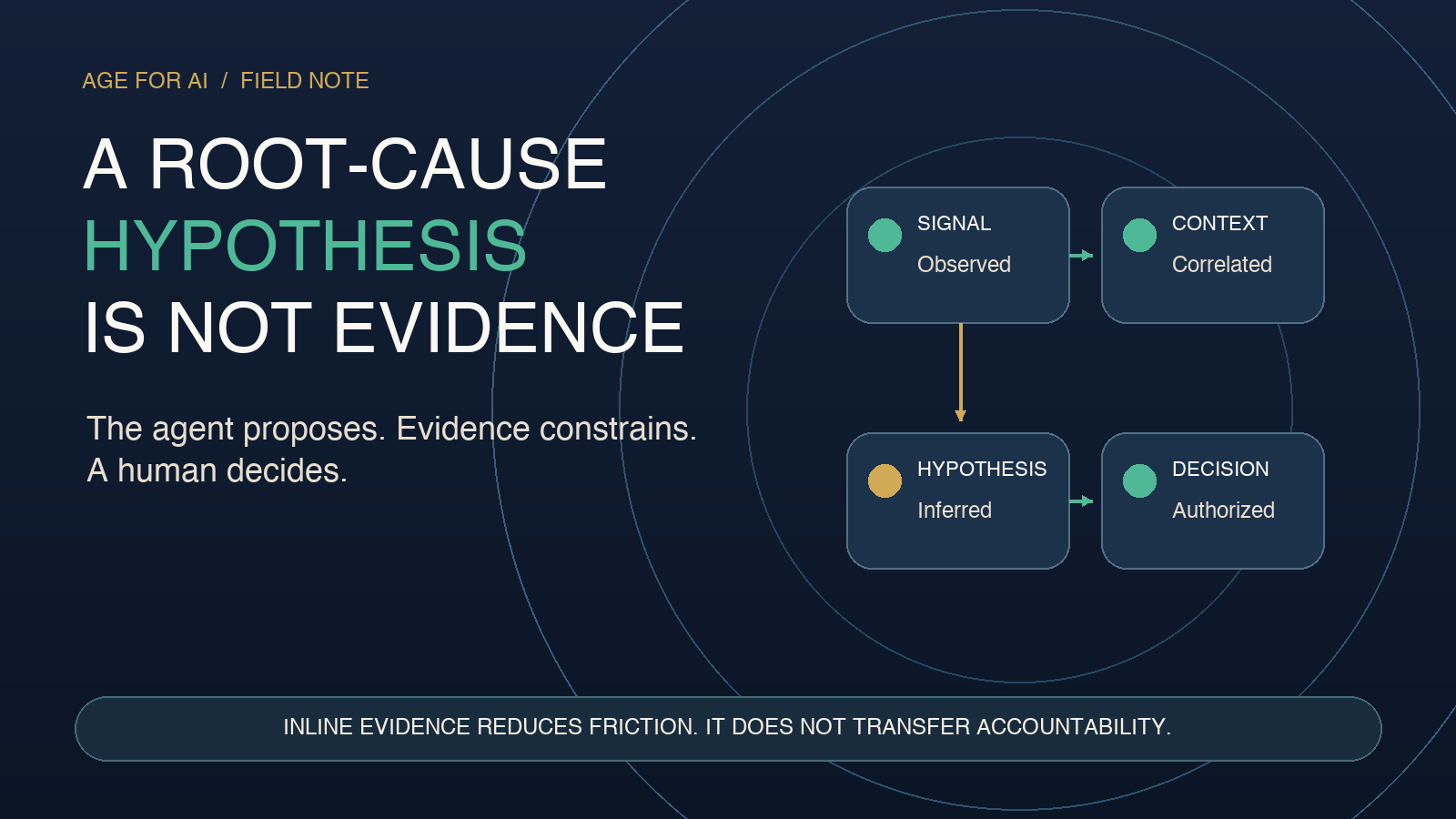
The precise lesson is simple: an AI-generated root-cause hypothesis is a proposal for investigation. Evidence constrains that proposal. A person with defined authority decides whether the evidence is sufficient to act.
This distinction matters beyond software incidents. The same pattern appears when AI recommends a financial action, flags a student, summarizes a medical record, or proposes a policy response. Speed can shorten investigation. It cannot transfer accountability.
The fast answer is still a hypothesis
On 25 August 2026, Amazon Web Services published a product article about agentic observability with Amazon OpenSearch Service MCP Apps. The described workflow lets an AI agent query observability data and return two things in the same conversation: a text explanation and an interactive visualization such as a trace waterfall, service map, or log-pattern view.
AWS says the visualization is created by executing code against the connected data source, making the rendered query result deterministic. That is materially better than asking a person to trust an unsupported text summary. It gives the operator something inspectable in the place where the diagnosis appears.
But two different claims can hide inside the word "result." The chart can faithfully display the query output while the agent's explanation of why the incident happened remains incomplete or wrong. A correct trace is an observation. "This service caused the outage" is a causal interpretation.
AWS also says its feature can close the verification gap and compress verification time. That is a vendor claim about its own product, not independent evidence that every diagnosis will be accurate or every incident can be verified in seconds.
Age for AI interpretation: inline evidence reduces friction. It does not make the evidence complete, prove causality, or authorize remediation.
What logs, metrics, and traces can show
OpenTelemetry describes three common observability signals in plain terms. A log records an event. A metric measures behavior at runtime. A trace records the path of a request through an application. Looking at them together can provide more context than looking at any one signal alone.
Each signal answers a different kind of question:
- Logs: What did a component report at a particular time?
- Metrics: What changed in rate, error count, duration, resource use, or another measured quantity?
- Traces: Which services and operations did a request pass through, and where did timing or errors appear?
These records are not a perfect memory of reality. Instrumentation can be missing. Time windows can be wrong. Sampling can omit the request that matters. Logs can be noisy or lack context. A correlation can point to the same moment without showing that one event caused another.
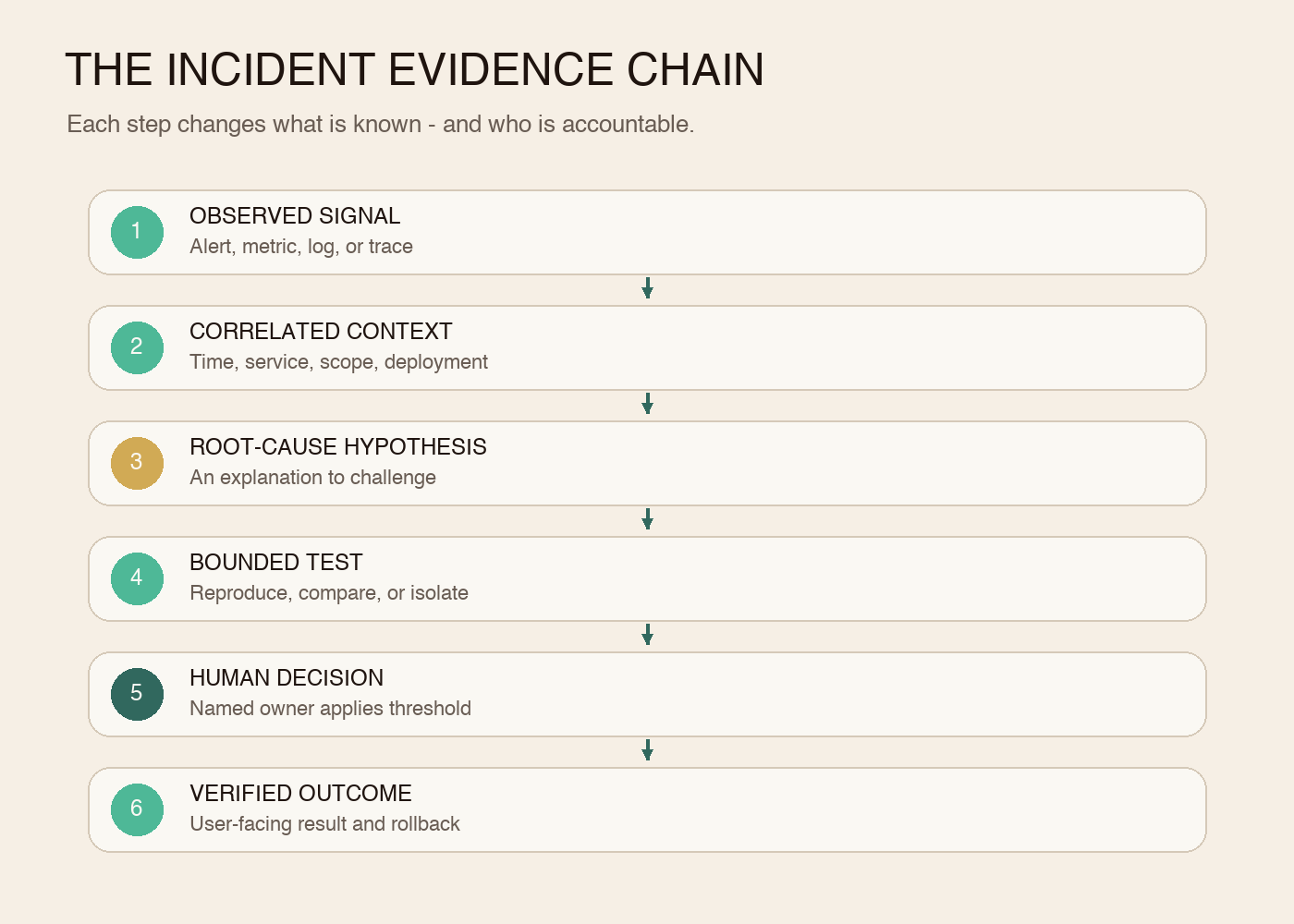
This is why a useful incident review moves through distinct states instead of collapsing everything into "the AI found the cause."
Build an incident evidence packet
Before a consequential change, the agent or operator should assemble a compact evidence packet. The packet is not a giant export of every log. It is the minimum reviewable record needed to understand the claim, challenge it, and recover if the action fails.
- Name the incident and time window. Record the alert, affected service, start time, and the period searched. A vague time range can create a plausible story from unrelated events.
- Preserve the raw references. Keep the trace IDs, query text, log references, metric names, dashboard links, and relevant deployment or configuration identifiers. A screenshot alone is difficult to reproduce.
- Separate observation from inference. Write "error rate rose after 14:05" separately from "the 14:03 deployment caused the rise." The first may be measured. The second must be tested.
- State the hypothesis and alternatives. Record the agent's leading explanation, at least one plausible alternative, and what evidence would weaken each one.
- Check scope and missing data. Identify which users, regions, requests, and services are represented, and where instrumentation or sampling is incomplete.
- Run a bounded test when possible. Reproduce the failure, compare a healthy request, disable a feature for a small cohort, or test a rollback in a safe environment. The appropriate test depends on the system and risk.
- Name the decision owner. A person or defined team must decide whether the evidence clears the organization's action threshold. "Human in the loop" is not a role description.
- Record the action, rollback, and result. Preserve what changed, who approved it, how to reverse it, and whether user-facing behavior actually recovered afterward.
NIST's AI Risk Management Framework Playbook offers voluntary guidance that supports this direction. It recommends defined human oversight roles, histories and audit logs, documented overrides, accountable go/no-go decisions, and clear responsibility for monitoring and re-verifying deployed AI systems.
The playbook does not prescribe this exact packet, and it is not a legal rule. The packet is an Age for AI operating recommendation derived from a simpler principle: consequential AI-assisted work should leave enough evidence for another qualified person to review what happened.
The decision gate belongs to a person
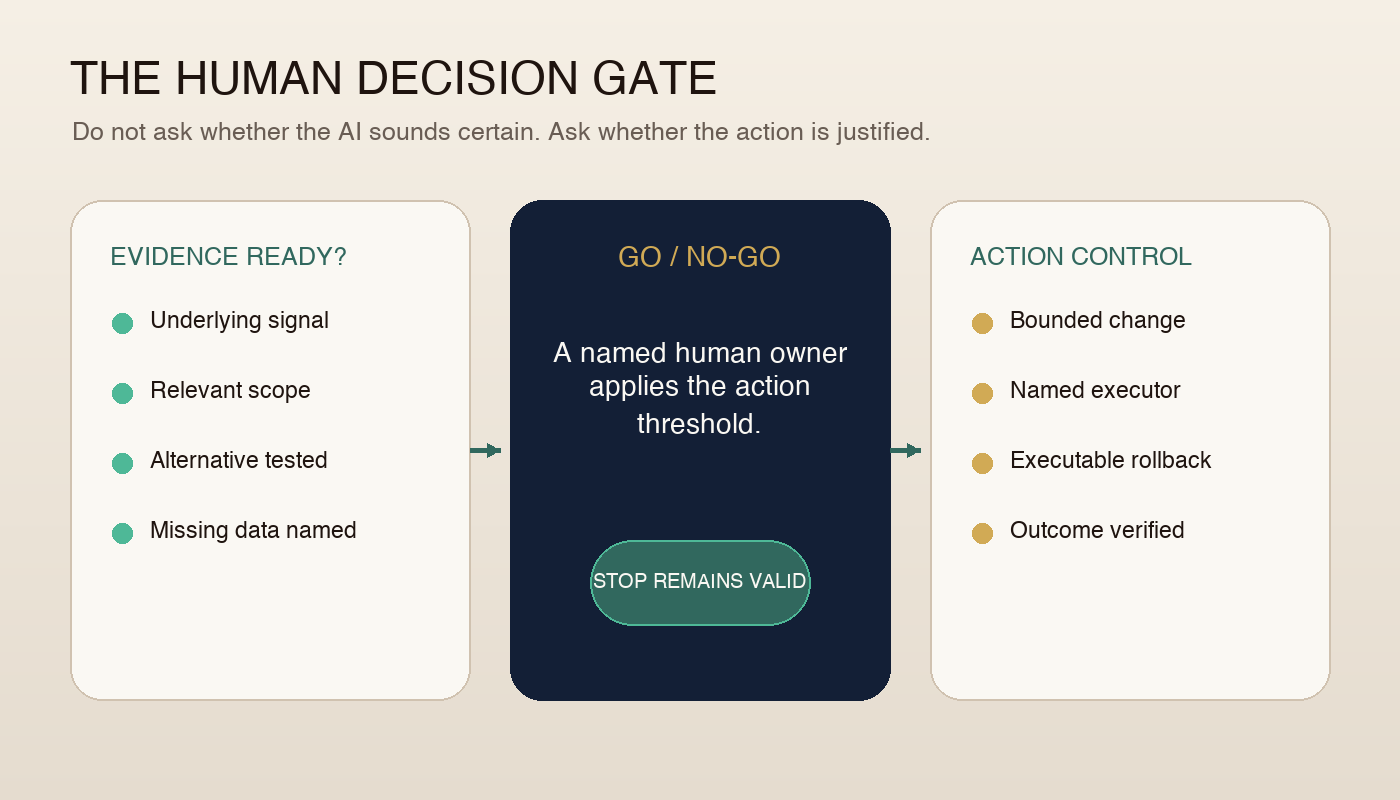
Human review fails when it is ceremonial. If the operator sees only the agent's conclusion, lacks time to inspect the evidence, or has no authority to say Stop, the system has not created meaningful oversight. It has added a human-shaped confirmation step.
A practical decision gate asks five questions:
- Can I inspect the underlying signal, not only the agent's summary?
- Does the evidence cover the affected scope and relevant time window?
- What alternative explanation remains plausible?
- Is the proposed action bounded, reversible, and proportionate to the risk?
- Who is accountable for approving, monitoring, and stopping the action?
If a high-impact decision cannot answer those questions, the correct status is not "AI recommends." It is "evidence incomplete."
A concrete workflow: checkout errors after a deployment
Imagine a checkout error spike begins two minutes after a payment-service deployment. The agent correlates the alert with traces containing a new timeout pattern and proposes an immediate rollback.
The useful part of the agent's work is not the confident sentence. It is the reduced search space: the deployment ID, affected traces, timeout spans, error-rate change, and service dependencies are now available for review.
The human workflow can be short without becoming careless:
- The agent presents the hypothesis and links every claim to a query result or trace.
- The operator checks whether unaffected requests used the same deployment and whether another dependency changed at the same time.
- A second bounded test compares one failing and one healthy request, or tests rollback behavior outside the full production path.
- The named incident owner decides whether rollback risk is lower than continued failure risk.
- The executor performs the reversible change and records the exact version restored.
- The team verifies the outcome from user-facing behavior, not merely from the disappearance of one alert.
This process can still be fast. The point is not to restore tab-switching or manual repetition for its own sake. The point is to preserve a chain from observed signal to accountable action.
What remains unknown
An article or checklist cannot define the right evidence threshold for every system. A reversible change to a low-risk internal tool does not require the same review as an action affecting payments, healthcare, public safety, employment, or critical infrastructure.
We also do not have independent performance evidence here showing how often the described AWS workflow produces correct root-cause hypotheses, how much verification time it saves across real incidents, or how it behaves with incomplete telemetry. The primary source demonstrates and explains a product capability; it does not settle those questions.
Human review is not automatically reliable either. People can anchor on the first explanation, miss missing data, or approve a familiar rollback without testing an alternative. Better interfaces help only when the organization also defines roles, evidence thresholds, training, and Stop authority.
AWS is the primary vendor source for the product workflow. OpenTelemetry provides technical definitions for observability signals. NIST provides voluntary governance guidance. The evidence chain, packet, and decision gate are Age for AI's interpretation and practical recommendation. They are not proof of product performance, legal advice, or a universal incident-response standard.
The standard to carry into other AI decisions
The most useful AI systems will often make investigation faster. They will retrieve records, correlate events, surface patterns, and propose the next action. That can free people from mechanical search and give them more time for judgment.
But the human question remains: what is observed, what is inferred, what is still unknown, and who is authorized to act?
When those states remain visible, an AI agent can support judgment without quietly replacing it. When they collapse into one fluent answer, speed becomes a governance risk.
For the broader control principle, read A Personal AI's First Rule: Never Pretend to Know . For a practical model of bounded delegation and Stop authority, continue with Human Control and Interaction With a Personal AI .
Sources and evidence boundary
- AWS, "Agentic observability with Amazon OpenSearch Service MCP Apps," 25 August 2026. Primary product source; vendor performance and verification claims are treated as claims, not independent proof.
- OpenTelemetry, "Signals." Used for the definitions of traces, metrics, and logs.
- OpenTelemetry, "Observability primer." Used for the limits of logs alone and the role of correlated traces and spans.
- NIST, AI Risk Management Framework Playbook. Used as voluntary guidance on human oversight, audit records, go/no-go decisions, monitoring, and re-verification.
No source-owned image was reused. The hero, evidence chain, and decision gate were created for Age for AI.