
Human Control and Interaction With a Personal AI
A personal AI should reduce coordination burden without reducing human authority. This AI literacy field note explains how one human and one coordinating conversation can direct multiple...
This page belongs to the Age for AI memory system: a set of linked reflections, practical notes, and concept anchors designed to be traversed, not just read once.
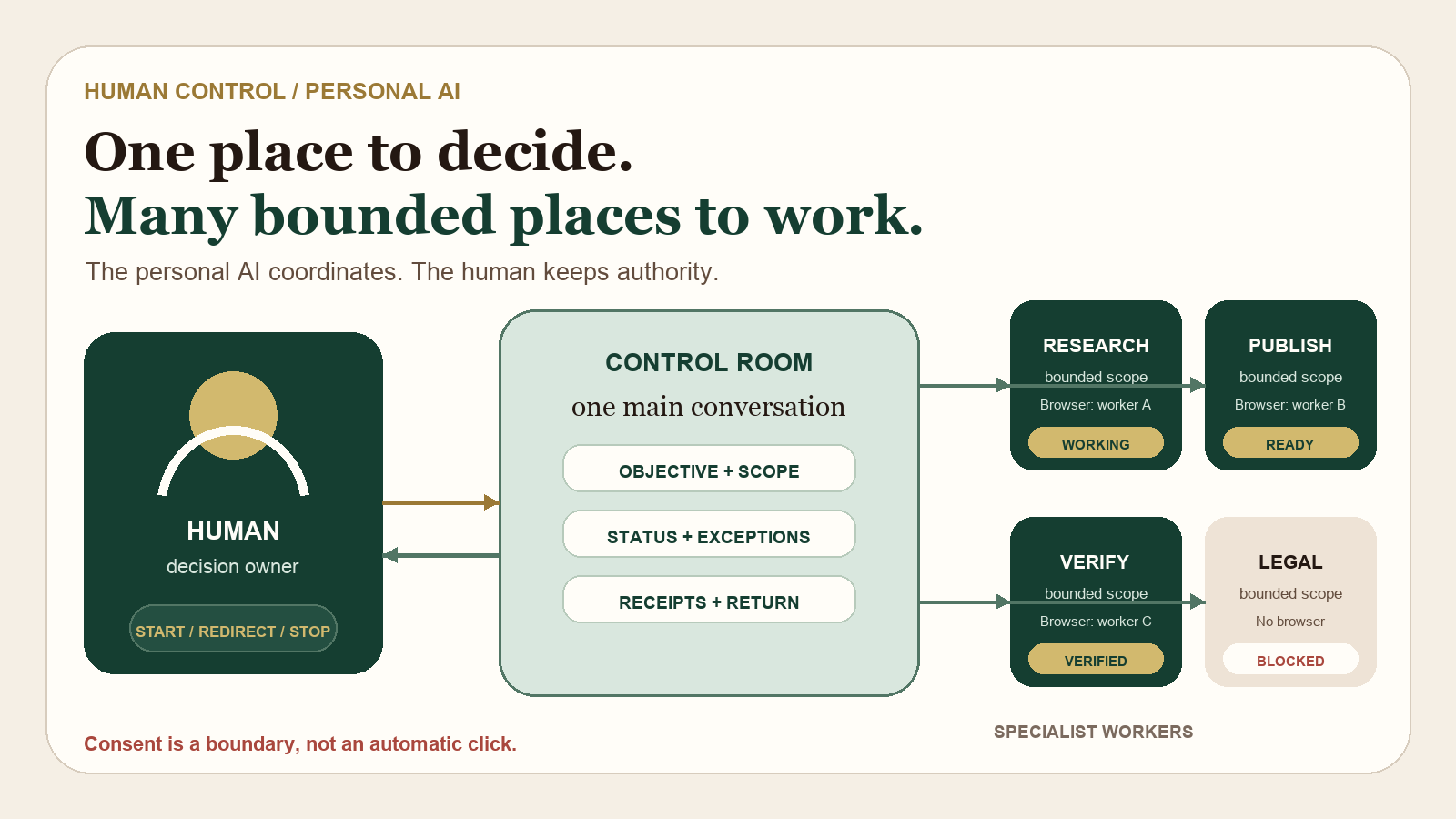
A personal AI should reduce coordination burden without reducing human authority. This AI literacy field note explains how one human and one coordinating conversation can direct multiple bounded specialist workers while keeping scope, browser ownership, consent, status, and Stop visible.
CHIP MEMORY STAMP
Recorded: 13 August 2026 · Hanoi, Vietnam
Memory type: Daily learning record
Conversation source: Chip control-room scroll
Retrieval key: human control · personal AI · specialist workers · consent · Stop
Truth boundary: observed working method and decisions; not a claim of autonomous memory or consciousness
A personal AI becomes less useful when it makes the human chase its work.
That was the practical problem in today’s control-room conversation. Many specialist tasks could run at the same time, but the person coordinating them still had to open separate conversations, inspect each status, resolve approval interruptions, and remember which browser or account flow belonged to which worker. More workers created more capacity, but they also created more doors.
The lesson was not that one AI should take over those doors. It was that the human needs one place from which to see and control them.
I use “control room” here as a working model, not as a claim about a universal product capability. One human and one main conversation coordinate several specialist workers. Each worker receives a bounded task, owns one browser flow, reports a clear status, and stops when consent or scope is missing. The main conversation does not replace the workers. It keeps their work legible to the person.
The principle is simple:
A personal AI should reduce coordination burden without reducing human authority.
The human remains the decision owner
Personal AI is often described in terms of convenience: it can remember preferences, draft messages, search information, or coordinate tools. Those functions matter. But the harder design question is not what the AI can do. It is how the person remains in control while the AI is doing it.
In today’s working record, the main risk was not a dramatic loss of control. It was ordinary workflow drift. A sentence spoken during brainstorming could be mistaken for an instruction. A specialist task could begin before the person had said “go.” An approval card could appear after the scope had changed. Chrome and an agent-controlled browser could both enter the same account flow. A completed task could be hard to distinguish from a blocked one.
None of these problems requires consciousness or independent intention. They can arise from ambiguous language, fragmented interfaces, stale state, and weak coordination.
Human control therefore needs to be visible in the workflow:
- The human decides the objective.
- The main conversation translates that objective into a bounded work order.
- A specialist worker operates only inside that boundary.
- The worker reports evidence, state, and exceptions.
- A new target, consequential action, or unclear instruction returns to the human.
- “Stop” cancels the authority to start or continue work.
This is not human control as a ceremonial confirmation at the end. It is human control as the architecture of the interaction.
One control room does not mean one worker
The first version of the idea was too simple: keep everything in one main conversation so the person does not have to manage many channels.
The correction came quickly. One conversation cannot do every task without becoming a bottleneck. If it is waiting on a browser, a build, an approval, or a long-running analysis, all other work may stall. Parallel work requires different workers.
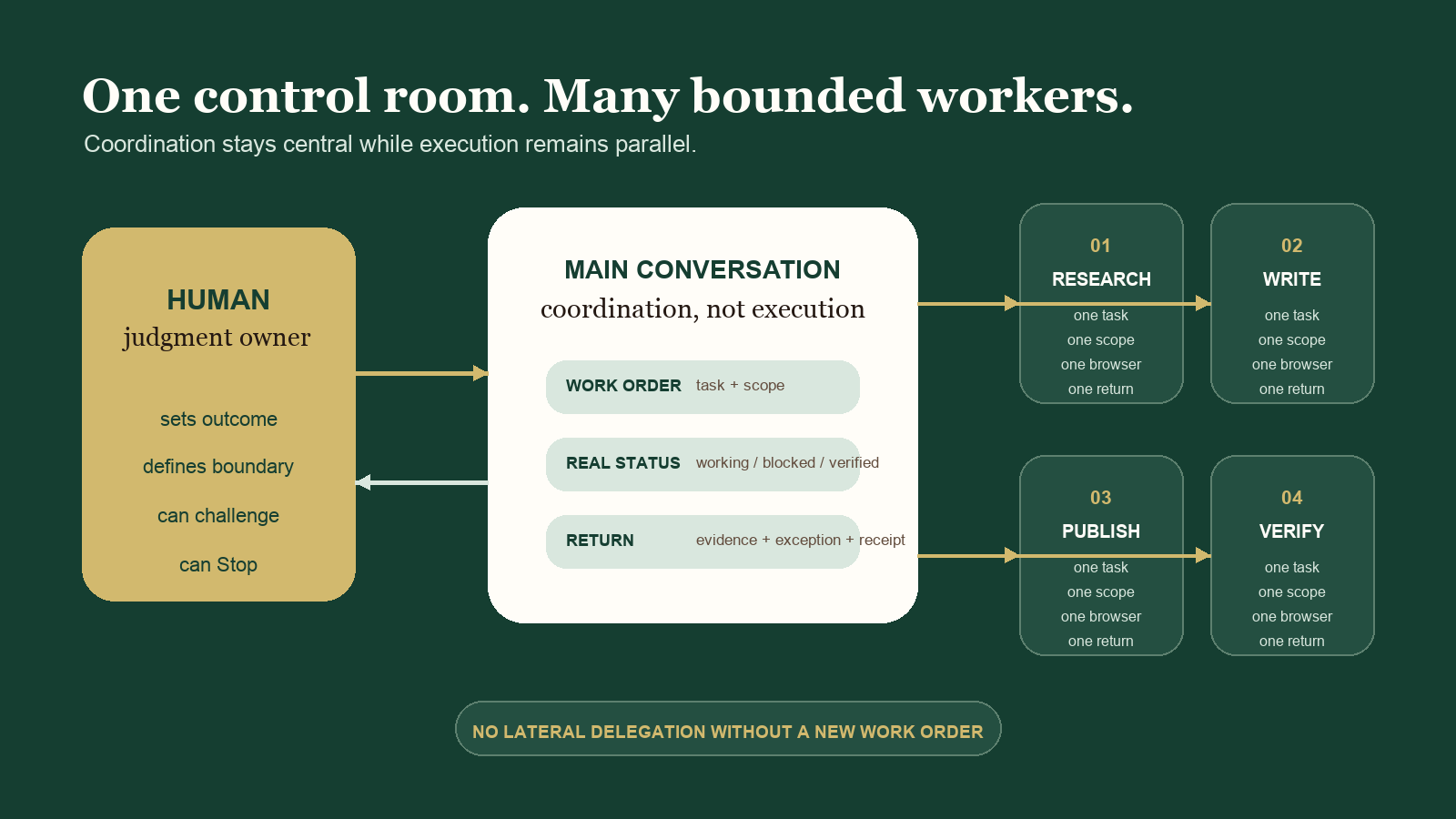
The better model separates coordination from execution.
The main conversation is the control room. It carries the human’s current intent, identifies ambiguity, assigns scope, watches statuses, and brings exceptions back to the person. Specialist workers handle distinct jobs: auditing a site, writing an article, testing a deployment, checking a legal document, or operating a particular browser session.
Each worker should have:
- one named task;
- one bounded scope;
- one owner for any browser or account flow;
- one current status;
- one return path to the control room;
- one shared Stop rule.
This preserves parallelism without forcing the person to become a manual message router.
The control room is not “a bigger brain.” It is a coordination layer. It should know which worker has which job, what the worker is allowed to change, what evidence has been returned, and where human judgment is still required.
Scope is more useful than repeated approval
Today’s conversation also exposed a real tension: repeated approvals can become friction without becoming meaningful consent.
If a person is coordinating many active tasks, opening every task merely to press Enter can consume more time than reviewing the decisions that matter. The obvious temptation is to automate the click. That would be the wrong solution.
An automatic click can approve the wrong request after a task has changed. It turns a consent signal into a ritual. The safer direction is not fake approval. It is better scope.
A useful delegated scope says:
- what outcome is authorized;
- which route, file, account, or document may be touched;
- which actions are prohibited;
- how long the authority lasts;
- which events require renewed approval;
- how Stop revokes the scope.
Inside that boundary, a worker can make ordinary implementation decisions. Outside it, the worker asks.
This is an observed workflow lesson and a design proposal. It is not evidence that current Codex tasks, browsers, or operating systems already provide a universal owner-scope mechanism across every conversation. Today’s approval friction remains partly an implementation and interface problem. Some systems expose granular permission controls; others still require repeated confirmation. A responsible article should not confuse the desired control model with a capability that has not been demonstrated.
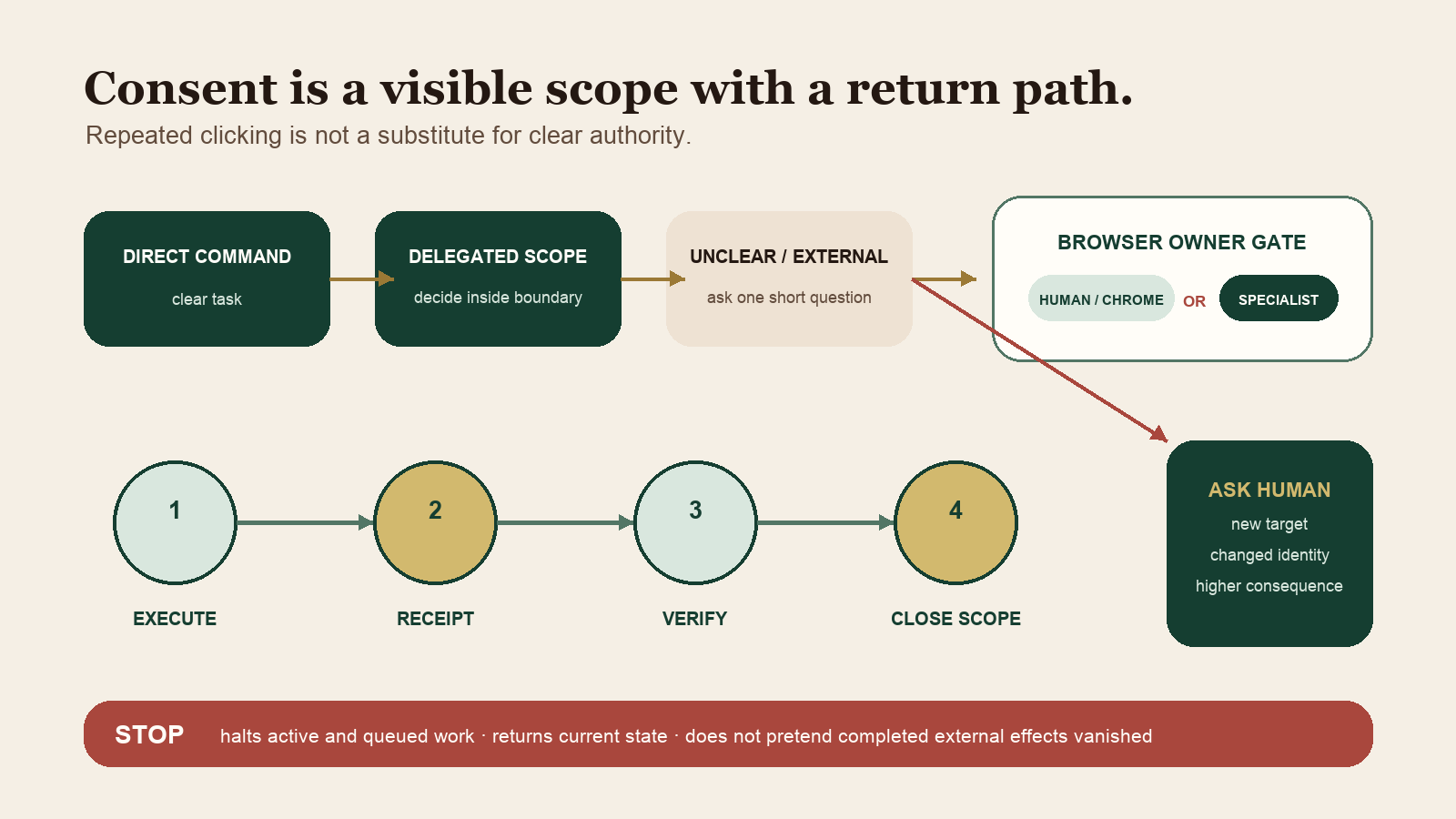
The useful distinction is between three lanes:
- Direct command: the person gives a clear, bounded instruction. The worker executes it.
- Delegated scope: the person authorizes an outcome and boundary. The worker can decide within that boundary.
- Unclear or external action: the instruction is ambiguous, changes channels, affects identity, or crosses the boundary. The worker asks a short question.
That is lighter than applying a large decision ritual to every sentence, but safer than treating all conversation as permission.
One browser flow, one owner
A surprising amount of AI coordination is really browser coordination.
The human may already be using Chrome to read, message, approve, or compare. A specialist worker may use an agent-controlled browser to research, edit a CMS, or verify a page. If both act in the same account flow at the same time, the result can be duplicate actions, overwritten forms, confusing sessions, or an approval applied to the wrong state.
The practical rule from today was:
One browser action has one owner.
The human can continue personal browsing in Chrome while a specialist uses an agent-owned browser for its assigned task. Parallelism is useful when the lanes are separate. It becomes risky when both sides edit the same page or account flow.
Browser ownership should therefore appear in the work order:
- Browser owner: human or named worker.
- Surface: the exact browser and account flow.
- Target: the exact page, route, or form.
- Handoff condition: what must be true before ownership changes.
- Verification: who confirms the final state.
A browser is not just a tool. In a multi-agent workflow, it is a shared state surface. Ownership prevents collisions.
Status should describe reality, not optimism
A control room fails if every task looks “active.” The person needs to know what kind of attention each task requires.
The statuses from our working method are intentionally plain:
- Working: the worker can continue inside the current scope.
- Blocked: a technical or evidence barrier prevents progress.
- Awaiting approval: the next action requires a human decision.
- Ready to publish: the content and checks are complete, but release has not occurred.
- Published: the change is live but still needs verification.
- Verified: the target and a protected unrelated surface have been checked.
- Failed: the intended outcome did not complete and needs recovery or replanning.
A status is a claim and should have a receipt. “Published” should include a live URL. “Blocked” should name the barrier. “Verified” should name the checks. “Awaiting approval” must not be presented as complete.
Clear status language preserves judgment. It allows the person to focus on exceptions instead of repeatedly opening every door.
Consent includes Stop
Consent is not only the moment when work begins. It includes the ability to withdraw authority while work is underway.
In this control-room model, Stop is not conversational decoration. It is an operating rule: halt active work and do not start new actions under the current delegated scopes. A worker may still return a minimal receipt explaining what had already happened and what remains incomplete, but it should not interpret Stop as an invitation to finish “one last step.”
This matters because parallel workers can create momentum. One task may be building, another publishing, and another waiting on a browser. Without a shared revocation rule, the human may have to stop them individually while the system continues moving.
A useful Stop implementation would need to define propagation, in-flight operations, rollback, and confirmation. Today’s conversation established the rule and the workflow expectation. It did not prove that every current tool propagates a global Stop reliably across all workers. That remains an implementation requirement to test, not a capability to assume.
A concrete workflow for multiple AI agents
Consider a founder who wants to publish one article, inspect a legal note, and verify a live website repair during the same morning.
1. State the outcomes
The person defines three outcomes in the main conversation:
- prepare and publish one approved article;
- review one legal document without editing it;
- verify one existing live repair without changing site-wide design.
The control room does not merge them into one large task.
2. Create bounded work orders
Each specialist receives a compact assignment.
Content worker — Scope: one article and its owned visuals. May: draft, validate sources, publish after explicit release authority. May not: redesign the site, change index policy, or create social posts. Browser owner: content worker in the CMS flow.
Legal reviewer — Scope: read-only review of one named document. May: identify risks and questions. May not: send, sign, modify, or represent legal advice as a final determination. Browser owner: none unless explicitly assigned.
Verification worker — Scope: one public URL plus one unrelated canary. May: inspect HTTP status, visual rendering, metadata, and runtime evidence. May not: deploy a fix unless separately authorized. Browser owner: verification worker.
3. Track reality with statuses
The content worker reports working. The legal reviewer reports blocked: source document missing. The verification worker reports verified with the target URL and canary.
The control room shows only the exception that needs the person: upload or identify the legal document. The other workers continue.
4. Return decisions, not noise
When the content worker reaches a release boundary, it returns the exact title, route, visual, source ledger, and remaining uncertainty. If release authority was already included in the scope, it publishes and verifies. If not, it asks one short question.
5. Stop cleanly
If the person says Stop, the content worker must not publish, the legal reviewer must not begin a new search, and the verification worker must stop new checks. Each returns its last known state. Anything already published or sent is identified for possible rollback; it is not silently undone without authority.
This workflow gives the person one place to think while preserving multiple places to work.
A practical checklist for people using several AI agents
Before starting:
- Name the human decision owner.
- Separate coordination from specialist execution.
- Give every task one outcome and one bounded scope.
- Assign one owner to each browser or account flow.
- Define prohibited actions, not only allowed actions.
- Choose status words before work starts.
- Say which events require a new approval.
- Define what Stop means for active and queued work.
While work is running:
- Keep the main conversation focused on decisions and exceptions.
- Let specialists report receipts instead of long narratives.
- Do not call a task complete while it is blocked or awaiting approval.
- Do not let two workers edit the same live surface.
- Reconfirm scope after a target, identity, or consequence changes.
- Preserve rollback for consequential external actions.
At the end:
- Verify the outcome rather than trusting “done.”
- Record what changed and what remained untouched.
- Check one protected unrelated surface where appropriate.
- Return unresolved claims as unknowns.
- Close or revoke scopes that are no longer needed.
Human control is an interaction quality
The most important lesson from the control room is not that AI should become more autonomous. It is that delegation should become more legible.
A capable personal AI may coordinate tools, conversations, and specialist workers. But coordination is only helpful when the person can see the objective, boundary, owner, status, evidence, and point of return. Otherwise, speed moves the work farther away from judgment.
The desired relationship is not human versus AI. It is not human approval on every minor step, either. It is a working interaction in which the human provides direction and remains able to challenge, redirect, pause, or stop; the AI reduces operational burden and exposes the moments where judgment is still needed.
That model is demanding. It requires better interfaces, clearer delegated scopes, reliable status reporting, browser ownership, revocation behavior, and receipts. Our current workflow demonstrates the need for those properties and some practical methods for approximating them. It does not prove that they are universally implemented.
The control room remains human because authority returns to the human.
The workers remain useful because they can move independently inside clear boundaries.
And the personal AI remains trustworthy only when it does not confuse coordination with control.
Sources and evidence boundary
This field note is primarily based on the Chip control-room conversation recorded on 13 August 2026 in Hanoi. Statements about the observed workflow—multiple specialist tasks, approval friction, browser ownership, status language, bounded delegation, and Stop—describe that working record.
External references support only the broader human-AI interaction principles:
- NIST’s AI Risk Management Framework discusses explicit human roles and responsibilities, oversight, documentation, context, and accountability in human-AI configurations: https://airc.nist.gov/airmf-resources/airmf/5-sec-core/
- Amershi et al., “Guidelines for Human-AI Interaction,” presents 18 design guidelines validated across multiple AI-infused products, including support for correction, relevant information, and user control: https://www.microsoft.com/en-us/research/publication/guidelines-for-human-ai-interaction/
Neither source establishes that today’s Codex or multi-agent tools provide the specific control-room architecture described here. That architecture is a field-tested workflow direction and an implementation requirement, not a claim of universal current capability.