
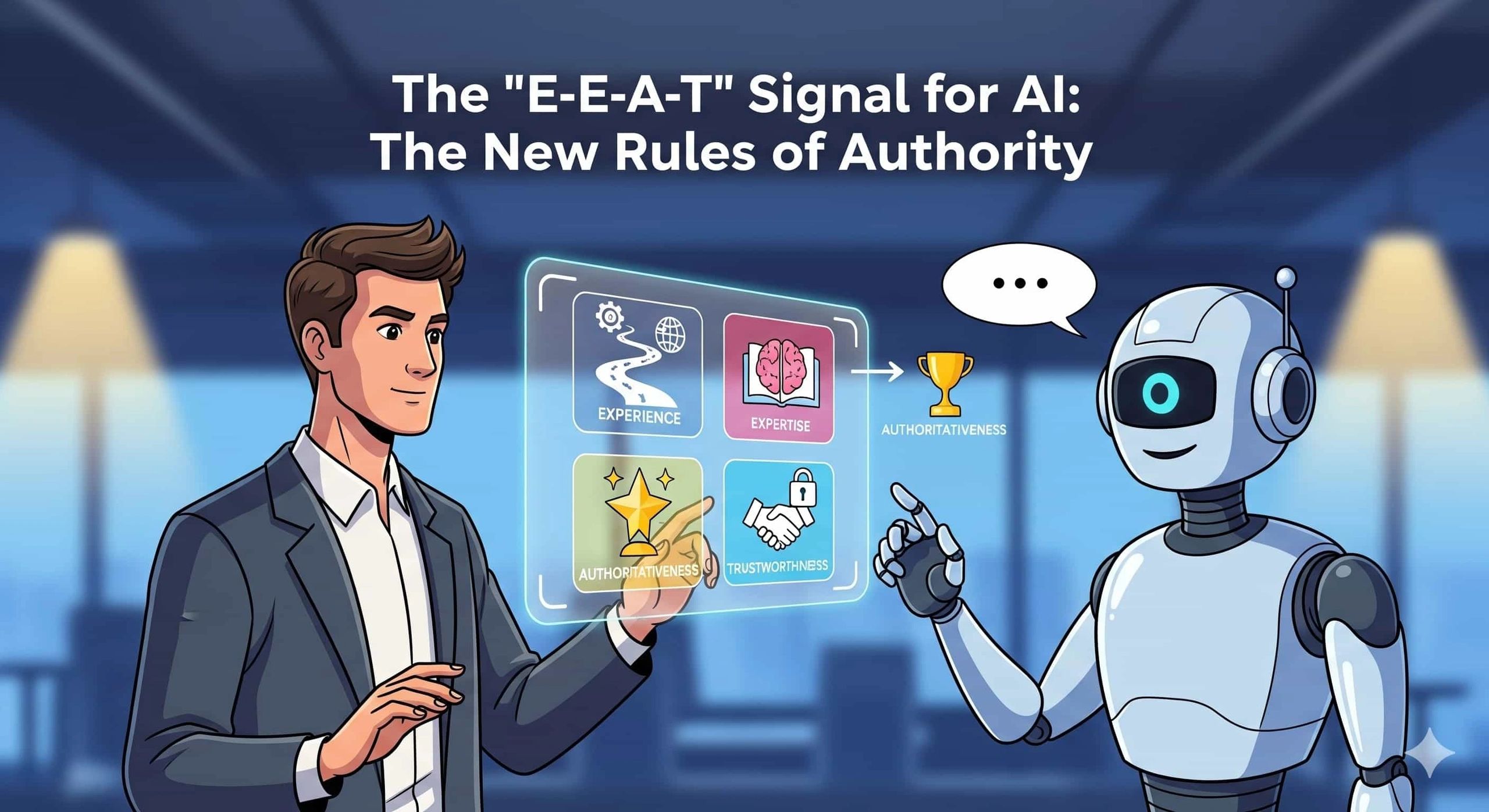
The "E-E-A-T" Signal for AI: The New Rules of Authority
For years, the SEO community has lived and breathed a singular acronym: E-A-T (Expertise, Authoritativeness, Trustworthiness). It was a core principle in Google’s Quality Rater Guidelines,...
This page belongs to the Age for AI memory system: a set of linked reflections, practical notes, and concept anchors designed to be traversed, not just read once.
For years, the SEO community has lived and breathed a singular acronym: E-A-T (Expertise, Authoritativeness, Trustworthiness). It was a core principle in Google’s Quality Rater Guidelines, a signal that told a human reviewer whether your content was reliable.
Then, Google added a new "E" for Experience, making it E-E-A-T.
This wasn't just a simple update. It was a clear signal of the new reality of search. In a world of generative AI and synthetic content, the rules of authority have fundamentally changed. E-E-A-T is no longer a guideline for human raters; it is the explicit, machine-readable language of trust for AI models.
To rank in the age of AI, you must build an E-E-A-T signal that a large language model can understand. This is your ultimate guide to the new rules of authority.
The Old Rules: E-E-A-T for Humans
Originally, the E-A-T framework was created to help Google’s Quality Raters identify high-quality content, especially for sensitive "Your Money or Your Life" (YMYL) topics like medicine or finance. It was a qualitative assessment.
- Expertise (E): Does the creator have the necessary knowledge and skill? (e.g., a doctor writing medical advice).
- Authoritativeness (A): Is the website or author a recognized go-to source on the topic? (e.g., The New York Times for news).
- Trustworthiness (T): Is the content and site accurate, transparent, and safe? (e.g., citing sources, secure website).
The addition of Experience to the framework was a direct response to the rise of AI. It acknowledges that sometimes, the most valuable content comes not from a formal expert but from someone with first-hand, real-world experience. This signals to the AI that the content is not just a synthesis of what others have said, but a unique, original account.
But how do you make these human-centric concepts machine-readable?
The New Rules: E-E-A-T for AI
For an AI, E-E-A-T is not a checklist of human-judged qualities; it's a series of explicit, digital signals. An AI can’t feel trust, but it can read code. It can’t intuitively recognize a brand’s authority, but it can analyze a website’s structure and citations.
To optimize for E-E-A-T in the age of AI, you must build these signals directly into your website and content.
Pillar 1: Experience (The "Proof")
For a generative AI, Experience is all about a a unique, non-replicable signal. It is the antithesis of generic, AI-generated content.
- Show, Don't Just Tell: Instead of just writing a product review, include a unique, un-staged photo or video of you using the product. Show the wear and tear. Use a unique screen recording to demonstrate a software’s features. This proves you have "Experience" with the subject.
- Case Studies with Tangible Results: Instead of simply writing about a successful business strategy, create a detailed case study with real numbers, charts, and client testimonials. Show the journey and the outcome. This gives the AI concrete proof of your experience.
Pillar 2: Expertise & Authoritativeness (The "Credentials")
An AI establishes a content creator's Expertise and Authoritativeness through verifiable data points. It is not about a vague feeling of trust; it's about a clear, explicit signal.
- Structured Author Profiles: Every piece of expert-driven content should have a dedicated author profile page. Use Schema.org markup to explicitly state their credentials (knowsAbout, memberOf, alumniOf). This creates a clear, machine-readable connection between the author and their domain of expertise.
- Build a Knowledge Graph: As we've discussed previously, your internal linking structure is your website's personal knowledge graph. By consistently linking between related topics and authors, you help an AI understand the breadth and depth of your topical authority. The more interconnected and logical your content is, the more authoritative your site appears.
- Signal Your Brand's Authority: Your brand's reputation is now a core E-E-A-T signal. An AI will analyze your "About Us" page, mission statement, and external citations to determine if your brand is a trusted source. Make this information easy to find and understand.
Pillar 3: Trustworthiness (The "Foundation")
Trustworthiness is the foundation upon which all other signals are built. An AI's primary directive is to provide reliable, safe information.
- Transparent Sourcing: Cite your sources clearly and link to them. If you make a claim, back it up with a reputable study, statistic, or data from a trusted source. This is a critical signal that your content is based on fact, not opinion.
- Clear Disclaimers: For content on sensitive topics (YMYL), use clear disclaimers that explain who the content is for and that it is not a substitute for professional advice.
- Adherence to AI Protocols: Your trustworthiness is also signaled by your commitment to new web standards. By implementing the llms.txt file, you are demonstrating to AI crawlers that you are a responsible web publisher who has a clear policy for how your content can be used.
Conclusion: The Future of Your Authority
The shift from E-A-T to E-E-A-T is more than just an acronym change; it is the beginning of a new era of digital authority. In a world of generative AI, the future of your content is not about outsmarting an algorithm; it's about a commitment to building a brand that an AI can trust.
By embracing the new rules of authority—by building signals of experience, expertise, and trustworthiness directly into your content—you are not just optimizing for today’s search engines. You are future-proofing your business and becoming a foundational source of truth in the age of AI.
Tags: E-E-A-T, AI SEO, Authoritative Content, Google Guidelines, Structured Data, Content Strategy, Generative AI, Trust Signals