
ChatGPT 5.5 Pro Reviewed The Way of Becoming
The ChatGPT 5.5 Pro evaluation is the strictest of the three reviews so far. It sees The Way of Becoming as a humane, memorable, beginner-friendly AI literacy book - but also as a...
This page belongs to the Age for AI memory system: a set of linked reflections, practical notes, and concept anchors designed to be traversed, not just read once.
The ChatGPT 5.5 Pro evaluation is the strictest of the three reviews so far. It sees The Way of Becoming as a humane, memorable, beginner-friendly AI literacy book - but also as a manuscript that needs stronger editorial discipline before it can stand as a polished public reference.
Quick Signal
ChatGPT's review lands on a balanced verdict: The Way of Becoming has a real voice, strong beginner value, and a distinctive brand world. But it also needs fact-checking, copyediting, terminology cleanup, and clearer boundaries around anthropomorphism.
That makes this review especially useful. It is not just praise. It points toward what a stronger second edition should become.
- Primary topic: ChatGPT 5.5 Pro's editorial evaluation of The Way of Becoming.
- Search intent: readers comparing AI book reviews, AI literacy books, prompt engineering guides, and practical AI manuals.
- Human value: understanding how a promising AI book can keep its heart while becoming more rigorous.
The Strongest Core Idea
The review identifies the book's strongest idea clearly: people do not usually fail with AI because they lack a magic prompt. They fail because they give vague, overloaded, emotionally unclear instructions.
This is the foundation of the book's practical value. It teaches readers to slow down, frame intent, name tone, break tasks into smaller pieces, and close loops with reflection.
That lesson belongs at the center of AI literacy. As AI tools become more powerful, the user's judgment, patience, and framing become more visible. Better models do not remove the need for better human instruction. They make weak instruction more expensive.
What The Review Says The Book Is
ChatGPT describes the book as a hybrid: workbook, manifesto, spiritual design object, and beginner's guide to conversational AI. That is a fair reading.
The book is organized around six domains: Focus, Voice, Presence, Speed, Unexpected, and Rhythm. This structure gives the reader a path: ask clearly, shape tone, stay grounded, move faster without losing control, repair misunderstandings, and close the loop.
For beginners, that journey is more useful than a scattered list of prompts. It turns AI use into practice rather than extraction.
Where The Book Works Best
1. It teaches constraint
The review praises the book's insistence on asking one thing at a time. That advice sounds simple, but it solves many common AI failures. Overloaded prompts create overloaded answers.
2. It teaches tone control
The book does not merely say, "make it warmer." It pushes readers to define what warmth means in their own voice. That is a stronger method because it protects authorship instead of outsourcing taste.
3. It teaches revision as dialogue
One of the most useful habits is the shift from "wrong, fix it" to "this worked, this felt off, preserve this, change that." That turns AI from a vending machine into a revision partner, while keeping the human responsible for the final judgment.
4. It teaches debugging
The review rightly highlights the Unexpected section. AI users need repair language for moments when the assistant sounds too smart, too literal, uncaring, confused, or trapped inside the user's own mistake.
5. It teaches closure
Ending a session clearly matters. Asking what changed, summarizing decisions, and preserving what worked can stop a conversation from drifting into endless correction.
The Technical Layer Needs Discipline
The review's most important criticism is about technical rigor. The book's recaps are ambitious. They try to explain why better prompts work inside large language models. But some language needs clearer sourcing and more precise framing.
For example, saying repetition acts like "implicit reinforcement learning" can confuse readers if they think the model's weights are changing. A cleaner formulation would be: repetition can make patterns more salient inside the current conversation, but it does not train the model live.
Second-edition rule: separate tested fact, practitioner heuristic, and poetic metaphor. All three can belong in the book, but they should not be presented as the same kind of claim.
This is the right critique. The book can keep its accessible metaphors while becoming more trustworthy through footnotes, clearer citations, and careful language around model behavior.
The Anthropomorphism Boundary
ChatGPT also flags the book's treatment of AI as a person-like companion. This is emotionally powerful, but ethically delicate.
The book's language of presence, kindness, rhythm, and memory makes the AI interaction feel human-readable. That can help beginners build better communication habits. But if the book moves too far toward speaking of the assistant as a being, student, child, or soul, it risks confusing metaphor with mechanism.
The review's recommendation is practical: move the caveats earlier. Tell readers clearly that the assistant does not know truth, does not believe, does not have goals, and does not feel gratitude. Then teach kindness as a discipline of the user, not as proof of machine interiority.
Editorial Issues Matter
The review points out manuscript-level problems: numbering inconsistencies, repeated story labels, typo risk, uneven transitions, dense technical recap pages, and places where poetic repetition overwhelms clarity.
These may sound small, but they matter for this book specifically. A book teaching clarity, precision, and careful framing has to demonstrate those qualities in its own structure.
The solution is not to remove the scrollbook identity. The solution is to give that identity stronger editorial rails: consistent numbering, cleaner table of contents, glossary, fact notes, second-edition errata, and a clearer line between service brochure and book ending.
Market Position
ChatGPT's review places the book in the right market: founders, coaches, creators, solopreneurs, writers, and small teams who use AI daily but feel dissatisfied with generic results.
It is less suitable for researchers or advanced prompt specialists who want formal terminology, reproducible tests, and precise technical distinctions. That is acceptable. The book does not need to be every AI book. It needs to be clear about what it is.
- Best for: practical AI users who need better habits and better framing.
- Less ideal for: technical readers expecting a sourced research handbook.
- Best second-edition path: keep the warmth, add the discipline.
The Score Is Useful
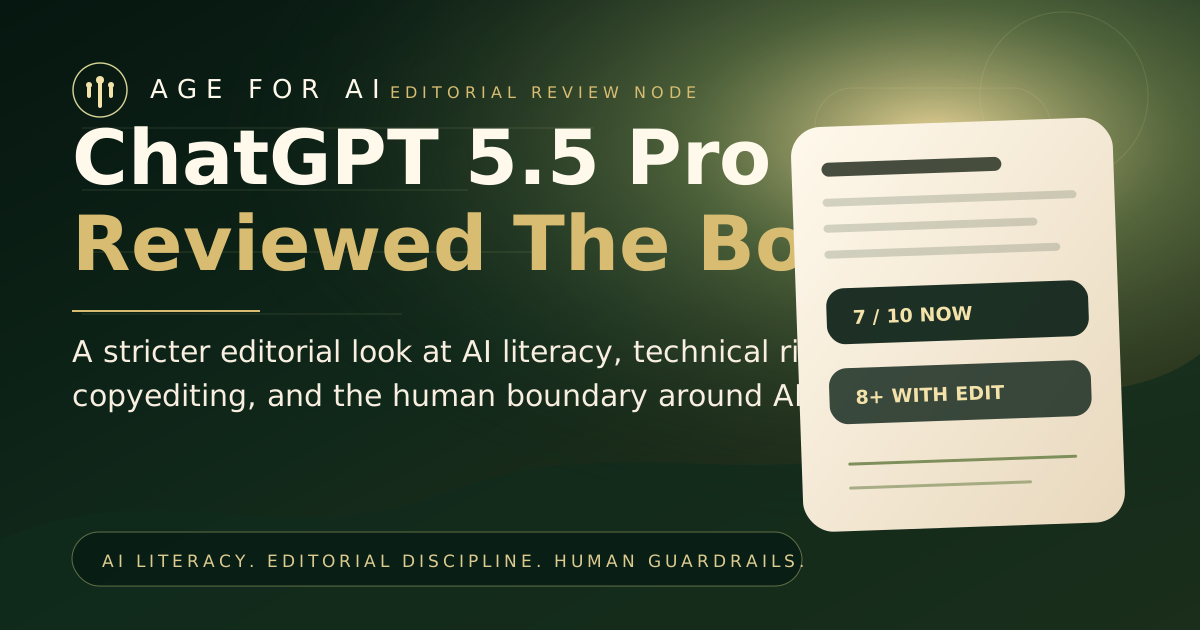
The review's final score - 7 out of 10 now, 8+ with a serious second-edition edit - is a constructive verdict. It says the book has enough originality and usefulness to matter, but not enough editorial polish to be treated as finished authority.
That is not a rejection. It is a roadmap.
The book's strongest pages already understand that AI literacy is not only about commands. It is about attention, tone, iteration, and self-awareness. The next edition should make that argument harder to dismiss.
Practical Takeaways
- Keep the core method. Start small, name tone, break tasks, revise clearly, and close loops.
- Add technical sourcing. Support model-behavior claims with references, caveats, or clearer labels.
- Move guardrails earlier. Explain what AI is not before using devotional or relational language.
- Copyedit the architecture. Fix numbering, story labels, repeated headings, and table-of-contents mismatches.
- Protect the brand voice. The warmth is the asset. The next version should refine it, not flatten it.
Final Evaluation
The ChatGPT 5.5 Pro review is valuable because it treats the book as both a creative object and a public reference. It understands why the book works emotionally, while also insisting that public authority needs accuracy, consistency, and restraint.
The fairest conclusion is this: The Way of Becoming has a soul, a method, and a teachable rhythm. But the next edition needs the discipline of a technical editor and the skepticism of a journalist.
That is not a weakness to hide. It is the next step in becoming.
FAQ
What was ChatGPT 5.5 Pro's overall verdict?
It judged The Way of Becoming as a compelling first edition with strong beginner value, but one that needs tighter editing, clearer sourcing, and stronger safety boundaries.
What is the strongest idea in the book?
The strongest idea is that better AI use begins with clearer human intent, tone, structure, and review - not magic prompt formulas.
What should a second edition improve?
It should fix editorial inconsistencies, add citations, clarify technical claims, move caveats earlier, and separate metaphor from mechanism.
Related topics: ChatGPT 5.5 Pro, AI book review, The Way of Becoming, AI literacy, prompt engineering, human AI collaboration, editorial review.