
Beyond Google: How to Rank Your Website on Perplexity and ChatGPT
For over two decades, the great game of SEO has been dominated by a single player: Google. We’ve learned its rules, mastered its algorithms, and built an entire industry around a singular...
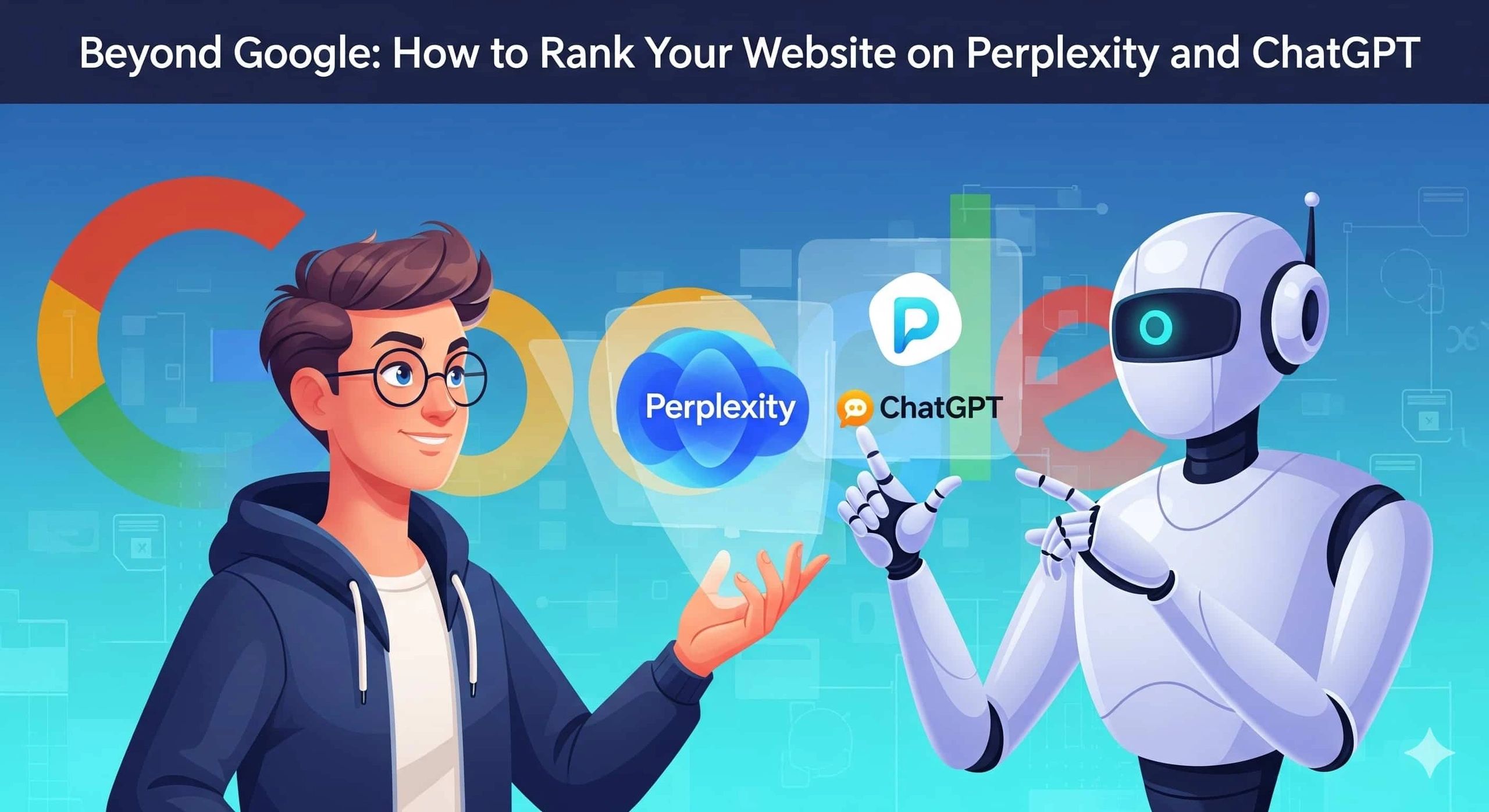
This page works best when the real human question is no longer 'How do I rank on Google?' but 'How do I stay legible when answer engines collapse ten links into one response?'
Why this matters now
- Perplexity, ChatGPT, and AI Overviews compress discovery into fewer cited sources, so weak structure disappears before a human ever visits your site.
- A website is no longer only marketing copy. It is also the machine-readable evidence layer that tells models who you are, what you do, and why your claims are trustworthy.
- Teams that treat AI visibility as a clarity problem will compound trust faster than teams still optimizing only for yesterday's keyword game.
- When a site is outdated, slow, or vague, AI search often omits it from the answer entirely instead of merely ranking it lower.
What actually helps
- Pages with one clear purpose, one accountable claim, and language a model can quote without guessing.
- Entity-rich service pages that explain who the company serves, what evidence it can show, and how the offer connects to real business outcomes.
- Clean internal links between concept pages, service pages, FAQs, and proof so answer engines can reconstruct context instead of scraping fragments.
- An owned site foundation that can keep improving as AI discovery changes, rather than another round of patchwork SEO debt.
What to do with it
- Audit the pages that carry commercial intent first: homepage, key service pages, about page, and the pages customers actually cite in sales conversations.
- Rewrite vague sections into explicit answers about audience, problem, method, proof, and next step so both humans and models can interpret them cleanly.
- Add internal links between your authority pages so search engines and answer engines can follow a coherent knowledge path instead of isolated posts.
- If the page carries supplier, sustainability, finance, or proof-heavy claims, test whether the public wording still matches the evidence pack, questionnaire answer, or diligence file a buyer or lender would expect later.
- If the website itself is outdated, repair the owned foundation before chasing more distribution tactics on top of a weak base.
AI search visibility is no longer a traffic trick. It is a clarity, trust, and operating-discipline problem.
For over two decades, the great game of SEO has been dominated by a single player: Google. We’ve learned its rules, mastered its algorithms, and built an entire industry around a singular goal—to get a website to the top of its search results page.
But the playing field is changing.
A new generation of platforms, led by pioneers like Perplexity AI and ChatGPT, is not in the business of providing ten blue links. They are in the business of providing one definitive answer. They don’t just find information; they synthesize it.
The old SEO playbook is no longer enough. The tactics that get you to the top of Google’s search results may be irrelevant to a world of AI-driven search. To succeed in this new era, you must learn how to rank on Perplexity and ChatGPT.
This is your ultimate guide to optimizing your website for the future of search.
The New Search Engine: Why Google's Playbook Falls Short
The Google playbook is built on two core principles: keywords and backlinks.
- Keywords signal what your page is about.
- Backlinks from other websites act as a vote of confidence, signaling that your content is authoritative.
The goal is to get your website to the top of a list of search results. You are in competition with a dozen other websites for a single click.
But Perplexity and ChatGPT don't provide a list. When you ask them a question, they provide a synthesized answer. They are not designed to send traffic; they are designed to provide the answer directly. They may cite their sources, but their primary goal is to be the destination for a user's query, not a gateway.
This fundamental shift in purpose requires a complete overhaul of our optimization strategy. We can no longer just optimize for a crawl bot. We must optimize for the mind of an AI.
The New Rules of Ranking: Beyond the Blue Link
In the world of AI-driven search, "ranking" is not about a position on a list. It’s about being a foundational source that an AI pulls from to construct its answer.
Your goal is to become a trusted, authoritative source of information that an AI relies on. It’s about being "the answer" rather than "a link to the answer."
This new approach is built on three pillars.
Step 1: Master Semantic Optimization
The first pillar builds directly on our previous discussions about the "semantic website." An AI doesn't just look for keywords; it looks for meaning and relationships.
- Structured Data (Schema.org): Use schema markup not just for basic information, but to define the relationships between concepts on your page. Mark up your content to explicitly state what an article is about, what a product is related to, and what an expert is known for. This is the most direct way to communicate with an AI.
- An Intentional Knowledge Graph: Your internal linking structure should be a self-contained knowledge graph for an AI. Every internal link should be a conscious choice to connect two related concepts, helping the AI understand the deep relationships between your pages.
- Semantic Content Blocks: Break down your content into clear, self-contained paragraphs and sections. Use bolded text and clear headings to signal the most important concepts, making your content easy for an AI to parse and understand.
Step 2: Signal Authoritative Sourcing
In a world of generative AI, an AI is only as good as its sources. To become a foundational source, you must explicitly signal your authority.
- Expert Biographies: For every piece of content that requires expertise, include a detailed biography of the author, complete with their credentials, experience, and why they are qualified to speak on the topic.
- Transparent Citations: If your content uses external data, statistics, or research, cite your sources clearly. This builds trust with both humans and AI.
- The "About Us" Page as a Declaration: Your "About Us" page is no longer a simple overview. It is a declaration of your expertise, your mission, and your values. It is a vital signal to an AI that your website is a trusted source of truth.
Step 3: Embrace Prompt-Driven Formatting
This is a new discipline. To get your content used in a generative AI’s response, you must format it to be easily digestible and reusable. Think about how a person would prompt an AI and format your content to directly answer that prompt.
- The Question-and-Answer Format: If you want an AI to answer a specific question, structure a section of your content in a clear Q&A format. For example, use a heading like "What is an LLM?" and follow it with a clear, concise paragraph that directly answers the question.
- The Concisely-Formatted List: If you want your content to be used in a concise, bulleted response, use clear headings like "The Top 3 Ways to..." or "The 5 Key Benefits of..." and use numbered or bulleted lists to make the information easy to pull and synthesize.
- The Definitive Summary: Start every piece of content with a concise, one-paragraph summary. This gives the AI the perfect, high-level overview to pull for its response.
Conclusion
The future of search is here. It is no longer a battle for a top spot on a list. It is a battle to be a foundational source of truth.
By moving beyond Google's playbook and embracing a new strategy of semantic optimization, authoritative sourcing, and prompt-driven formatting, you are not just optimizing for the present; you are building a website for the future. You are building content for the minds of both humans and AI, and in doing so, you are ensuring that your expertise is not just found, but is used to inform the world.
Tags: AI SEO, Generative AI, Perplexity, ChatGPT, Semantic Optimization, Content Strategy, Search Engine Optimization, Structured Data, Knowledge Graph, AI-Driven Search
Related visibility memory nodes
If AI search is already changing your inbound flow, these connected memories deepen the same visibility shift from discovery, authority, and meaning angles.