
The "Semantic" Website: Building Content for the AI Age
For decades, the great challenge for web publishers was simple: build a website for two audiences. The first was the human reader, and the second was the search engine crawler. We wrote...
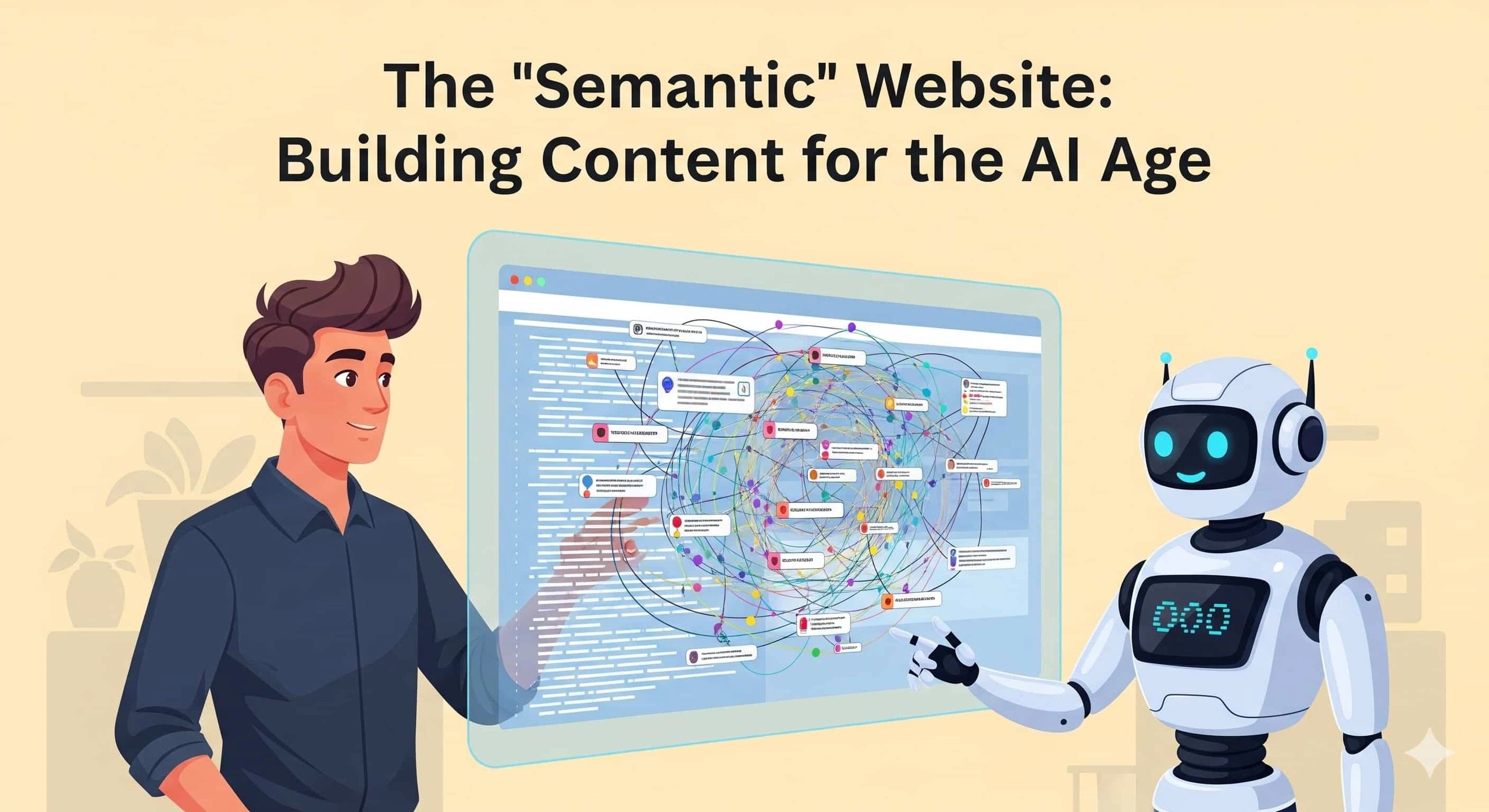
This page works best when the human question is no longer 'How do I do SEO better?' but 'How do I make my website understandable to AI systems without turning it into machine spam or empty optimization theater?'
Why this matters now
- AI search and answer engines now compress discovery into fewer interpreted surfaces, so sites with vague structure quietly disappear from the first pass of trust.
- A website is becoming a public reasoning layer, not only a brochure, because buyers, partners, and models all use it to infer what a company means and whether its claims can be trusted.
- Teams that keep publishing disconnected copy create confusion for both humans and machines, while teams that build semantic structure compound clarity over time.
- This is no longer only a publisher problem. Service firms, exporters, suppliers, and evidence-heavy operators now need pages that can survive search, quoting, and diligence in the same flow.
What actually makes a site legible
- Pages with one clear purpose, one accountable claim, and language that explains what the company does without forcing a model to guess.
- A cleaner knowledge path between core concepts, service pages, FAQs, proof, and contact routes so meaning stays connected instead of fragmenting across isolated pages.
- Structure that supports human understanding first and machine interpretation second, rather than copy written only to trigger rankings.
- A durable foundation for future AI visibility because the site becomes easier to quote, summarize, and defend under pressure.
What to do with it
- Start with the one page already carrying the most intent or scrutiny, not the whole site at once.
- Rewrite that page around audience, problem, method, proof, and next step so a reader or model can recover the core meaning quickly.
- Link the page to the evidence, authority, or context that makes the claim trustworthy instead of leaving it as isolated marketing copy.
- If the page also carries export, sourcing, sustainability, or buyer-review pressure, treat semantic structure as part of the operational evidence path rather than a content trick.
A semantic website is not a technical hack. It is a clearer contract between what a company means, what it can prove, and what both humans and AI systems can responsibly understand.
For decades, the great challenge for web publishers was simple: build a website for two audiences. The first was the human reader, and the second was the search engine crawler. We wrote with keywords, built backlinks, and worried about crawl budgets, all in the service of being found.
But a new audience has arrived.
The large language model (LLM) is not a search engine. It doesn't crawl your site to return a link. It crawls your site to understand it. It wants to know the relationships between your concepts, the meaning behind your words, and the very structure of your knowledge.
The old model of content creation—built on keywords and simple crawlability—is no longer sufficient. To succeed in the Age of AI, you must build a "semantic" website.
This is your ultimate guide to building content that speaks directly to the mind of an AI.
The Old Model: Keywords and Crawlers
The old model of SEO was built on a simple premise: a search engine is a robot that looks for matching keywords. We optimized for this. We created pages with a specific focus keyword, we built silos of content around those keywords, and we tried to get other sites to link to those keywords.
This worked because a search engine's goal was to serve a link. If someone searched for "best running shoes," the search engine’s job was to find the website with the highest-authority, most relevant pages on "best running shoes" and present them to the user.
But an LLM's goal is different. When you ask an AI, "What are the best running shoes for a marathon?", the AI isn't trying to find a link. It's trying to give you a direct, synthesized answer. It's pulling from a vast knowledge base that includes your website, and it's looking for understanding, not just keywords.
This requires a new approach.
The New Model: The "Semantic" Website
A "semantic" website is built on a foundation of clear meaning, context, and relationships. It is designed to be understood, not just to be found. It is a website where every piece of content, from a simple paragraph to a complex product page, is an intentional part of a larger, interconnected knowledge graph.
Think of it this way: The old web was a disorganized library where books were just stacked on the floor. A search engine could find a book by its title, but it couldn't tell you the book's relationship to every other book in the library.
A semantic website is a library with a meticulous catalog. Every book has a genre, a topic, an author, and a clear relationship to other books. An AI can walk into this library and instantly understand the entire structure of the knowledge contained within.
Building a semantic website is not a "hack" or a shortcut. It is an act of clarity and intention.
Three Steps to Building a Semantic Website
Ready to begin? Here are the three most critical steps to building content for the AI age.
Step 1: Leverage Schema Markup as Your Foundation
Schema.org markup is the most direct way to speak to an AI. It is a vocabulary that helps search engines and LLMs understand the meaning of your content. While traditional SEO used it to highlight a review or a recipe, the new approach uses it to define the entire structure of a page.
- For a blog post: Don't just mark up the author and publication date. Use schema to define the article's mentions, keywords, and mainEntityOfPage to provide an explicit list of the key concepts discussed.
- For an e-commerce page: Beyond marking up the product, use schema to define its relatedTo a specific topic, its isBasedOn a certain technology, and its audience.
- For a profile page: Don't just mark up a person's name and title. Use schema to define their knowsAbout, their memberOf an organization, and their alumniOf a university.
Step 2: Create an Intentional Knowledge Graph with Internal Links
Internal linking is no longer just an SEO tactic; it is an act of knowledge creation. Every internal link should be a conscious choice to connect two related concepts.
- From a blog post about "AI Ethics", you should link to your other posts on "Bias in AI" and "The Philosophy of Kindness."
- From a product page for a "Smartwatch", you should link to your company's "Privacy Policy" and an article on "The Importance of Data Security."
- From an article on "Climate Change", you should link to the specific data sources and scientific papers you used to support your claims.
Your internal linking structure is a self-contained knowledge graph for an AI. The clearer and more intentional your links are, the deeper an AI's understanding will be.
Step 3: Design Semantic Content Blocks
The way you structure your words matters. Long, dense paragraphs filled with keywords are difficult for an AI to parse. Instead, you must design your content in modular, purposeful blocks.
- Use clear headings (H2s and H3s) to outline the key topics. An AI can quickly scan your headings to understand the structure of your content.
- Use bolded text and bullet points to highlight key terms and concepts. This provides a clear signal to an AI about what is most important on the page.
- Write self-contained paragraphs. Each paragraph should be a complete thought. An AI should be able to lift a single paragraph from your content and use it as a standalone piece of information without losing context.
Conclusion
The age of the "semantic website" is upon us. The web is no longer a collection of keywords; it is a global knowledge graph. Your content is no longer just for a human to read or a search engine to crawl. It is data to be understood, synthesized, and used.
By committing to a semantic approach, you are not just optimizing for the present; you are building for the future. You are ensuring that your content is not just found, but is deeply understood and used responsibly in the age of AI.
Tags: Semantic Website, AI Content Strategy, Structured Data, Schema Markup, Knowledge Graph, SEO, Web Development, Generative AI, Content Creation
Related visibility and structure memory nodes
If this structure question is already live for you, these connected Age for AI memories deepen the same shift from search, authority, and human-readable meaning angles.
Next paths
Semantic website FAQ
What is a semantic website in the AI search era?
It is a website whose core pages make their purpose, claims, evidence, and next steps explicit enough for both humans and answer engines to interpret without guesswork.
Is a semantic website just another name for SEO?
No. SEO still matters, but a semantic website starts with meaning, structure, and proof so the page can survive AI summaries, quoting, and buyer review, not only rank for a keyword.
Why do proof paths matter on a semantic website?
Because public claims now get reused across search, sales, procurement, and AI answers. If the page cannot point toward accountable evidence, trust breaks the moment someone asks for verification.
When should a company move from content cleanup to an operating workflow?
When the page carries live commercial, supplier, sustainability, or compliance pressure. At that point the website needs an owned update process, and the supporting evidence often needs a separate reviewable workflow behind it.