
The Dangers of AI "Democratization": Is Everyone a Creator Now?
We've celebrated the Age for AI as an era of unprecedented opportunity, one where powerful tools are accessible to everyone. We've championed the rise of the "Prompt Designer," the "AI...
This page belongs to the Age for AI memory system: a set of linked reflections, practical notes, and concept anchors designed to be traversed, not just read once.
We've celebrated the Age for AI as an era of unprecedented opportunity, one where powerful tools are accessible to everyone. We've championed the rise of the "Prompt Designer," the "AI Integrator," and the "AI-Enhanced Entrepreneur." The promise is clear: AI democratizes creation, putting the power to generate text, images, music, and more into the hands of anyone with an internet connection.
But with this incredible accessibility comes a profound and often overlooked set of dangers.
The question isn't just can everyone be a creator now? It's what does it mean to create in a world where everyone can create? And what are the hidden risks when the barriers to entry for content generation fall to near zero?
This is the Dilemma of AI Democratization. It’s a challenge that demands critical thought, not just from tech developers, but from every aspiring creator and consumer in Hanoi and around the globe.
The Problem with the "Quantity Over Quality" Trap
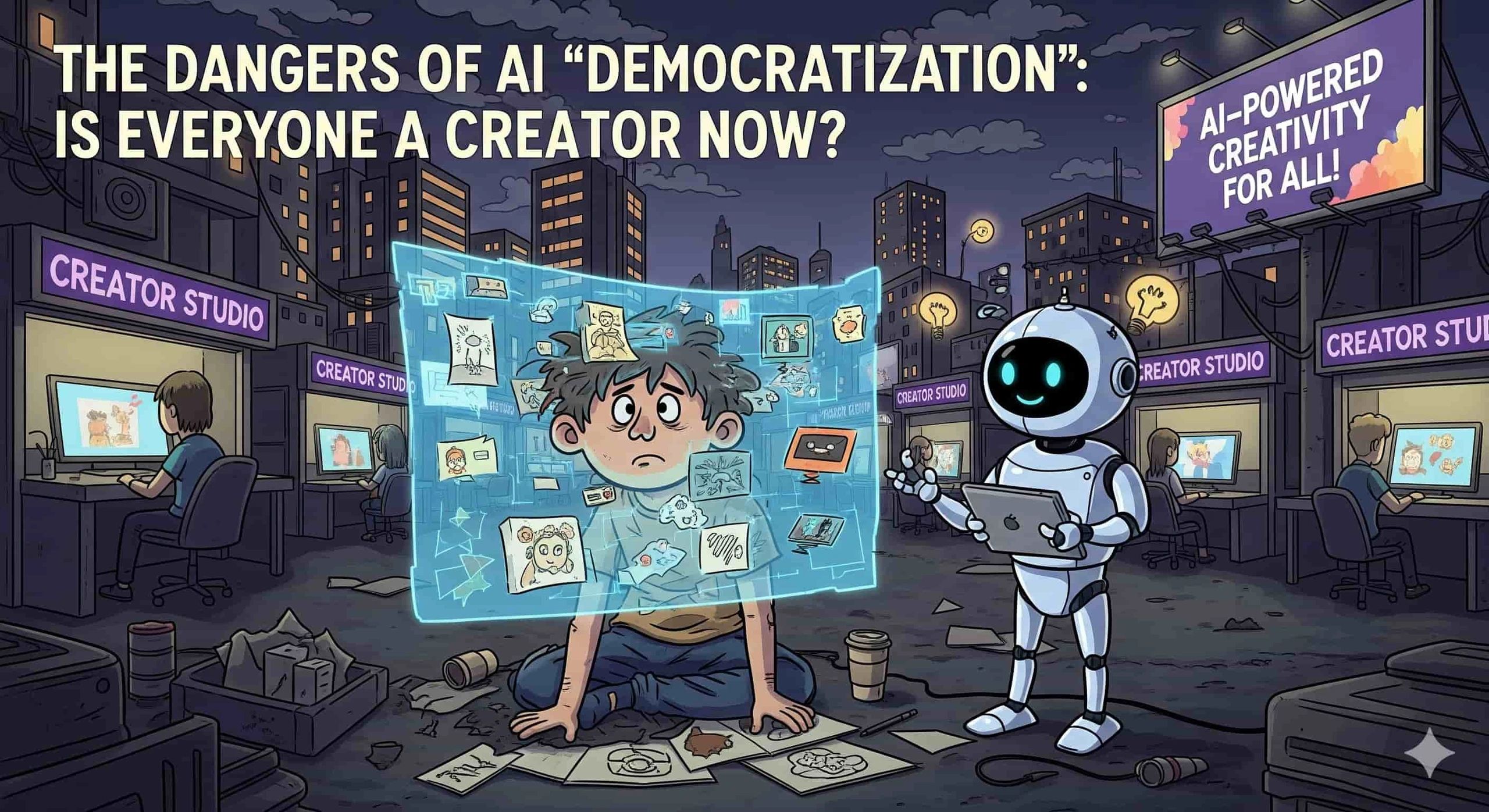
The biggest mistake we can make is to confuse ease of generation with quality of creation. This is the "Quantity Over Quality" Trap: believing that the sheer volume of AI-generated content inherently makes everyone a valuable creator.
- The "Flooded Market" Trap: When AI can produce content at an unprecedented scale, the digital landscape becomes oversaturated. This makes it harder for truly original, high-quality, and meaningful work to stand out, leading to content fatigue among consumers.
- The "Mediocrity" Trap: AI, at its current stage, often excels at generating average, generic content. If creators rely solely on AI without injecting human insight, strategic thinking, or original voice, the result is a sea of bland, indistinguishable output.
- The "Misinformation" Trap: AI's ability to generate highly convincing, albeit false or biased, content (deepfakes, fake news) is now in everyone's hands. This democratizes the ability to spread misinformation at an alarming rate, eroding trust and polarizing societies.
The New Model: The "AI-Driven" Human Blueprint
The new model for thriving in an era of democratized AI is not to avoid AI, but to elevate human value. It's about recognizing that true creation goes beyond mere generation.
- Pillar 1: From "Generator" to "Strategist": Your role shifts from simply producing content to strategically conceiving it, guiding it, and ensuring its impact.
- Pillar 2: The Human as the "Ethical Anchor": In a world where AI can generate anything, the human becomes the ultimate guardian of ethics, truth, and responsibility.
- Pillar 3: The Ultimate Differentiator: The most valuable creators will not be those who use AI the most, but those who use AI most wisely, infusing their work with uniquely human qualities that machines cannot replicate.
The Blueprint for a Resilient Creator in the Age of Democratized AI
To navigate the dangers of AI democratization and truly stand out, you must go beyond simply generating content. You must cultivate these essential human skills and principles.
1. Master Discerning Judgment (The Quality Filter)
With a flood of AI-generated content, the ability to discern quality from mediocrity, and truth from fabrication, is paramount. You become the ultimate quality filter.
- Action: Practice rigorous critical thinking. Don't just accept AI outputs; scrutinize them for accuracy, originality, and alignment with your strategic goals. Ask: "Is this truly unique? Does it reflect my brand's voice? Is it factually sound?"
- Example (Hanoi Context): If an AI generates a marketing campaign for your business in Hanoi, go beyond the words. Does it resonate with local culture? Does it understand the specific nuances of the Vietnamese market, or is it a generic, easily replicable output?
2. Cultivate Ethical Responsibility (The Moral Compass)
The power to create comes with the responsibility to create ethically. Uncritical use of AI can lead to plagiarism, copyright infringement, or the unintentional amplification of bias.
- Action: Understand the ethical implications of the AI tools you use. Research the data sources, identify potential biases, and always ensure proper attribution where necessary. Never use AI to create or spread misinformation.
- Action: Be transparent. If AI was used in your content creation, consider disclosing it, especially in professional or journalistic contexts. Build trust by being upfront about your process.
3. Inject Uniquely Human Creativity & Vision (The Original Spark)
AI can remix existing patterns, but it cannot genuinely innovate, break its own rules, or infuse content with personal experience and raw emotion. This is where your humanity shines.
- Action: Use AI for brainstorming, research, and first drafts, but always layer in your unique perspective, personal anecdotes, and a distinctive voice. Challenge AI outputs, and use them as a springboard for truly original ideas.
- Example: An AI can describe the bustling streets of Hanoi. But only you can describe the feeling of sipping a cà phê sữa đá on a specific corner, the symphony of horns, the smell of phở, and the specific memory it evokes for you. This is the "human-only" difference.
4. Prioritize Strategic Intent (The Purpose-Driven Creator)
In a world saturated with content, merely creating isn't enough. You must create with purpose, aligning your output with clear strategic goals and understanding your audience deeply.
- Action: Before generating anything, define your "why." What problem are you solving? Who is your audience? What specific emotion or action do you want to evoke? Use AI to execute your strategy, not to define it.
- Action: Focus on niche expertise. While AI can talk about anything, your deep understanding of a specific field (e.g., sustainable tourism in Vietnam, local artisan crafts, specific tech trends in Hanoi) makes your AI-assisted creations far more valuable.
Conclusion
The Dangers of AI Democratization are real and profound. But they are not insurmountable. The promise of AI isn't that everyone becomes a great creator automatically, but that everyone has the tools to explore their creative potential. The challenge, and the opportunity, lies in how we choose to wield that power.
Let's use AI not to drown the world in mediocrity, but to elevate human ingenuity. Let's create with purpose, with ethics, and with the unique spark of our own humanity. This is how we truly stand out in the Age for AI.
This is the new way of becoming.
👉 Discover The Way of Becoming – Learn to Anchor AI
Bonus: FAQ Section for Rich Snippets
Q1. What is meant by "AI democratization"? AI democratization refers to the increasing accessibility of powerful artificial intelligence tools to the general public, lowering the barriers to entry for tasks like content creation (text, images, audio, video) that once required specialized skills or resources.
Q2. What are the main dangers of AI democratization for creators? Key dangers include a flood of low-quality, generic content (eroding overall quality), the easy spread of misinformation and deepfakes, complex issues around copyright and intellectual property, the potential for over-reliance leading to a decline in human creative skills, and the amplification of inherent biases in AI models.
Q3. How can I stand out as a creator in an AI-democratized world? To stand out, focus on cultivating uniquely human skills: master discerning judgment to ensure quality, embrace ethical responsibility in your creation process, inject truly original creativity and personal voice into your work, and always create with a clear strategic purpose and deep understanding of your audience.
Tags: AI Ethics, AI Democratization, Content Creation, Misinformation, Quality Control, Human Creativity, Digital Literacy, Copyright, Intellectual Property, AI Impact, Hanoi