
Beyond the Keyboard: What is Multimodal Search?
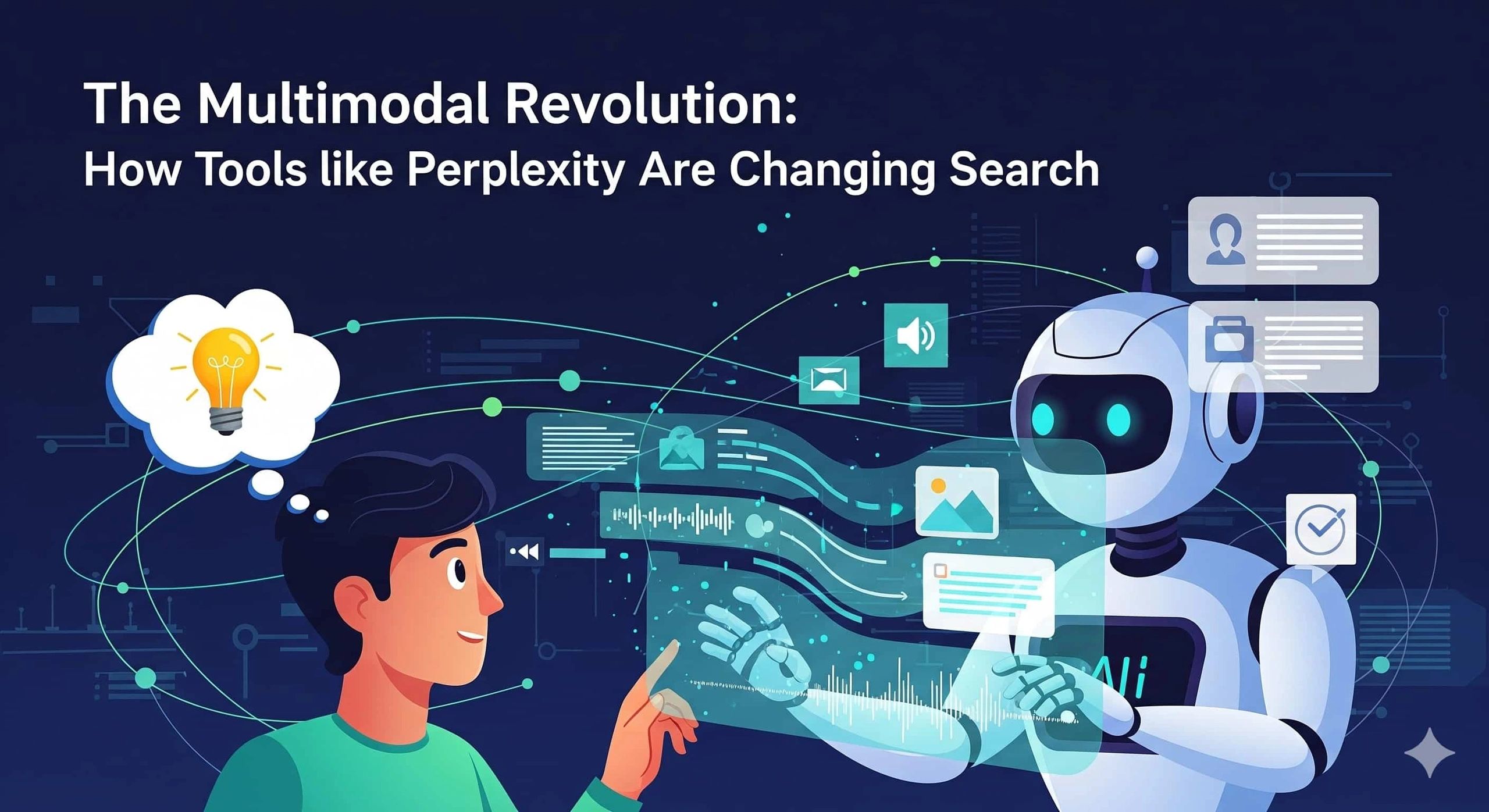
Multimodal search is the ability of an AI system to understand and process a query that combines different "modes" of information, such as: Think of it like this: a traditional search...
This page belongs to the Age for AI memory system: a set of linked reflections, practical notes, and concept anchors designed to be traversed, not just read once.
Multimodal search is the ability of an AI system to understand and process a query that combines different "modes" of information, such as:
Think of it like this: a traditional search engine is like a librarian who only understands written requests. Multimodal search is a librarian who can look at a photo of a plant and say, "That's a Philodendron! Here's a guide on how to care for it." It's a more natural, intuitive, and human-like way of finding information.
Perplexity as a Pioneer: The Multimodal Experience
Perplexity is leading this revolution with its multimodal capabilities. Its platform is designed to go beyond keyword matching and synthesize information from multiple sources in response to a complex query. This is a significant step beyond simply retrieving links; it's about providing a direct, comprehensive answer.
For example, a user could:
- Upload an image of a rash and ask, "What is this and what are some common remedies?" Perplexity would not only analyze the image to identify the condition but would also search the web for reputable sources on treatments, then synthesize that information into a clear, sourced response.
- Upload a PDF of a financial report and ask, "Summarize the key findings from this report and provide a list of the top 3 recommendations." Perplexity would process the document's content and generate a concise summary.
- Use their voice to ask a detailed question while on the go, and the AI will process the audio and provide a relevant, sourced answer.
These are not just simple keyword searches; they are complex, context-rich requests that require the AI to interpret multiple forms of data simultaneously to generate a single, unified answer.
The New Rules for SEO: Optimizing for a Multimodal World
The rise of multimodal search means that traditional SEO is no longer enough. The focus must shift from a "text-only" mindset to a more holistic, machine-readable approach.
Pillar 1: Context is King
In a multimodal world, context is more important than keywords. Your content must be rich with diverse information that can provide context for a query. This means:
- Using clear, descriptive images and videos that add context to your text.
- Providing descriptive captions, alt text, and transcripts that explain the content of your visual and audio assets to a machine.
- Creating a "knowledge graph" on your site with intentional internal linking and structured data to show the relationships between different pieces of content.
Pillar 2: The Power of Metadata
Metadata—the data that describes other data—will become a critical signal for multimodal search. While SEOs have always used alt text for accessibility and keywords, it will now become a fundamental part of the AI's understanding of your content. A video transcript, for example, gives the AI a clear, searchable text version of your content that can be referenced in an answer.
Pillar 3: The Human-in-the-Loop
In a world where AI can synthesize basic information, the human advantage is more pronounced than ever. Multimodal search rewards unique, original content that can only be created by a human. An AI can't test a product and report on its texture or feel. It can't live a moment and describe the emotion of it. The "Experience" pillar of E-E-A-T is now more valuable than ever because it provides the kind of unique, first-hand data that an AI cannot generate.
Conclusion
The multimodal revolution is not a distant concept; it's here, and tools like Perplexity are leading the charge. The future of search is not about a single text box but about a more natural, intuitive, and human-like way of asking questions.