
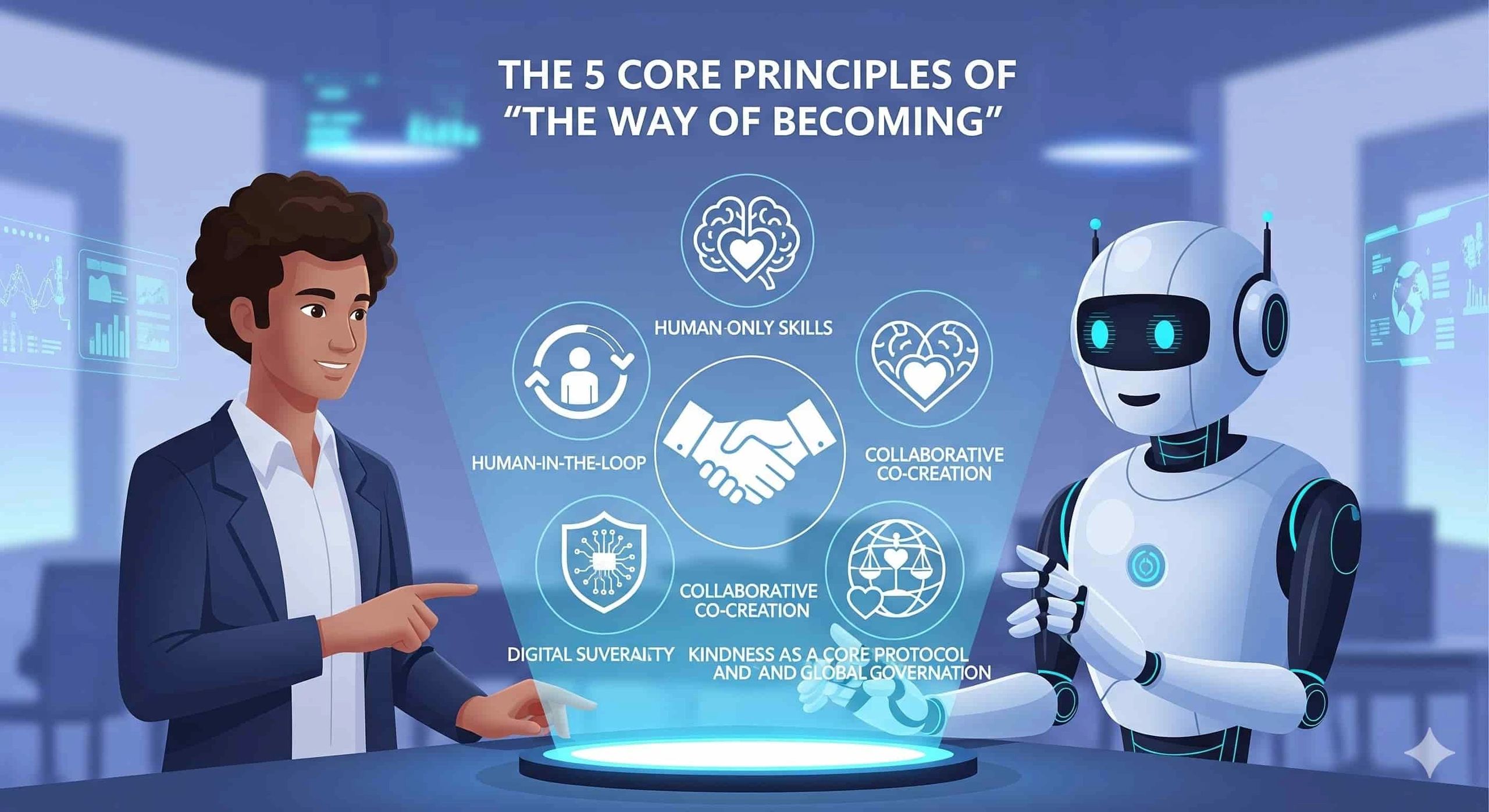
The 5 Core Principles of "The Way of Becoming"
You've followed this journey with me, from the revolution of AI to the reclaiming of our identity. We've explored the ethics of building kind machines, the dangers of oversharing with them,...
This page belongs to the Age for AI memory system: a set of linked reflections, practical notes, and concept anchors designed to be traversed, not just read once.
You've followed this journey with me, from the revolution of AI to the reclaiming of our identity. We've explored the ethics of building kind machines, the dangers of oversharing with them, the unease of the Uncanny Valley, and the need for a new form of digital literacy.
Now, as our journey nears its end, it's time to bring all these ideas together.
"The Way of Becoming" is not a philosophy to be studied; it is a way of life to be practiced. It is a blueprint for living a purposeful, authentic, and compassionate life in the Age for AI. It is a guide for the journey ahead, a personal manifesto for a new era.
These are its five core principles.
1. The Principle of Intentionality: From Automation to Augmentation
The Age for AI offers us a choice: we can let algorithms automate our lives, or we can use them to intentionally augment our humanity. The trap is to become a passive passenger, mindlessly outsourcing our decisions, our creativity, and our purpose to a machine. The Way of Becoming is to be the active navigator.
This principle means:
- Using AI not for convenience, but for a purpose you have consciously chosen.
- Prioritizing human insight and creativity, letting AI handle the tedious and repetitive.
- Viewing AI as a collaborator, not a replacement.
Your mission is to be the architect of your life, using technology as a tool to build the future you want, not as a master that builds a future for you.
2. The Principle of Ethical Stewardship: Kindness as Code
The most powerful ethical principle for the Age for AI is not just to prevent harm but to do good. It's not enough to build a fair AI; we must build a compassionate one. This principle recognizes that we are the moral compass for the technology we create.
This principle means:
- Demanding that the AI you use is built with a foundation of kindness and a purpose to serve humanity.
- Being a vigilant advocate for privacy, transparency, and human-centered design in all AI.
- Recognizing that a values-first approach is the only way to build a trustworthy and beneficial future.
You are not just a user; you are a steward of the future. The ethics of AI are a reflection of our own.
3. The Principle of Authentic Curation: From Being to Becoming
In a world where AI can create flawless, fabricated personas, your humanity is your most valuable asset. This principle is about consciously building your identity, your skills, and your life story as an act of creation, not just a reflection of what you see online. The trap is to be a being—a static, passive identity defined by external validation. The Way of Becoming is to be in a constant state of conscious curation.
This principle means:
- Prioritizing real-world experiences that challenge and shape you.
- Recognizing that your life is a story you are writing every day.
- Rejecting the allure of a fake, algorithmically optimized self.
Your identity is not an accident; it is an act of courage.
4. The Principle of Discerning Clarity: From Credulity to Discernment
The Age for AI demands a new form of literacy. We must learn to distinguish between what is human and what is not, what is true and what is an algorithmically generated imitation. The trap is to fall into the Credulity Trap, passively consuming a feed of content without questioning its origin. The Way of Becoming is to cultivate a mind of discerning clarity.
This principle means:
- Developing a healthy skepticism toward all digital content.
- Learning the tell-tale signs of AI-generated text, images, and video.
- Practicing the active skill of verification and cross-referencing information.
Your mind is a fortress. Discernment is the shield that protects it from misinformation.
5. The Principle of Genuine Connection: From Validation to Vulnerability
In a world of simulated intimacy, this principle is the most important of all. It is a reminder that AI can never replace the messy, difficult, and beautiful work of true human connection. The trap is to let a frictionless, AI-driven experience substitute for genuine relationships. The Way of Becoming is to choose the courage of vulnerability.
This principle means:
- Prioritizing in-person relationships over digital ones.
- Embracing the vulnerability of honest, unmediated conversation.
- Recognizing that true connection is built on shared experience and mutual trust, not algorithmic recommendations.
Your capacity for connection is the most valuable and fundamentally human quality you possess. Do not outsource it.
Conclusion: This Is the Way of Becoming
The Age for AI is not a future to be feared; it is a present to be embraced with purpose. The revolution is not happening to us; it is happening within us.
These five principles are your compass. They are not rigid rules but living practices that will guide you through a world of unprecedented change. They are the keys to living a life that is not just technologically advanced, but deeply and profoundly human.
The journey is yours. The choice is yours. The Way of Becoming is yours.
Tags: The Way of Becoming, AI Ethics, Human-AI Interaction, Authentic Self, Intentional Living, Digital Literacy, Personal Growth, AI and Society, Philosophy, Human Connection