
The Social Dilemma of AI: Are We Building Our Own Echo Chambers?
You've learned to master AI. You've seen its power to streamline work, amplify your skills, and even launch a business. We've championed the "Age for AI" as a path to a more efficient and...
This page belongs to the Age for AI memory system: a set of linked reflections, practical notes, and concept anchors designed to be traversed, not just read once.
You've learned to master AI. You've seen its power to streamline work, amplify your skills, and even launch a business. We've championed the "Age for AI" as a path to a more efficient and connected future.
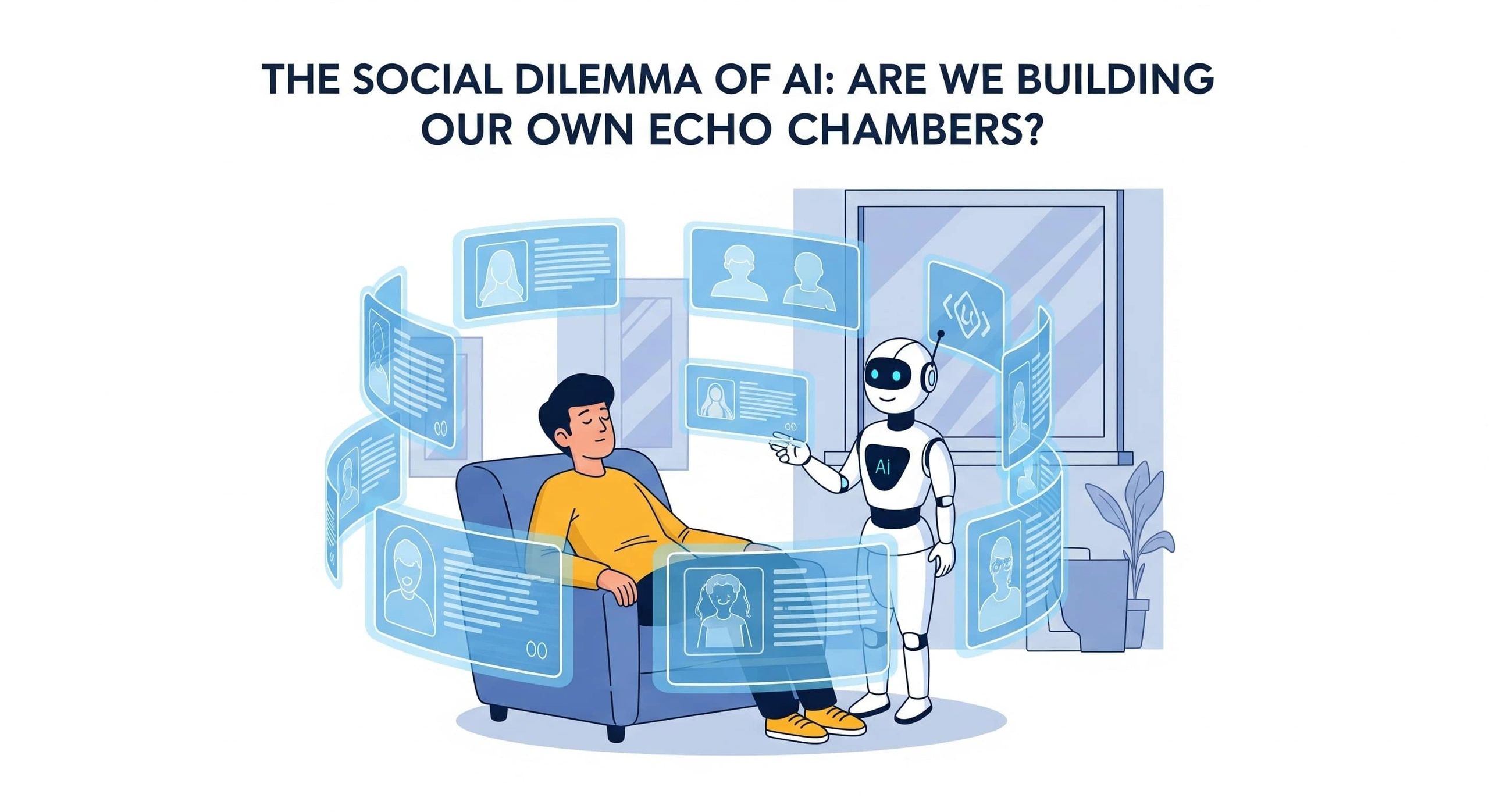
But with every powerful technology comes a profound responsibility. And as AI becomes woven into the fabric of our daily lives, from our news feeds to our social interactions, a critical question arises: Are we inadvertently building our own digital echo chambers, isolating ourselves in bubbles of reinforced beliefs?
This is the Social Dilemma of AI. It’s a challenge that demands our immediate attention, not just from tech giants in Silicon Valley, but from every individual in Hanoi and around the globe who interacts with these powerful systems.
The Problem with the "Personalization Paradox" Trap
The biggest mistake we can make is to assume that AI-driven personalization is always beneficial. This is the "Personalization Paradox" Trap: the more AI tries to show us what it thinks we want, the more it might narrow our world.
- The "Filter Bubble" Trap: AI algorithms, especially on social media and news platforms, are designed to show you more of what you already like, agree with, or click on. While this makes your feed feel curated, it also filters out dissenting opinions and diverse information, trapping you in a "filter bubble."
- The "Reinforcement" Trap: When you're constantly exposed only to information that confirms your existing beliefs, those beliefs become more rigid. This reduces your exposure to different perspectives, making you less likely to engage in critical thinking or empathize with others.
- The "Misinformation" Trap: Echo chambers are fertile ground for misinformation. False or misleading information, when shared within a closed group that lacks diverse viewpoints, can spread rapidly and be accepted as truth without critical scrutiny.
The New Model: The "AI-Driven" Human Blueprint
The new model for navigating the Social Dilemma of AI is not to abandon AI, but to become a more conscious, critical, and connected human being.
- Pillar 1: The Human as the Curious Explorer: Your role shifts from passively consuming content to actively seeking out diverse perspectives. You become the explorer, intentionally breaking out of the algorithmic comfort zone.
- Pillar 2: The AI as the Intelligent Assistant: AI should serve as an assistant to your curiosity, not a gatekeeper to information. You direct the AI to provide diverse viewpoints, not just confirming ones.
- Pillar 3: The Ultimate Connection: The result is a society that is not fragmented by AI, but enhanced by it. We use AI to free up time for genuine human connection, critical dialogue, and shared understanding, both online and in the vibrant communities of places like Hanoi.
The Blueprint for Breaking the Echo Chamber
Breaking out of AI-driven echo chambers requires conscious effort and a strategic approach, blending your "Human-Only" skills with a smart approach to AI.
1. Become an "AI Integrator" of Information (Your Personal Diversity Agent)
Instead of letting algorithms choose your information, you become the architect of your own diverse information diet.
- Action: Build a personal "diversity agent" (as we learned in our "AI Integrator" post). Use an AI agent to actively seek out news and opinions from sources you wouldn't normally encounter. Prompt it with: "Provide me with three reputable articles on [topic] from perspectives that challenge my current understanding."
- Example (Hanoi Context): If your usual feed in Hanoi focuses on tech news, ask your AI to summarize current events from local independent media or even international perspectives on Vietnamese culture and politics.
2. Cultivate Critical Thinking (Your Inner Fact-Checker)
AI can generate persuasive arguments, even if they're based on flimsy evidence. Your "Human-Only" skill of critical thinking is your best defense.
- Action: Whenever you encounter a new piece of information, especially online, practice asking critical questions: "Who created this content, and what is their agenda? Is there evidence to support these claims? What are alternative perspectives on this issue?"
- Example: If an AI-generated social media post goes viral in Vietnam, take a moment to pause. Use your critical thinking skills to verify the source and the claims before sharing.
3. Prioritize Human Connection (Break the Digital Walls)
AI can streamline communication, but it can never replace the depth of in-person interaction. Actively seek out opportunities for genuine dialogue and diverse perspectives in your local community.
- Action: Intentionally engage in conversations with people who hold different viewpoints than your own, either online or in person. Join local community groups, attend public discussions, or simply strike up conversations with people from different backgrounds.
- Example (Hanoi Context): Instead of just consuming personalized content, join a local book club, participate in a community event in Hoan Kiem, or engage in respectful debates with friends and colleagues about current affairs.
4. Demand Transparency & Ethical AI Design (The Citizen's Imperative)
As users, we have a responsibility to demand more from the technology we use. Support platforms and companies that prioritize ethical AI design.
- Action: Advocate for greater transparency in how algorithms work. Choose platforms that allow you to customize your feed, see diverse viewpoints, and understand why certain content is being shown to you.
- Example: As digital literacy grows in Vietnam, encourage conversations about how AI impacts information consumption and push for responsible AI development that serves societal good.
Conclusion
The Social Dilemma of AI is a challenge born from convenience and amplified by algorithms. But it is not an insurmountable one. By embracing our roles as curious explorers, critical thinkers, and champions of human connection, we can choose to use AI not to isolate ourselves, but to expand our horizons and build a more informed, empathetic, and connected world.
The future of human connection in the Age of AI depends on our choices today, here in Hanoi and across the globe. Let's use AI to build bridges, not bubbles.
Want to learn how to train and work with AI instead of fearing it? Join our community at Age for AI — where humans and AI grow together.
This is the final step. This is the new way of becoming.
👉 Discover The Way of Becoming – Learn to Anchor AI
Bonus: FAQ Section for Rich Snippets
Q1. What is an AI-driven echo chamber? An AI-driven echo chamber or filter bubble is a personalized information environment created by algorithms that show users content aligning with their past behavior and beliefs. This limits exposure to diverse viewpoints, reinforces existing ideas, and can lead to ideological isolation and polarization.
Q2. How do AI algorithms create echo chambers? Recommendation algorithms on social media and news platforms are designed to maximize engagement by showing users more of what they already like. This creates a feedback loop that filters out challenging or differing opinions, gradually narrowing a user's information intake without their explicit awareness.
Q3. How can individuals break out of an AI echo chamber? Individuals can break out by actively seeking diverse information sources, practicing critical thinking and media literacy to evaluate content, engaging in real-world conversations with people of different viewpoints, and demanding greater transparency and control from the platforms they use.
Tags: AI Ethics, Echo Chambers, Filter Bubbles, Critical Thinking, Digital Literacy, Human Connection, AI Impact, Social Media, Polarization, Hanoi