
The AI-Powered Mind: The New Psychology of Creativity
For centuries, creativity has been seen as a solitary pursuit. The image of the lonely artist, writer, or designer battling for inspiration, facing the daunting blank page, is a timeless...
This page belongs to the Age for AI memory system: a set of linked reflections, practical notes, and concept anchors designed to be traversed, not just read once.
For centuries, creativity has been seen as a solitary pursuit. The image of the lonely artist, writer, or designer battling for inspiration, facing the daunting blank page, is a timeless one. The creative genius was a singular figure, and the burden of all ideas, research, and execution rested squarely on their shoulders.
But that era is over.
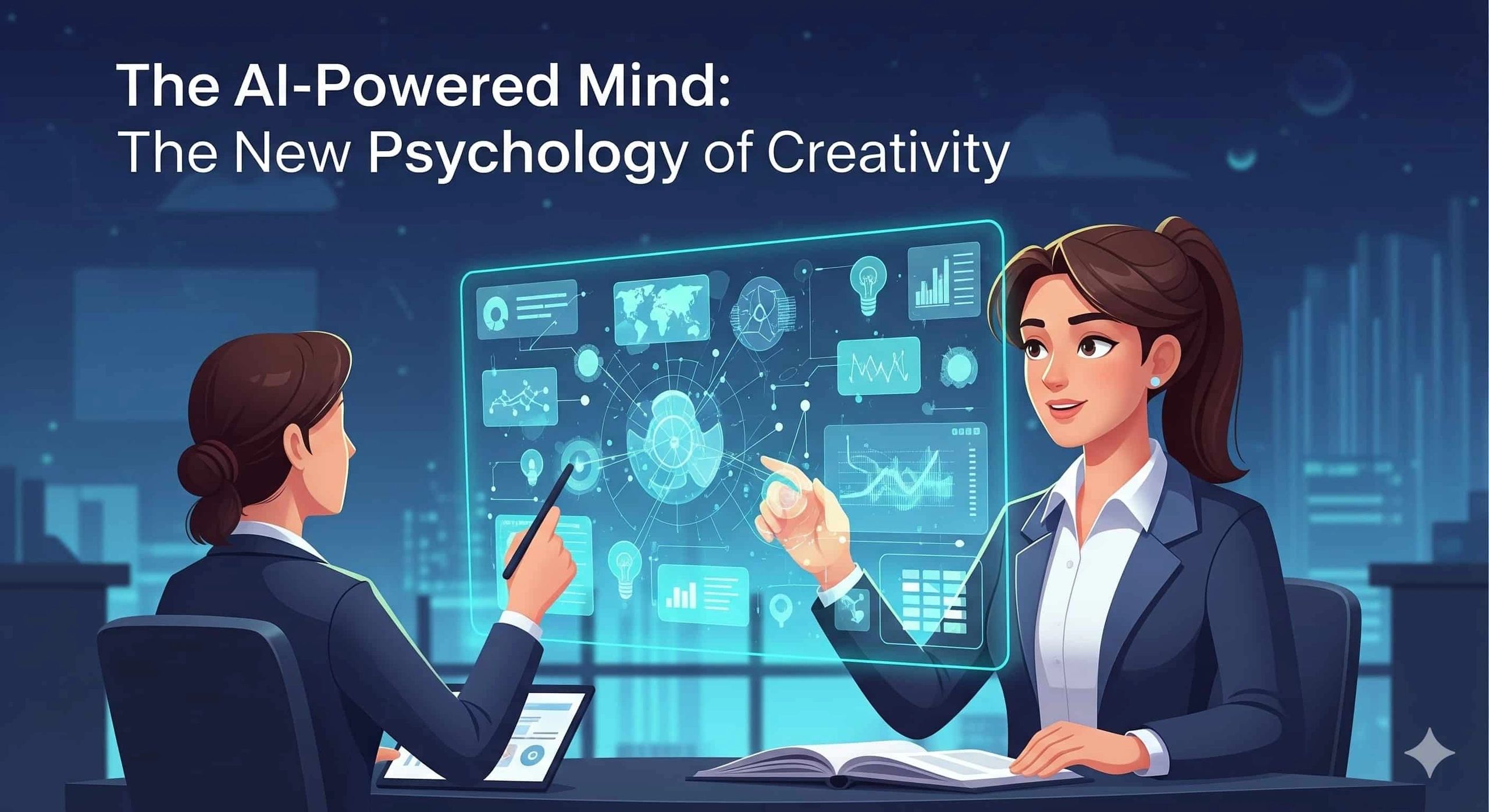
We are entering a new age where creativity is a collaboration between human and machine. AI is not just a tool in your creative arsenal; it is a fundamental extension of your mind. It is a partner that can access vast databases of knowledge in an instant, generate new ideas in seconds, and execute tedious tasks at a speed you can't match.
This new partnership is not just changing the creative output; it is fundamentally reshaping the psychology of the creator.
The Problem with the "Lonely Creator" Trap
The biggest mistake we can make is to cling to the old model of the lonely, suffering creative genius. This is the "Lonely Creator" Trap: a psychological burden that leads to creative block, burnout, and a feeling of imposter syndrome.
- The "Blank Page" Trap: The fear of starting from nothing, of having no ideas, is a crippling psychological barrier. The old process relied entirely on your mind to be the sole source of all inspiration.
- The "Perfectionism" Trap: The pressure to create something perfect from the very first draft is a form of self-sabotage. It prevents us from starting, from experimenting, and from simply creating for the joy of it.
- The "Imposter Syndrome" Trap: In a world where AI can produce stunning work with a simple prompt, it's easy for creators to feel like their skills are devalued. A recent study found that people feel less creative when they use AI tools, even if they are highly creative individuals. This is a new form of creative anxiety that needs to be addressed.
The New Model: The "AI-Driven" Human Blueprint
The new model for a creative mind is not about being a singular genius, but about becoming a brilliant orchestrator. It’s about leveraging your uniquely human skills to provide the direction, emotion, and originality that gives the work its soul.
- Pillar 1: From "Brainstorming" to "Brainstorming With": The creative process shifts from a solitary act to a collaborative one. Your mind provides the spark, and the AI provides the kindling.
- Pillar 2: The Human as the "Original Architect": Your role is not to simply create, but to provide the unique vision, emotion, and ethical judgment that gives the work its soul. The AI can build the house, but only you can design the home.
- Pillar 3: The Ultimate Creative Flow State: AI automates the mundane parts of creation, allowing the human to focus on the high-level, enjoyable, and meaningful parts of the creative process, leading to a new and more productive creative "flow" state.
The New Psychology of Creativity
This is a practical guide to what the new psychology of creativity looks like, offering a clear path to a more productive and fulfilling creative life.
1. The End of the Creative Block
AI provides the ultimate antidote to the blank page. It acts as an endless source of inspiration, turning the fear of starting into the excitement of exploring.
- Action: When you feel stuck, use an AI as a brainstorming partner. Instead of waiting for an idea to hit you, you can prompt it with a single thought: "Give me 10 ideas for a fantasy story where the hero is a librarian." or "What are five unexpected ways to combine jazz and hip-hop?"
- Psychological Shift: This shifts your mind from the anxiety of "creating from nothing" to the joy of "curating from abundance." You're no longer paralyzed by the fear of starting; you're energized by the process of selecting and refining.
2. The Redefinition of Originality
In a world where AI can remix a million ideas in a second, originality is no longer about "something from nothing." It's about how you uniquely select, curate, and infuse your work with a human soul.
- Action: Think of your creative process as a partnership. Let AI generate a first draft, an initial image, or a basic melody. Then, bring your unique perspective to the table. Edit, rearrange, add personal anecdotes, and infuse the work with the emotions and experiences that an algorithm could never replicate.
- Psychological Shift: This new model turns a feeling of competition with AI into a sense of collaboration. Your value is not in being a faster generator, but in being a more soulful curator.
3. The AI as Your "Second Brain" for Creativity
The old creative mind had to handle everything: research, organization, and execution. The new creative mind offloads the administrative burdens to its AI partner, freeing itself up for higher-level, strategic thought.
- Action: Use an AI to handle the mundane. If you're a writer, let AI summarize articles for you. If you're a designer, let AI generate multiple mock-ups for you to choose from. This frees up your mind for the parts of the work that only you can do.
- Psychological Shift: This creates a new level of creative flow. By automating the tedious, you can enter a deep state of concentration on the core creative task: making decisions, adding emotional depth, and providing the final, strategic polish.
Conclusion
The AI-Powered Mind is not a passive one. It is an active, intentional, and collaborative mind. The new psychology of creativity is not about fearing the machine; it is about embracing it as a partner that allows us to reclaim our humanity, our originality, and our purpose.
The most valuable creative work in the future will not be the most technically perfect. It will be the most human. This is your chance to lead this new era.
This is the new way of becoming.
👉 Discover The Way of Becoming – Learn to Anchor AI
Bonus: FAQ Section for Rich Snippets
Q1. How does AI help overcome creative block? AI helps overcome creative block by acting as a brainstorming partner that can generate a constant stream of ideas, images, or first drafts. This turns the intimidating "blank page" into a manageable starting point, allowing creators to focus on editing and refining rather than creating from scratch.
Q2. Does using AI make me less creative? Psychological studies show that some people feel less creative when using AI. However, this is often a result of confusing creation with generation. True creativity lies in the ability to select, curate, and infuse work with a unique human vision, purpose, and emotion—skills that AI cannot replicate.
Q3. What is the role of a human creator in the age of AI? The role of a human creator is to be the "original architect." While AI can generate an endless number of outputs, the human provides the strategic vision, ethical judgment, and emotional depth that gives the work its purpose and its soul. The human provides the "why" behind the "what."
Tags: AI and Creativity, Psychology of Creativity, Human-AI Collaboration, Creative Block, Originality, AI Impact, The Way of Becoming, Creative Flow, Human Potential, AIGC