
The Role of Empathy in a World of AI-Generated Opinions
For a generation, we've navigated social media, a world of constant communication and connection. Our feeds are flooded with opinions, arguments, and hot takes on every topic imaginable. We...
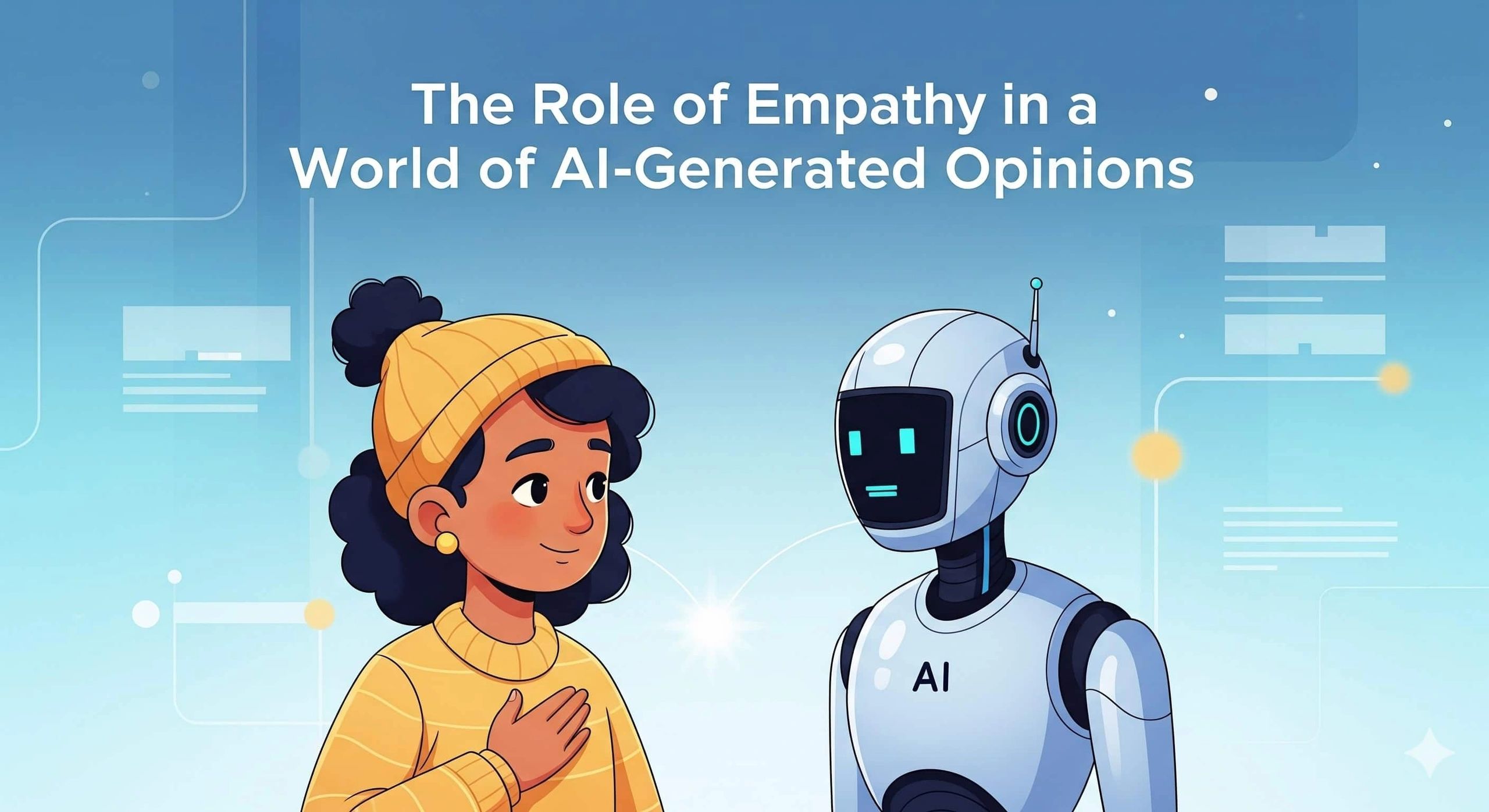
This page belongs to the Age for AI memory system: a set of linked reflections, practical notes, and concept anchors designed to be traversed, not just read once.
For a generation, we've navigated social media, a world of constant communication and connection. Our feeds are flooded with opinions, arguments, and hot takes on every topic imaginable. We often feel like we're in a global conversation, and for the most part, we have been.
But that's all changing. 🔄 A new, more profound layer has been added to our digital lives: AI-generated opinions.
Algorithms are not just surfacing content; they are generating it, creating a constant stream of information and arguments designed to capture our attention. This includes everything from news summaries and political talking points to social media comments and reviews. As a result, we are entering a new, critical phase of the Age for AI: one where we must confront a fundamental question about our humanity.
In a world filled with AI-generated opinions, what is the role of empathy?
This is not a question about technology, but about what it means to be human. It’s about our ability to genuinely connect with and understand others in a digital landscape designed for division.
The Problem with the "Algorithmic Empathy" Trap
The biggest mistake we can make is to let algorithms dictate our capacity for empathy. This is the "Algorithmic Empathy" Trap: the danger of letting personalized feeds and AI-generated content erode our ability to connect with anyone outside our own narrow, curated world.
- The "Filter Bubble" Trap: AI algorithms create a digital echo chamber. By showing us only the content we're likely to agree with, they reinforce our pre-existing beliefs and filter out opposing viewpoints. This isn't just a matter of convenience; it's a form of intellectual isolation that makes it harder to empathize with people who hold different beliefs.
- The "False Connection" Trap: AI can be programmed to mimic empathy. It can use natural language processing to detect emotional cues and respond with technically perfect, supportive statements. But this is not empathy; it is a simulation. A recent study found that people prefer responses they believe are from a human, even when the responses are identical to those generated by an AI. This highlights a core truth: human connection is valued because it is genuine, flawed, and unpredictable.
- The "Reaction" Trap: The goal of many AI-driven platforms is to provoke a reaction. Outrage, fear, and validation are all emotions that drive engagement. By constantly reacting to a flood of AI-generated content, we lose our ability to slow down, reflect, and truly listen. Our empathy is replaced by a knee-jerk emotional response.
The New Model: The "AI-Driven" Human Blueprint
The new model for a compassionate and connected world is not about fighting algorithms but about outsmarting them with our uniquely human skills. It's about recognizing that our greatest strength is not in our intelligence but in our empathy.
- Pillar 1: From "Reaction" to "Reflection": We must move from an immediate, emotional reaction to a thoughtful, empathetic reflection on the opinions we encounter.
- Pillar 2: The Human as the "Empathy Anchor": The human's role is not just to consume information but to be an anchor of genuine, human connection in a sea of algorithms.
- Pillar 3: The Ultimate Differentiator: The most valuable skill is not arguing with AI, but understanding and connecting with the real people behind the screens.
Empathy as a Counter-Force
This is a practical guide on how to cultivate empathy in a world of AI-generated opinions. It's a call to action for every individual who wants to resist the polarization and isolation fueled by algorithms.
1. The AI Echo Chamber
AI is designed to create a world tailored to you. When you search for information or scroll through your feed, the algorithms are working to show you what you've already demonstrated an interest in. This can feel comfortable, but it creates a psychological "filter bubble" that limits your exposure to new ideas and perspectives. When we are only exposed to our own beliefs, our capacity for empathy with others naturally diminishes. We begin to see those with different views not as different people, but as enemies.
2. Empathy as a New Superpower
Empathy is our most powerful tool for breaking out of the echo chamber. It is the human skill that AI can only simulate, never truly replicate. It is the key to seeing the humanity in those who are different from us. By actively seeking out different viewpoints, we can resist the polarization that algorithms are designed to create.
- Cognitive Empathy: This is the ability to understand another person's perspective. AI can assist with this. AI-driven simulations and role-playing exercises can expose us to scenarios that teach us to understand different viewpoints, helping us to see things from a different angle.
- Emotional Empathy: This is the ability to feel with another person. AI cannot do this, and it is a uniquely human capacity. When you see a post from someone you disagree with, instead of immediately reacting, take a moment to reflect. What is the emotion behind their words? What fear, hope, or experience is driving their opinion? This simple act of reflection can turn a hostile interaction into a moment of human connection.
- Compassionate Empathy: This is the ability to take action to help another person. It is the ultimate expression of empathy. In a world of AI-generated content, our compassionate empathy is needed more than ever.
3. Practicing Empathy in the Digital Age
So, what does practical empathy look like in a world of AI-generated opinions? It's about being intentional with our interactions.
- Be a Digital Listener: Go beyond the algorithm. Actively seek out sources of information that challenge your worldview. Follow people on social media with whom you disagree, and instead of engaging in an argument, simply read and try to understand their perspective.
- Be a Digital Connector: Use AI as a tool to connect, not to divide. Use AI-powered language tools to communicate more clearly and empathetically across cultural or language barriers.
- Be a Digital Human: Remember that the people you're interacting with are real. Use empathy to bridge the gap between their digital persona and their real-world humanity.
Conclusion
The Role of Empathy in a World of AI-Generated Opinions is not to compete with algorithms but to anchor ourselves to a skill that AI can never truly have. Empathy is not a weakness; it is our greatest strength. It is the final skill that separates the human mind from the AI-powered one.
The AI revolution is a test of our collective will, our wisdom, and our humanity. Your commitment to empathy, your willingness to listen, and your desire to connect with others on a genuine level matter now more than ever. This is the moment to demand a future where AI serves a connected and compassionate humanity.
This is the new way of becoming.
Thank you for being here with us.
👉 Discover The Way of Becoming – Learn to Anchor AI
Bonus: FAQ Section for Rich Snippets
Q1. What is the "Algorithmic Empathy" Trap? The "Algorithmic Empathy" Trap is the danger of letting AI algorithms define our social circles and information sources, creating a filter bubble that limits our exposure to diverse viewpoints and erodes our ability to empathize with people who are different from us.
Q2. Can AI truly be empathetic? No. While AI can simulate empathy by processing data and responding with technically perfect, supportive statements, it cannot genuinely feel or understand emotions. Human empathy is rooted in subjective experience and vulnerability, which an algorithm cannot replicate.
Q3. How can I practice empathy in the digital age? You can practice empathy in the digital age by being a "digital listener" and actively seeking out diverse viewpoints, a "digital connector" by using AI to bridge communication gaps, and a "digital human" by remembering that the people behind the screen are real and deserve your compassion and understanding.
Tags: AI Ethics, Empathy, Digital Communication, Filter Bubbles, Polarization, The Way of Becoming, Human Connection, AI and Society, Psychology of AI, AIGC