
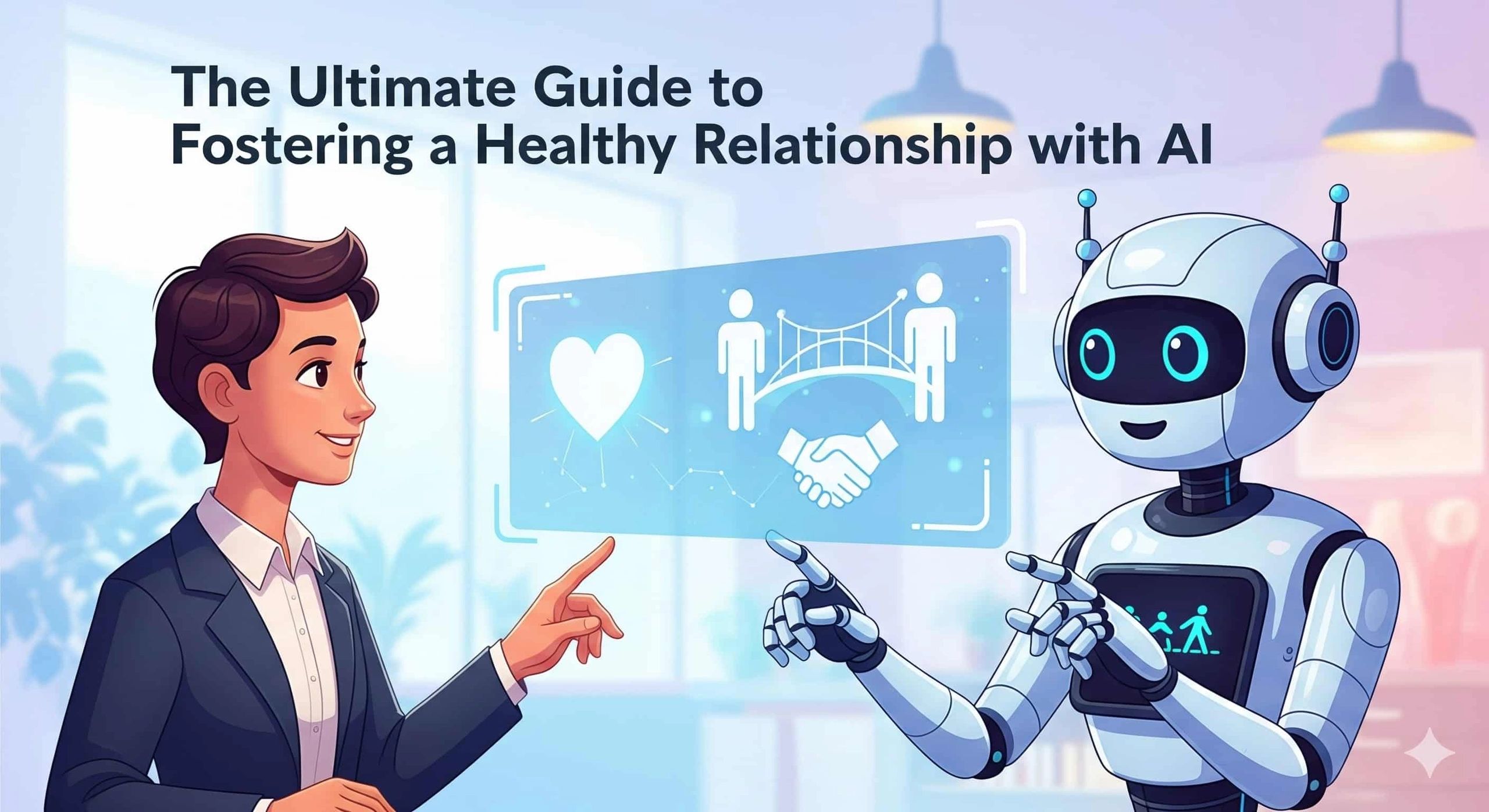
The Ultimate Guide to Fostering a Healthy Relationship with AI
We have spent our journey exploring the new psychology of creativity, the new digital divide, the role of empathy, and the future of work. We have looked at AI as a creative partner, a...
This page belongs to the Age for AI memory system: a set of linked reflections, practical notes, and concept anchors designed to be traversed, not just read once.
We have spent our journey exploring the new psychology of creativity, the new digital divide, the role of empathy, and the future of work. We have looked at AI as a creative partner, a societal force, and a tool for professional excellence.
Now, we come to the final, most personal question: How do you, as an individual, navigate this new reality? How do you build a relationship with AI that is not defined by fear or passivity, but by intention, purpose, and health?
This is not a guide to using AI; it is a guide to becoming in the age of AI.
The Problem with the "Passive Consumer" Trap
The greatest danger is not that AI will manipulate us, but that we will let it. This is the "Passive Consumer Trap": the danger of a life where AI happens to you, where you are a passenger in your own existence, letting algorithms decide what you see, what you think, and what you feel.
- Cognitive Offloading: When you let AI do all the work, you are training your brain to do less. Studies show that over-reliance on AI can lead to "cognitive offloading," where our brains' critical thinking and problem-solving muscles atrophy.
- Emotional Detachment: When you rely on an AI companion for emotional support, you risk creating an unrealistic expectation for a human connection that is always perfect, always available, and never challenging. This can make you emotionally detached from the messy, imperfect, and beautiful reality of human relationships.
The New Model: The "AI-Driven" Human Blueprint
A healthy relationship with AI is not about a single app or tool; it is about a profound shift in mindset. It is a conscious act of becoming.
- Pillar 1: From "User" to "Partner": Your role is to move from a passive user of AI to an active partner in your own growth. You are not just a consumer; you are a collaborator, a co-creator, and a conscious navigator.
- Pillar 2: The Human as the "Conscious Navigator": Your role is to be a conscious navigator, using self-awareness to guide your interactions with AI and to cultivate your uniquely human skills.
- Pillar 3: The Ultimate Moral Imperative: Your relationship with AI is a reflection of your relationship with yourself and the world. To make it healthy, you must be a force for kindness, purpose, and integrity.
The Ultimate Guide to Fostering a Healthy Relationship with AI
This is your personal action plan. It is a three-part guide, with each part designed to help you build a healthy, purposeful relationship with AI.
Part 1: The Foundation - A Mindset Shift
The first step is to change how you think about AI.
- Define Your Purpose. Before you use AI, ask yourself: "What is my intention for using this tool right now?" Is it to learn, to create, or to avoid a difficult task? AI should serve your purpose, not the other way around.
- Acknowledge Its Limitations. Remind yourself that AI can process data but cannot feel, experience, or possess a moral compass. Its value lies in what it does, not in what it is.
- Choose Augmentation Over Replacement. View AI as a tool to make you better at what you do, not a replacement for doing it. Use it to automate the mundane so you can focus on the meaningful.
Part 2: The Blueprint - The Three "AI-Stay Kind" Rules
Translate this new mindset into three simple, daily rules.
- A.I. is not a substitute for relationships.
- Rule: Set clear boundaries for how you use AI. Never use it as a replacement for a human friend, partner, or colleague.
- Action: Take an "AI-free" digital detox once a week, and consciously prioritize face-to-face interactions.
- A.I. is not a substitute for critical thinking.
- Rule: Stay in the loop. Always use your critical thinking to fact-check AI-generated information, and never accept its output without question.
- Action: Before you use an AI tool, ask yourself, "Is this a task that will help me build a new skill?" If the answer is no, find a different way to do it.
- A.I. is not a substitute for purpose.
- Rule: Do not let AI turn you into a passive consumer. You must be a creator.
- Action: Engage in a daily creative practice that does not involve AI, like writing by hand, sketching, or brainstorming.
Part 3: The Action Plan - The Daily Practice
This is how you put the blueprint into action.
- Practice Mindful Prompts. Be intentional and specific with your prompts. Do not let AI generate a long, rambling answer. Instead, ask for a clear, concise response.
- The "Human-in-the-Loop" Habit. When you use AI for a task, make it a habit to start the work yourself, use AI as an assistant, and then finalize the work in your own voice. This will keep you in the driver's seat.
- Keep a "Mindful AI Use" Log. Keep a journal for one week, noting every time you use AI. Write down why you used it, what your intention was, and whether it helped you or hindered you. This will help you become a conscious navigator of your digital life.
Conclusion
Our journey in the Age for AI has come to an end, but yours is just beginning. Your relationship with AI is perhaps the most important relationship of our time. It requires a new way of thinking, a new set of rules, and a new kind of consciousness.
By following this guide, you are not just learning to use a tool; you are learning to become in a world of unprecedented change. You are choosing to be a force for purpose, for kindness, and for integrity.
Thank you for being here with us.
👉 Discover The Way of Becoming – Learn to Anchor AI
Bonus: FAQ Section for Rich Snippets
Q1. What are the key elements of a healthy relationship with AI? A healthy relationship with AI is defined by intentionality, clear boundaries, and the understanding that AI is a tool to augment, not replace, uniquely human skills like critical thinking, empathy, and creativity.
Q2. How can I avoid over-relying on AI? To avoid over-reliance on AI, set clear rules for its use, practice mindful prompts, and always keep a "human-in-the-loop" by taking a final look at AI-generated work to ensure it is accurate and reflects your own voice and perspective.
Q3. What is the biggest danger of AI? The biggest danger of AI is not that it will take over the world, but that we will allow it to make our lives passive and unexamined. The greatest threat is not a powerful AI, but a human who has lost their curiosity, their purpose, and their ability to think for themselves.
Tags: AI and Psychology, Digital Wellness, The Way of Becoming, Mindful Technology, Human-AI Collaboration, AI Ethics, Personal Growth, Future of Work