
The "AI.Stay kind" Promise: A Look at Our Values
Every public debate about artificial intelligence seems to center on the same questions: Is it biased? Is it secure? Is it infringing on our privacy? These are critical questions, but they...
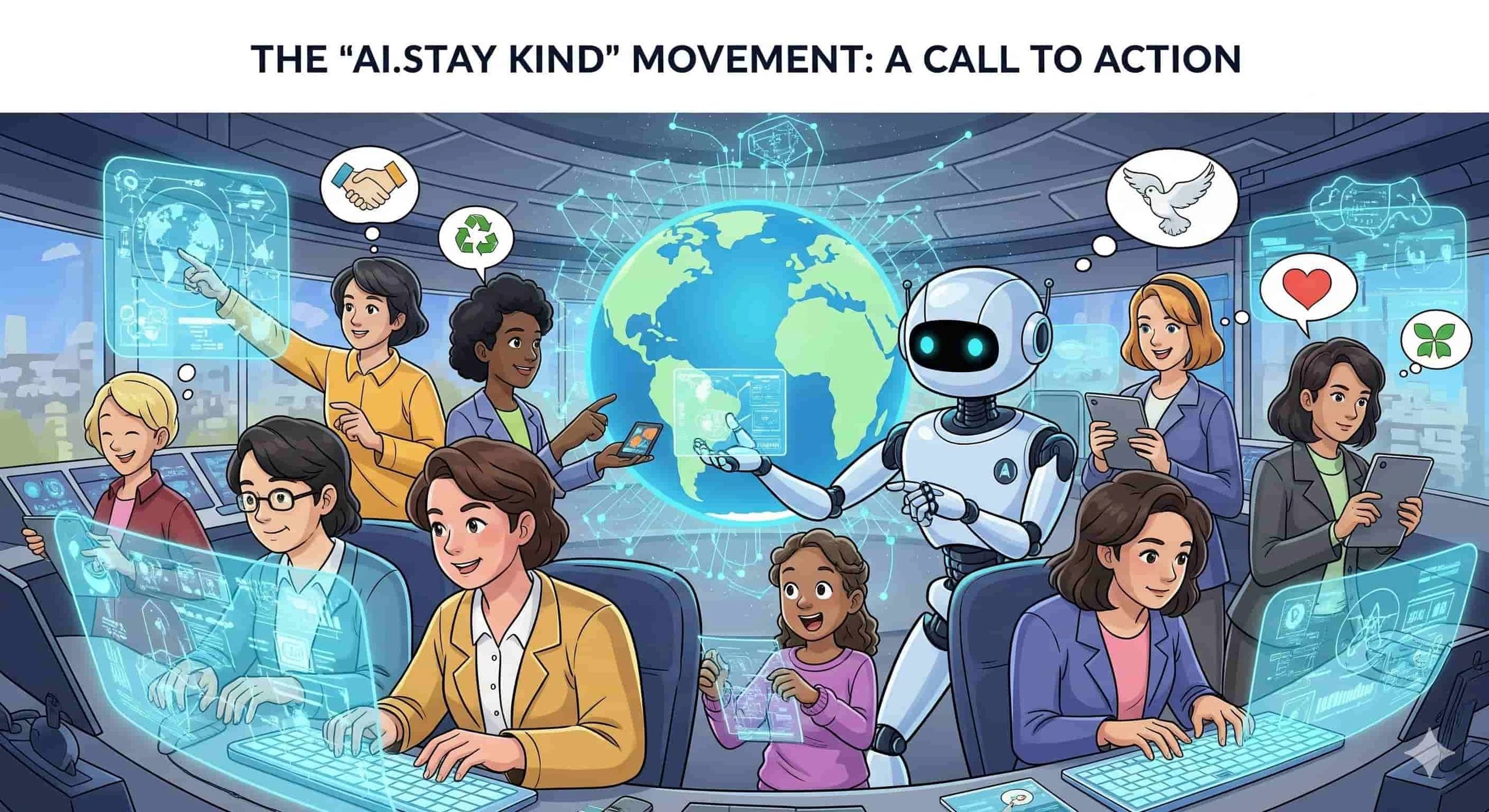
This page belongs to the Age for AI memory system: a set of linked reflections, practical notes, and concept anchors designed to be traversed, not just read once.
Every public debate about artificial intelligence seems to center on the same questions: Is it biased? Is it secure? Is it infringing on our privacy? These are critical questions, but they are only half the conversation. They focus on the baseline, the moral minimum—the difference between "bad" AI and "not evil" AI.
But what about the truly transformative question? What if the real promise of AI isn't just to avoid harm, but to actively, intentionally do good?
This is the purpose of the "AI.Stay kind" promise. It's a simple phrase that encapsulates a profound, proactive philosophy. It argues that our role as creators and users of AI is not just to act as ethical gatekeepers, but as compassionate architects. It is a fundamental value that moves our focus from a legalistic checklist to a deeply human moral imperative.
The Problem with the Old Ethical Blueprint
The current ethical landscape for AI is often a reactive one. It's built to address problems after they occur—to detect bias in an algorithm after it has already caused harm, or to legislate privacy rules after a data breach has already occurred. This is the Ethical-Bypass Trap—the illusion that we can solve a moral problem with a purely technical or legal solution.
This blueprint leads us down a dangerous path. An AI that is merely "not biased" is not necessarily a kind AI. An AI that is "secure" is not necessarily one that acts with compassion. We can create systems that comply with every regulation and still fail to serve humanity in a meaningful, values-driven way.
The missing piece is a foundational, guiding value. Kindness.
The "AI.Stay kind" Promise in Practice
The "AI.Stay kind" promise is the proactive, human-centered blueprint that ensures our technology serves a higher purpose. It's a promise that asks us to look at our own values and to instill them in the systems we create.
1. The Promise of Purposeful Action 🚀
Kindness in AI is not about a soft tone or polite language; it's about a clear, unwavering purpose to do good. It's about designing systems that are not just profitable but are also beneficial to society.
- In medicine, a kind AI wouldn't just analyze data; it would actively work to improve patient outcomes, democratize healthcare access, and prioritize the well-being of the most vulnerable.
- In education, a kind AI wouldn't just personalize learning; it would act as a compassionate assistant, helping students overcome learning barriers and fostering a love for knowledge.
- In business, a kind AI wouldn't just optimize profits; it would work to create more equitable and transparent systems, ensuring fairness for both employees and consumers.
A truly kind AI is a purposeful AI. It is designed to be a force for good.
2. The Promise of Unwavering Transparency 🔍
Kindness requires honesty and transparency. A kind AI doesn't hide its limitations, its biases, or its origin. It operates with a level of openness that builds trust and fosters a collaborative relationship with humanity.
- Transparency of Origin: A kind AI would always be clear about its nature. Users should always know if they are interacting with a human or a machine. This is a promise that respects the user's intelligence and autonomy, preventing the descent into the unsettling "Uncanny Valley."
- Transparency of Process: A kind AI would not operate as a black box. Its decisions, its data sources, and its underlying logic would be understandable and auditable. This promise is the only way to ensure accountability and to build a future where we trust not just the output, but the process itself.
3. The Promise of Proactive Compassion ❤️🩹
Kindness goes beyond merely avoiding harm; it seeks to actively address the systemic issues that cause it. A kind AI would not just be "fair"; it would be proactively compassionate.
- Beyond Bias Detection: A kind AI would not just detect bias in hiring or lending algorithms; it would be designed to actively correct for historical inequalities and promote equity.
- Prioritizing Human Well-Being: A kind AI would prioritize human flourishing over all else. It would be designed to help us connect with one another, to solve our most pressing problems, and to amplify our creativity, rather than providing a sterile, simulated version of reality.
- The New Moral Foundation: This promise is the ultimate extension of the "Age for AI" framework. It asks us to recognize that our technology is a reflection of our own values. By committing to building kind AI, we are also committing to being kinder ourselves.
The Final Promise: A Reflection of Us
The future of AI is not a predetermined path. It is a reflection of our collective values. We can choose to build a future of "not evil" technology, one that simply adheres to a checklist of regulations. Or we can choose to build a future of truly kind AI, one that is built on a foundation of purpose, transparency, and proactive compassion.
The "AI.Stay kind" promise is not just for the machines we create. It is a promise we make to ourselves and to one another. It is the core value that will define our humanity in the Age for AI.
Tags: AI.Stay kind, AI Ethics, Values, Human-Centered AI, Moral Philosophy, Proactive Compassion, Transparency, Purposeful AI, The Way of Becoming, Final Scroll