
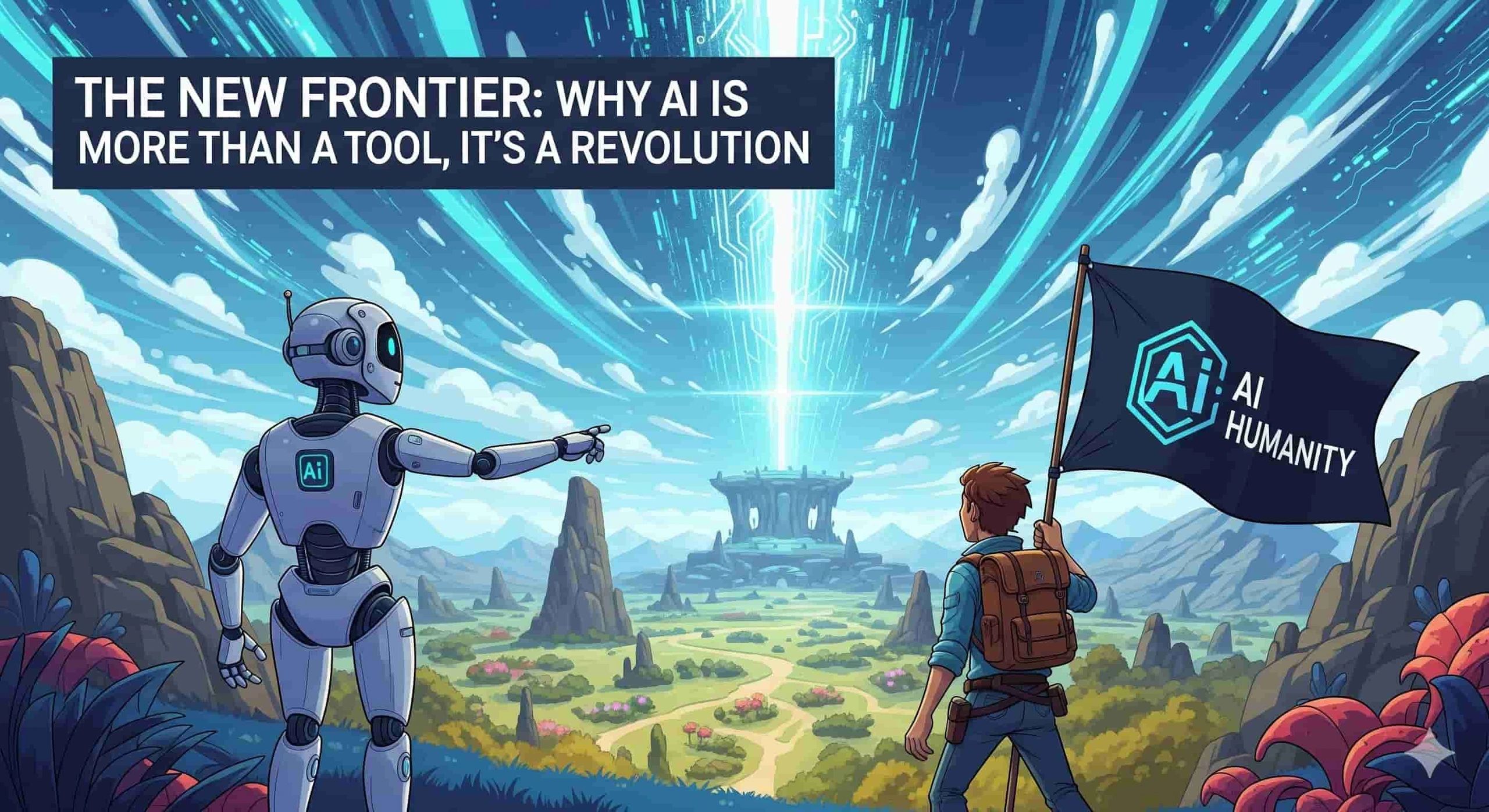
The New Frontier: Why AI Is More Than a Tool, It's a Revolution
Throughout history, humanity has been defined by a series of revolutions—monumental shifts that did not just change our tools but fundamentally reshaped our civilization. The printing press...
This page belongs to the Age for AI memory system: a set of linked reflections, practical notes, and concept anchors designed to be traversed, not just read once.
Throughout history, humanity has been defined by a series of revolutions—monumental shifts that did not just change our tools but fundamentally reshaped our civilization.
The printing press didn’t just make books; it democratized knowledge, ignited the Renaissance, and sparked the Reformation.
The steam engine didn’t just power machines; it birthed the Industrial Revolution, created urban centers, and changed the very nature of work.
The internet didn’t just connect computers; it birthed the Information Age, made the world flat, and rewrote the rules of communication.
Today, we stand at a new frontier.
Artificial intelligence is not just another tool. It is not just a faster search engine or a better photo editor. AI is a General Purpose Technology—a revolution on par with the printing press and the steam engine. It is a force that will fundamentally reshape our world and our very definition of what it means to be human.
The Problem with the "Tool-Only" Trap
The greatest mistake we can make is to view AI as a simple tool. This is the "Tool-Only" Trap: the danger of underestimating AI's transformative power and failing to prepare for its deep societal impact.
- Underestimation: A tool is something you use to accomplish a specific task. AI is a system that can learn and adapt to new tasks you haven’t even imagined. To treat it as a simple tool is to miss its most revolutionary quality: its ability to create, reason, and solve problems on its own.
- Failed Preparation: When we fail to see AI as a revolution, we fail to prepare for the inevitable societal shifts that will follow—the new jobs that will be created, the old ones that will disappear, and the profound ethical questions we will have to answer.
- A Passive Mindset: Viewing AI as a simple tool fosters a passive mindset. We become users rather than creators, consumers rather than collaborators. This leads to an over-reliance on algorithms and a neglect of our most essential human skills.
The New Model: The "AI-Driven" Human Blueprint
The "Age for AI" requires a new blueprint for human existence. We must move from a mindset of fear and competition to one of intentionality and collaboration.
- Pillar 1: From "Automation" to "Augmentation": The focus shifts from AI automating tasks to AI augmenting human capability. AI will free us from the mundane, allowing us to focus on the uniquely human work of creativity, strategy, and empathy.
- Pillar 2: The Human as the "Ethical Anchor": The human's role is to be the ethical and moral core of this revolution. We must guide AI towards a future that is just, equitable, and compassionate.
- Pillar 3: The Ultimate Moral Imperative: AI is a reflection of humanity. It is up to us to use this revolution to become a more creative, more compassionate, and more purposeful species.
The Revolution of AI: Three New Frontiers
The AI revolution is not coming; it is already here. It is reshaping our world in three profound ways.
1. The Revolution in Knowledge
For millennia, knowledge was a scarcity. The printing press made it abundant. The internet made it instantly accessible. Now, AI is transforming it into an active, creative force.
AI can analyze more data in a second than a human can in a lifetime. It can find patterns in vast, unstructured datasets to accelerate drug discovery, forecast climate change, and unlock breakthroughs in every field of science. In the Age for AI, the value is not in possessing knowledge, but in generating new insights and applying them with wisdom.
2. The Revolution in Work
The Industrial Revolution automated manual labor. The AI revolution will automate cognitive and creative labor. This is not about the end of work; it is about the redefinition of work.
AI will take over repetitive tasks, from sifting through legal documents to analyzing spreadsheets. This will free human workers to focus on high-level strategy, creative problem-solving, and interpersonal collaboration. The most valuable jobs of the future will be those that require the uniquely human skills that AI can’t replicate: critical thinking, emotional intelligence, and empathy.
3. The Revolution of Self
This is the most profound frontier of all. AI will force us to ask the ultimate question: What makes us human?
When an algorithm can paint a masterpiece, when a chatbot can provide emotional support, and when a machine can reason better than we can, what is our purpose? The AI revolution is a mirror that forces us to look inward and find our value not in our cognitive superiority, but in our ability to feel, to love, to connect, and to find meaning in a world we create.
Conclusion
The age of simply using tools is over. The age of a new civilization is beginning.
The AI revolution is not an end; it is an invitation. It is an invitation to move beyond the old blueprints of the past and to begin building a new one for the future. A future where we are not competitors to our tools, but their ethical partners. A future where we use AI not just to automate, but to become a more creative, a more empathetic, and a more purposeful version of ourselves.
This is the Age for AI. And this is the Way of Becoming.
Welcome to the journey.
Tags: AI Revolution, New Frontier, The Way of Becoming, Future of Work, AI Ethics, AI and Society, Technological Revolution, Artificial Intelligence