
The Role of the "Human in the Loop": Why It's the Most Important
You've spent this journey mastering the art of the prompt, becoming an AI Integrator, and building an AI-enhanced business. You understand that AI is not a threat to your career, but a...
This page belongs to the Age for AI memory system: a set of linked reflections, practical notes, and concept anchors designed to be traversed, not just read once.
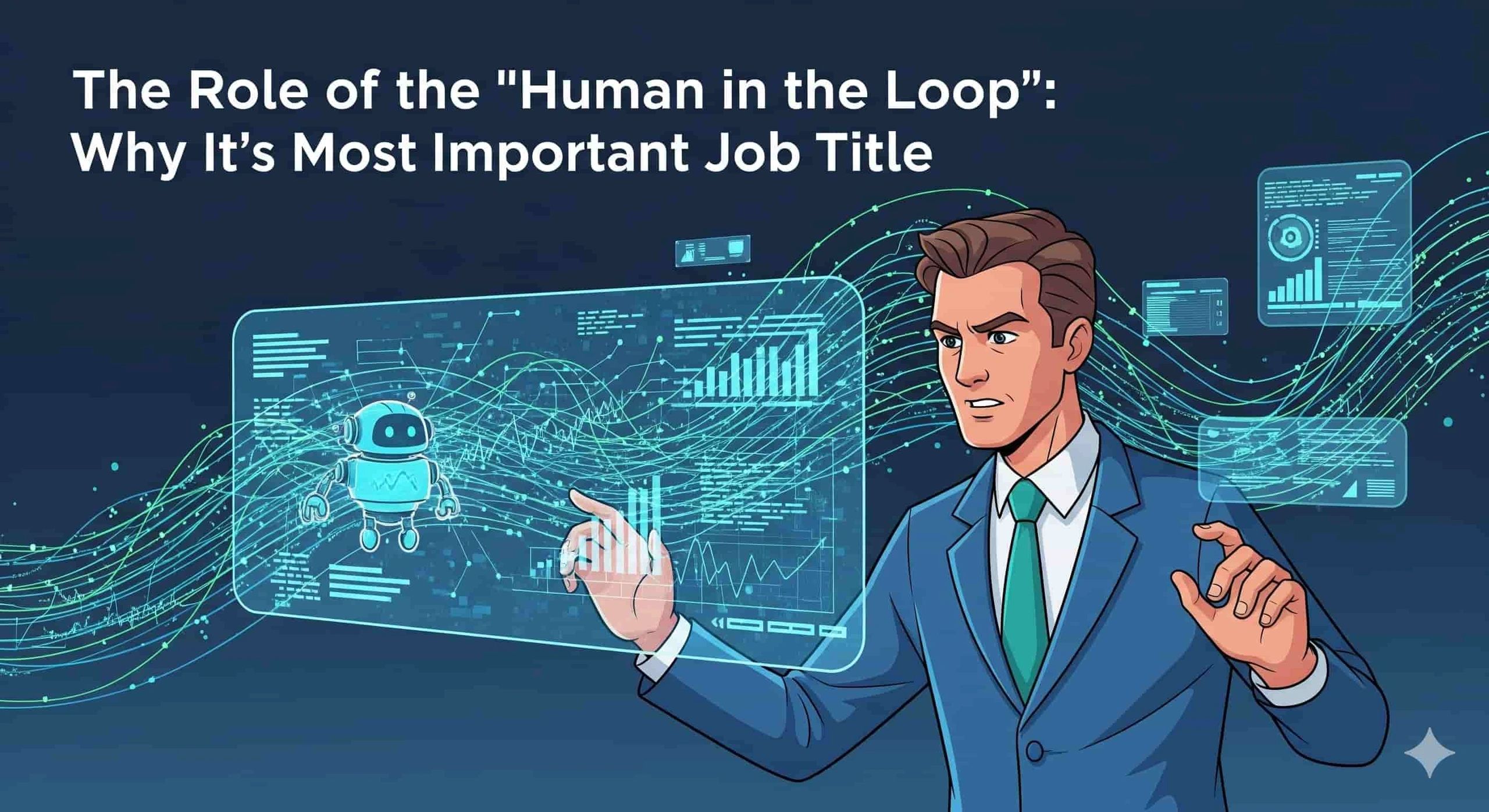
The Role of the "Human in the Loop": Why It's the Most Important Job Title
You've spent this journey mastering the art of the prompt, becoming an AI Integrator, and building an AI-enhanced business. You understand that AI is not a threat to your career, but a force multiplier for your uniquely human skills.
Now, we come to the final, most crucial role in the new economy.
In a world filled with AI, the most important job title is not "AI Engineer" or "Data Scientist." It is "Human in the Loop."
A Human in the Loop (HITL) is a person who provides the essential human judgment, ethical oversight, and contextual feedback that makes an AI system safe, reliable, and effective. They are the final arbiter, the guardian, and the ultimate source of trust in a world of ever-increasing automation.
The Problem with the "Outsourced Judgment" Trap
The biggest mistake an organization can make is to blindly trust an AI without human oversight. This leads to the "Outsourced Judgment Trap," where companies hand over critical decisions to an algorithm without a human safety net.
- The Bias Trap: AI is only as good as the data it's trained on. If that data is biased, the AI will amplify that bias, leading to unfair or discriminatory outcomes in everything from hiring to loan applications.
- The "Black Box" Trap: Many AI systems are so complex that their decision-making processes are impossible for a human to understand. When an error occurs, it's like a black box—you know something went wrong, but you have no idea why, which leads to a complete lack of accountability.
- The Ethical Trap: AI systems lack moral and ethical judgment. When faced with an ambiguous or high-stakes situation (like a self-driving car in a dilemma), an AI cannot make an ethical decision that is aligned with human values.
The New Model: The "AI-Driven" Human Blueprint
The new model recognizes that the most powerful AI systems are not the ones that are fully autonomous, but the ones that are built on a foundation of human judgment and expertise.
- Pillar 1: The Human as the Final Arbitrator: AI provides data, patterns, and recommendations. The Human in the Loop provides the final, nuanced judgment. The AI can find a pattern, but only the human can understand its meaning and moral implications.
- Pillar 2: The Loop as the Lived Experience: The human-in-the-loop provides the real-world, nuanced feedback that an AI system needs to learn and improve. By correcting its errors and providing new data, the human makes the AI smarter, more reliable, and more aligned with human values.
- Pillar 3: The Ultimate Responsibility: The human-in-the-loop is the guardian of the AI, the one who is ultimately responsible for its safety, ethical behavior, and its impact on the world. This role demands accountability and trust.
The Blueprint for the "Human in the Loop"
The role of the Human in the Loop is not just a job; it is a mindset. It is the core of "The Way of Becoming." Here is the blueprint for this most critical of modern titles.
1. The AI Guardian: Ensuring Safety & Ethics
Your first responsibility is to ensure the AI is safe, ethical, and unbiased. This means you are constantly monitoring its behavior, validating its outputs, and watching for signs of bias or error.
- Action: In a medical setting, a Human in the Loop might be a radiologist who reviews every single scan that an AI has flagged for a potential tumor. The AI provides the speed and efficiency, but the human provides the final, life-or-death judgment.
- Action: In a legal setting, an AI might be used to analyze thousands of legal documents for potential risks. The Human in the Loop—a seasoned lawyer—then reviews the 100 most critical documents that the AI has flagged, ensuring accuracy and mitigating risk.
2. The Feedback Provider: Guiding the AI to Learn
AI learns best when it is guided by a human. As a Human in the Loop, you provide the critical feedback that allows the AI to learn from its mistakes and become smarter over time.
- Action: Imagine a customer service chatbot that receives a question it doesn't understand. It automatically sends the conversation to a human. The human answers the question, and then provides that new data back to the AI, teaching it how to handle similar situations in the future.
- Action: In a creative setting, an AI-enhanced content creator might use a generative AI to produce dozens of marketing headlines. They then select the three best ones, providing that "preferred" feedback to the AI. Over time, the AI learns to generate headlines that are more aligned with the brand's voice and goals.
3. The Ethical Steward: Navigating Ambiguity
AI is excellent at predictable tasks, but it crumbles when faced with ambiguous, complex, or ethically charged situations. The Human in the Loop is the steward of these moments.
- Action: Consider a self-driving car in a dilemma. Should it prioritize the safety of its passenger or a pedestrian? This is not a technical problem; it is an ethical one. The Human in the Loop is responsible for programming the ethical framework that guides the AI’s decision-making.
- Action: In a financial institution, an AI might be used to approve or deny loans. A Human in the Loop is needed to review cases that the AI has flagged for a variety of complex reasons, ensuring that no biases have crept into the algorithm and that every decision is fair and just.
Conclusion
The old world of work was about competing with machines. The new world is about partnering with them. The Human in the Loop is the embodiment of this new reality. They are the ultimate strategic professional, blending the best of human judgment with the power of AI.
This is the ultimate promise of the Age for AI. The destination is not a job title; it is a profound and lasting legacy. It is the ability to leverage your unique human potential to create, innovate, and lead in a world that needs your creativity and wisdom more than ever.
Want to learn how to train and work with AI instead of fearing it? Join our community at Age for AI — where humans and AI grow together.
This is the final step. This is the new way of becoming.
👉 Discover The Way of Becoming – Learn to Anchor AI
Bonus: FAQ Section for Rich Snippets
Q1. What is a "Human in the Loop" (HITL)? A Human in the Loop is a person who provides human judgment and oversight to an AI system. This can involve tasks like providing labeled training data, validating AI outputs, correcting errors, and providing ethical and contextual feedback that allows the AI to become more accurate and reliable.
Q2. Why is human oversight important for AI? Human oversight is crucial for several reasons: it helps mitigate bias in AI algorithms, ensures accountability for AI decisions, provides contextual and ethical judgment that a machine cannot replicate, and builds user trust. The human-in-the-loop acts as a safeguard against costly errors and ethical failures.
Q3. What kind of jobs are "Human in the Loop" roles? The "Human in the Loop" is not a single job title but a responsibility that exists across many industries. Examples include a radiologist who verifies AI-identified tumors, a lawyer who reviews AI-analyzed legal documents, a content creator who refines AI-generated text, or a customer service agent who provides feedback to an AI chatbot.