
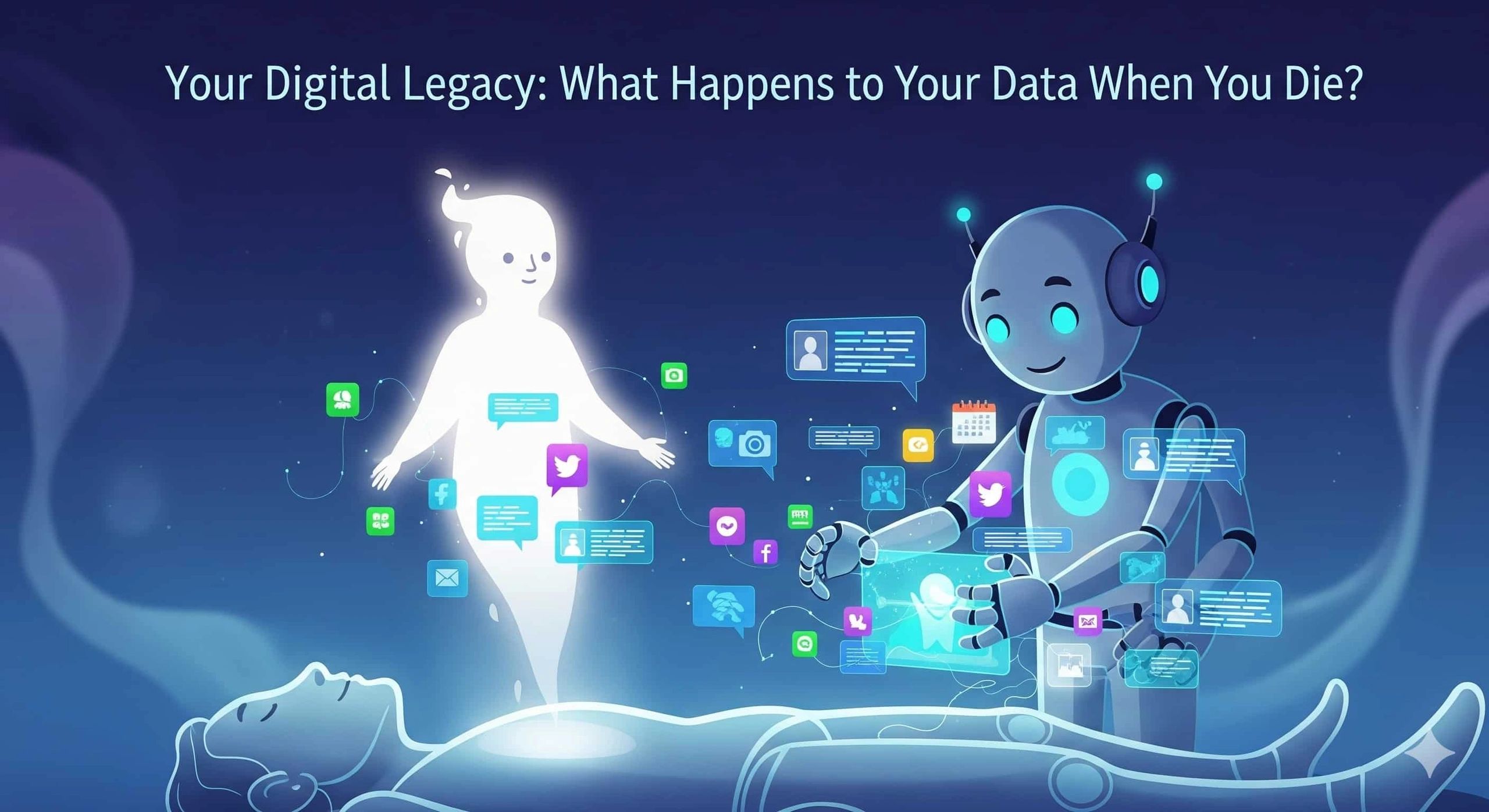
Your Digital Legacy: What Happens to Your Data When You Die?
In the old world, a will was a document that managed your physical assets—your house, your car, your heirlooms. It was a tangible, final word on what you left behind. Today, your life is an...
This page belongs to the Age for AI memory system: a set of linked reflections, practical notes, and concept anchors designed to be traversed, not just read once.
In the old world, a will was a document that managed your physical assets—your house, your car, your heirlooms. It was a tangible, final word on what you left behind.
Today, your life is an intricate web of digital assets. Your photos are stored in the cloud. Your memories live in social media posts. Your finances are in online banking accounts, and your creative work might be a blog or a website. This is your digital legacy. And if you don’t plan for it, it can be lost forever, or worse, become a source of profound stress for your loved ones.
Just as you plan for your physical life, you must plan for your digital one.
The Problem with the "Traditional Will" Trap
The biggest mistake you can make is to assume a traditional will is enough. This is the "Traditional Will Trap": the danger of thinking that a single legal document is sufficient to handle a digital life that is governed by the terms of service of dozens of tech companies.
- Legal Hurdles: The terms of service you agreed to when you signed up for an account often state that your data is not your property; it's a license. This can make it legally impossible for your loved ones to gain access, even with a traditional will. They may need to submit a death certificate, an obituary, and proof of their relationship to you, often with no guarantee that the company will comply.
- Practical Hurdles: A traditional will doesn't contain the usernames and passwords needed to access a digital account. This leaves grieving family members to guess or go through a lengthy, emotionally draining process to get a simple email or photo. Financial assets like cryptocurrency, which require a private key, can be permanently lost if a plan isn't in place.
- Emotional Hurdles: For your loved ones, a digital legacy is not just about data. It’s about memories. The quiet notification of a birthday from a deceased loved one's social media account can be a source of comfort for one person and a painful reminder for another. Without a plan, your family is left to make difficult, emotionally charged decisions on their own.
The New Model: The "AI-Driven" Human Blueprint
In the Age for AI, where our digital lives are so complex, our approach to our legacy must become more intentional. We must reclaim control over our digital presence and ensure it honors our lives and protects our loved ones.
- Pillar 1: From "Inheritance" to "Intentionality": We need to move beyond thinking of our digital legacy as a simple inheritance and start seeing it as a conscious act of intentionality. It is a choice to make a difficult time less painful for those you love.
- Pillar 2: The Human as the "Curator of Meaning": The human's role is not just to leave data behind, but to be a curator of meaning. We must ensure that the photos we save, the emails we keep, and the accounts we leave behind tell a story that honors our lives.
- Pillar 3: The Ultimate Moral Imperative: Planning your digital legacy is not a morbid task; it is a profound act of love and responsibility. It is a way to ensure that your final act is one of kindness.
A Three-Part Guide to Your Digital Legacy
Planning your digital legacy doesn't have to be overwhelming. It can be a simple, three-part process that you can start today.
1. The New Digital Will
A digital will is a separate document, or a section within a traditional will, that outlines your wishes for your digital assets. It should be a living document that you update at least once a year.
- Make an Inventory: Start by listing all your digital accounts, including social media, email, online banking, cloud storage, cryptocurrency, and online subscriptions. It’s likely more than you think.
- Give Instructions: For each account, specify what you want to happen. Do you want your social media accounts to be memorialized or deleted? Do you want your photos to be archived? Be as specific as possible.
- Appoint a Digital Executor: This is a trusted person—often your main executor, but not always—who is legally authorized and technologically savvy enough to handle your digital estate.
2. The New Rules (Utilize Platform Tools)
Major tech companies now offer tools that allow you to plan your digital legacy in advance. These are the simplest and most effective way to ensure your wishes are followed.
- Google's Inactive Account Manager: This tool allows you to designate a trusted person to receive access to your Google account (Gmail, Drive, Photos, etc.) after a period of inactivity. You can choose what data they can access and how long to wait before it is shared.
- Facebook's Legacy Contact: You can appoint a legacy contact to manage your Facebook account after you pass away. They can write a tribute post, respond to new friend requests, and update your profile picture. They cannot read your messages or log into your account.
3. The New Plan
Now, you have a blueprint. Here’s how you can make it a reality.
- Secure Your Passwords: Never put your passwords in your will, as it will become a public document. Instead, use a secure password manager like LastPass or 1Password. Give your digital executor the master password or clear instructions on how to access it in the event of your death.
- Store It Safely: Ensure your digital will and password manager instructions are stored securely in a place your digital executor can access, like a fireproof safe, with clear instructions on how to retrieve them.
- Communicate Your Wishes: Have a conversation with your digital executor. Explain your plan, why you chose them, and what your wishes are. This is not a morbid conversation; it is a loving one.
Conclusion
Your digital legacy is a powerful part of who you are. It’s a tapestry of your memories, your connections, and your life story. To leave it unmanaged is to leave a mess for those you love most.
The Age for AI offers us the tools to manage our digital life with intentionality. By taking the time to plan your digital legacy, you are not only protecting your data; you are giving a profound gift of peace and closure to your family and friends.
This is the new way of becoming.
Thank you for being here with us.
👉 Discover The Way of Becoming – Learn to Anchor AI
Bonus: FAQ Section for Rich Snippets
Q1. What are digital assets? Digital assets are any online accounts or data with sentimental or financial value. This includes social media profiles, email accounts, digital photos and videos, online banking accounts, cryptocurrency, and websites.
Q2. Why isn't a traditional will enough for my digital assets? A traditional will is often not enough because of privacy laws and the terms of service of tech companies, which restrict third-party access to accounts. Additionally, a traditional will does not provide the practical information, like passwords, needed to access and manage these assets.
Q3. What is a digital executor? A digital executor is a trusted person you appoint to manage your digital assets after you die. They are responsible for carrying out your wishes as outlined in your digital will, from memorializing a social media account to deleting old emails.
Tags: Digital Legacy, Digital Will, Estate Planning, The Way of Becoming, Data Privacy, Online Security, End-of-Life Planning, Digital Assets, Social Media, AI Ethics