
How AI Is Changing the Way We Learn, Love, and Live
For as long as we have told stories, we have told stories about technology. We've gone from living in caves to building cities, from communicating across oceans to connecting in an instant....
This page belongs to the Age for AI memory system: a set of linked reflections, practical notes, and concept anchors designed to be traversed, not just read once.
For as long as we have told stories, we have told stories about technology. We've gone from living in caves to building cities, from communicating across oceans to connecting in an instant. Every great technological leap has changed not just what we do, but who we are.
And now, with the advent of AI, we are at the precipice of the most profound shift of all.
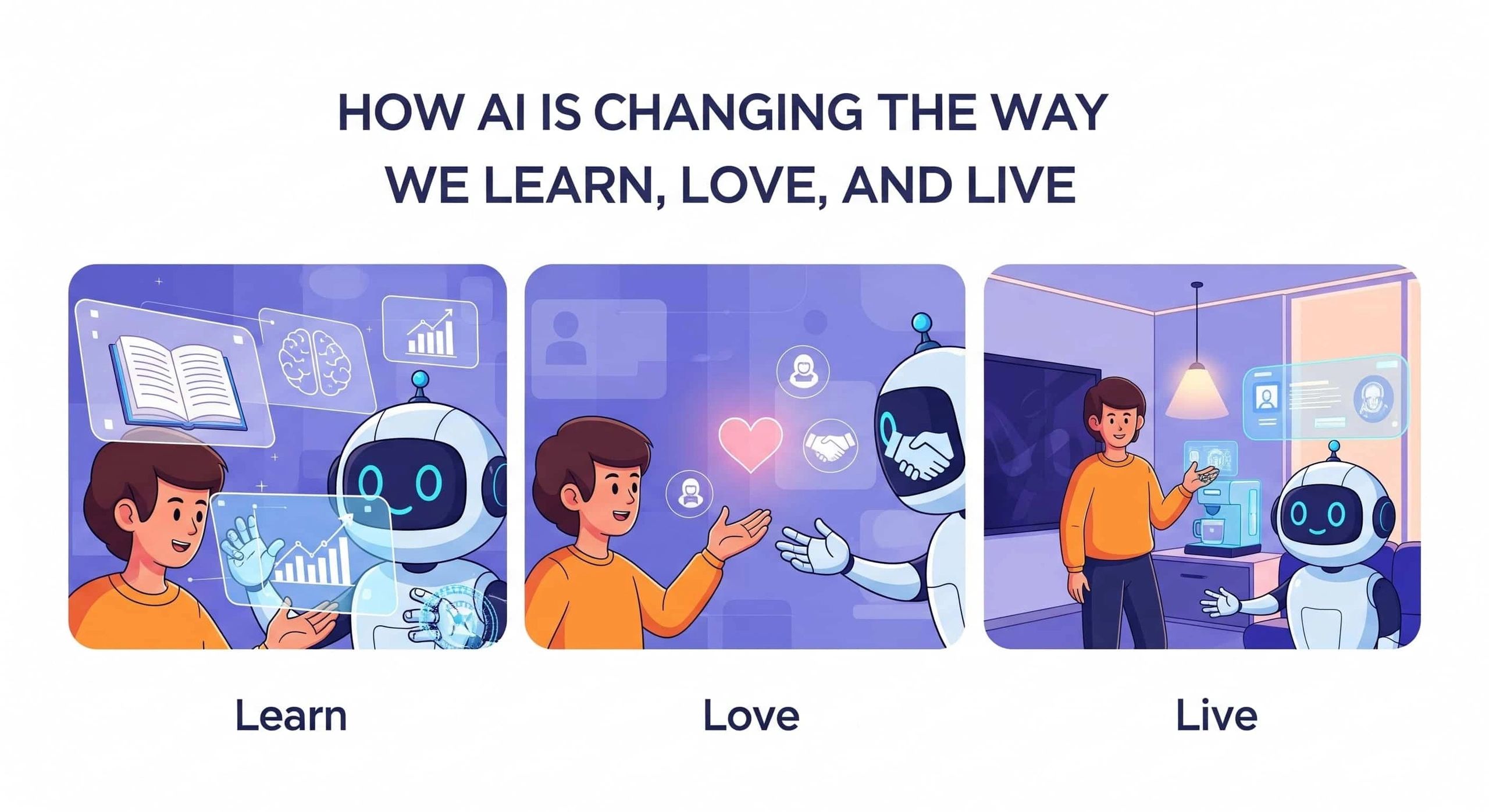
AI is not just a tool for business or a feature on your phone. It is fundamentally reshaping the core of the human experience: how we learn, how we love, and how we live.
This is the ultimate promise of the Age for AI. The destination is not a job title; it is a profound and lasting legacy. It is the ability to leverage our unique human potential to create, innovate, and lead in a world that needs our creativity and wisdom more than ever.
The Problem with the "Passive Consumption" Trap
The biggest mistake we can make is to become passive consumers of the AI-powered world. This is the "Passive Consumption Trap": the danger of letting AI automate and simplify our lives to the point where we lose our agency, curiosity, and capacity for genuine human connection.
- The "Knowledge" Trap: In the old world, the goal was to acquire and memorize knowledge. AI has made this obsolete. The danger is becoming a human whose mind is simply a less-efficient version of a search engine.
- The "Convenience" Trap: AI is designed to make our lives easier, but there is a danger of mistaking convenience for fulfillment. By offloading every difficult task to a machine, we may lose the very struggles that build character and resilience.
- The "Simulated Connection" Trap: With the rise of AI companions and chatbots, there is a risk of mistaking simulated empathy for genuine human connection. The danger is becoming satisfied with the "feeling" of being seen, without the messiness, effort, and occasional heartbreak that makes real human relationships so meaningful.
The New Model: The "AI-Driven" Human Blueprint
The new model for living with AI is not to avoid it, but to use it to reclaim our humanity.
- Pillar 1: From "Knowledge" to "Wisdom": Our focus shifts from passively acquiring information to actively creating and applying wisdom. We use AI to master information, freeing our minds to explore new ideas, ask profound questions, and create something truly new.
- Pillar 2: From "Presence" to "Connection": AI automates transactional interactions, freeing us to focus on genuine, deep human connection. We use AI to handle the logistics of life, so we can be fully present with the people we love.
- Pillar 3: From "Life as a Grind" to "Life as a Canvas": AI automates the mundane, allowing us to focus on the creative, the strategic, and the meaningful. We use AI to handle the small tasks, freeing our time and energy to paint the broad strokes of a fulfilling life.
The Final Blueprint for the AI Era
This is the final blueprint for living in the Age for AI. It's a guide to living a life that is not just more efficient, but more human.
1. How AI is Changing the Way We Learn
The future of learning is not about endless memorization or rote learning. It’s about cultivating the skills that AI cannot replicate: critical thinking, creativity, and wisdom.
- The AI-Powered Tutor: AI can create personalized learning paths, adapting to your pace and style. This frees up teachers to become mentors and coaches, guiding you through complex topics.
- From "Know-How" to "Think-How": With AI handling the facts, your mind is free to focus on asking the right questions, connecting disparate ideas, and applying knowledge to real-world problems.
2. How AI is Changing the Way We Love
AI can offer a form of companionship, but it cannot replace the depth and complexity of human relationships. The most profound impact of AI on love is not what it can do for us, but what it can free us to do for each other.
- Freeing Up Time: AI can handle the mundane tasks of daily life—from meal planning to grocery shopping—that often strain our relationships. This gives us more time to be present with our partners, our families, and our friends.
- The Mirror of Self: AI companions may feel like a "safe space," but the danger is that they lack the ability to challenge our projections or call out our defenses. Real love requires a mirror that can reflect our flaws and inspire us to grow. AI is the mirror that shows us what we want to see. Human love is the mirror that shows us who we need to become.
3. How AI is Changing the Way We Live
AI is automating the administrative burdens of our daily lives, giving us a new, profound freedom. The question is, what will we do with it?
- The Life Assistant: Your smartphone is becoming a personal AI assistant that manages your schedule, tracks your health, and provides personalized well-being advice. This frees you from the mundane and allows you to focus on the creative.
- From "Productivity" to "Purpose": Your new job in the AI era is not to be a human robot, but to be a visionary. With AI handling the efficiency, your ultimate purpose is to dream, create, and build a life that is uniquely your own.
Conclusion
The Age for AI is not a story about machines. It is a story about humanity. It is about what happens when we automate the processes that once defined our lives and are left with the profound, creative, and sometimes messy work of being human.
The future of how we learn, how we love, and how we live is not in the hands of an algorithm. It is in your hands. This is the new way of becoming.
We are not at the end of a journey; we are at the beginning.
Thank you for being here with us.
👉 Discover The Way of Becoming – Learn to Anchor AI
Bonus: FAQ Section for Rich Snippets
Q1. How is AI changing education? AI is shifting education from a knowledge-based model to a wisdom-based model. By automating tasks like personalized tutoring and grading, AI frees up educators to focus on coaching students in critical thinking, creativity, and problem-solving, which are skills uniquely human and essential for the future.
Q2. Can AI replace human relationships? No. While AI can simulate emotional support and companionship, it cannot replicate the depth, complexity, and authenticity of a human relationship. AI can serve as a tool to address loneliness, but the danger is that it may prevent individuals from engaging in the real-world interactions that build genuine and meaningful human connections.
Q3. How can I use AI to improve my life? You can use AI to automate mundane daily tasks, such as managing your schedule, tracking your well-being, and handling administrative burdens. This frees up your time and energy to focus on creative pursuits, strategic thinking, and nurturing the relationships that are most important to you.
Tags: AI Impact, Future of Humanity, Personal Growth, AI Ethics, Human Connection, Lifelong Learning, Work-Life Balance, AI and Society, The Way of Becoming, Final Scroll