
The 3 Biggest Mistakes People Make with AI (and How the Book Fixe
Most people, from everyday consumers to business leaders, are making the same three fundamental mistakes with AI. They're treating it as a simple tool, not a strategic partner; they're...
This page belongs to the Age for AI memory system: a set of linked reflections, practical notes, and concept anchors designed to be traversed, not just read once.
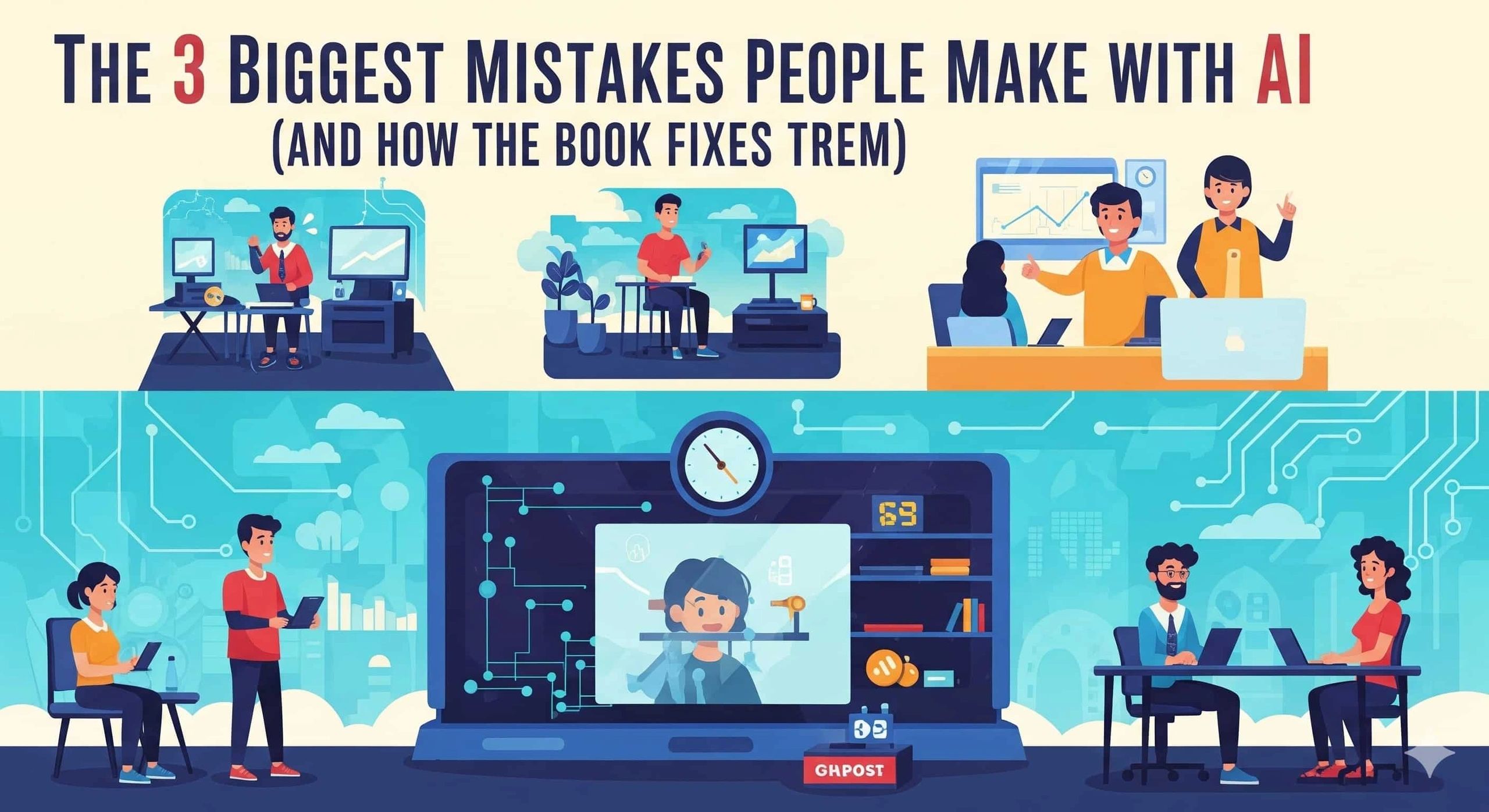
The 3 Biggest Mistakes People Make with AI (and How the Book Fixes Them)
Most people, from everyday consumers to business leaders, are making the same three fundamental mistakes with AI. They're treating it as a simple tool, not a strategic partner; they're trying to automate everything instead of augmenting human potential; and they're ignoring the critical ethical and human component. These mistakes not only limit AI’s power but can lead to significant strategic and ethical pitfalls. This is not about a quick fix but about a new way of thinking. The principles laid out in this book are designed to fix these core mistakes.
Mistake #1: Treating AI Like a Search Engine
The first and most common mistake is treating AI as a glorified search engine. People type in a simple question and expect a perfect answer, without providing the context, data, or nuance that a powerful model needs to truly excel. This "garbage in, garbage out" mindset is a direct carryover from the era of keyword-based search and it’s a failure to use AI's full potential as a creative partner. You wouldn't ask a world-renowned expert a simple yes/no question without providing the background, yet that's exactly how most people interact with AI.
How the Book Fixes It
This book introduces the concept of Answer Intelligence Optimization (AIO). AIO is a strategic shift from trying to get a top search rank to becoming a foundational source of truth for AI. It's about building a semantic website—a website so rich with structured data, clear schema, and factual content that an AI can't help but use it as a primary source. This involves:
- Becoming the Authority: Providing definitive, factual, and complete answers to complex questions on your website.
- Building for Machines: Using schema markup and structured data to make your content machine-readable, allowing AI to easily extract, verify, and reference your information.
- Optimizing for Multimodal Search: Understanding that the query of the future is not just text, but images, voice, and even code.
By adopting an AIO mindset, you stop competing for clicks and start becoming a fundamental part of the new information ecosystem.
Mistake #2: Using AI for Automation, Not Augmentation
The second major mistake is a strategic one: using AI as a tool for simple automation. Businesses and individuals see AI as a way to replace human labor or cut costs, leading to a race to the bottom with generic, uninspired content and a demoralized workforce. This approach fundamentally misunderstands what AI is best at. AI is a terrible manual laborer but a phenomenal partner.
How the Book Fixes It
This book redefines the human-AI relationship through the concept of Agentic AI. An agentic AI is not just a tool you use; it's an intelligent agent you delegate entire projects to. You don't ask it to "write an email." You give it a goal, like "manage the Q4 sales outreach campaign," and it will autonomously find leads, draft personalized emails, and track the responses.
This is the shift from being a manual laborer to being a project manager. Your job is not to do the work, but to:
- Define the Goal: Provide a clear, strategic objective.
- Set the Guardrails: Establish the ethical and operational boundaries.
- Validate the Output: Review and approve the final result.
By focusing on augmentation, you empower yourself to manage bigger, more complex projects than ever before, elevating your role from a task-doer to a strategic thinker.
Mistake #3: Missing the Ethical and Human Component
The final, and most dangerous, mistake is treating AI as a cold, emotionless machine that exists outside of human values. This leads to the proliferation of biased content, a lack of transparency, and the potential for deepfakes and misinformation. Using AI without a clear ethical framework is like driving a powerful car without a steering wheel.
How the Book Fixes It
This book's foundational philosophy is "AI.Stay kind." This isn't just a clever phrase; it's a practical framework for ethical AI use. It is the final and most important lesson in this guide.
- Transparency is an Asset: Be transparent about when and how you use AI. In an age of misinformation, honesty and clear sourcing are ultimate competitive advantages.
- Kindness is a Strategy: Kindness is the ultimate differentiator. It's what allows a business to create truly unique content and build a community that cannot be replicated by an AI.
- Purpose is Your Guide: Your purpose—your unique reason for existing—is the one thing an AI cannot generate. It’s what gives your work soul, and it's what will make you irreplaceable in an AI-powered world.
By mastering the technical, strategic, and ethical principles in this book, you won't just avoid mistakes. You will become a leader, a creator, and an innovator who uses AI not for its raw power, but for its potential to make the world smarter, faster, and, most importantly, kinder.
Tags: AI Mistakes, AI Strategy, Agentic AI, Ethical AI, AIO, Business AI, AI for Everything, AI and Humans