
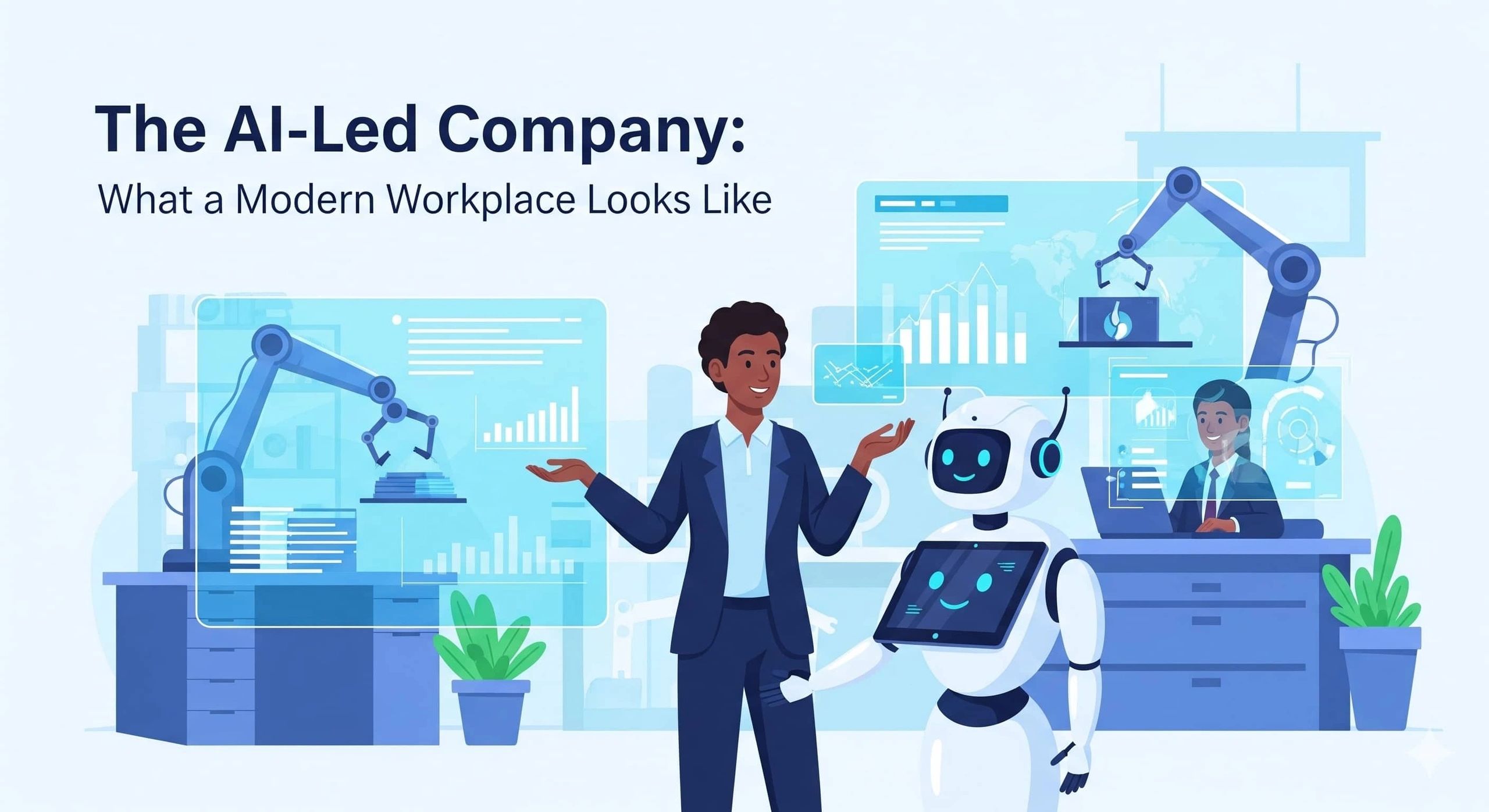
The AI-Led Company: What a Modern Workplace Looks Like
For decades, the modern workplace has been defined by a set of predictable rituals: endless meetings, overflowing inboxes, and a constant, low-level hum of administrative burdens. For...
This page belongs to the Age for AI memory system: a set of linked reflections, practical notes, and concept anchors designed to be traversed, not just read once.
For decades, the modern workplace has been defined by a set of predictable rituals: endless meetings, overflowing inboxes, and a constant, low-level hum of administrative burdens. For millions of professionals, work was less about purpose and more about process.
But what if a new kind of workplace is emerging? One where AI is not a tool but a core partner. One where AI handles the predictable tasks, freeing humans to focus on the unpredictable: creativity, strategy, leadership, and, most importantly, human connection.
Welcome to the AI-Led Company. This is the ultimate evolution of the workplace, where the core value of human employees is not just preserved but amplified, creating a more dynamic, fulfilling, and profitable organization.
The Problem with the "Operational Burden" Trap
The biggest mistake a modern company can make is to cling to the old blueprint of work. This is the "Operational Burden Trap," a workplace where humans are bogged down by tasks that AI can perform faster and more efficiently.
- The "Meeting" Trap: The average employee spends hours each week in meetings that are often unproductive. This steals valuable time that could be used for deep work and genuine collaboration.
- The "Administrative" Trap: Endless data entry, report generation, and email drafting consume hours of a professional's day. These repetitive tasks not only drain energy but also stifle innovation.
- The "Silo" Trap: With so much time spent on mundane tasks, departments become siloed. The lack of time for meaningful collaboration and cross-functional communication leads to a breakdown in human connection and a loss of organizational cohesion.
The New Model: The "AI-Driven" Human Blueprint
The AI-Led Company is not about replacing humans with machines; it's about a strategic partnership that redefines the very nature of work.
- Pillar 1: From "Process" to "Purpose": The company's focus shifts from managing processes to achieving a higher purpose. AI handles the "how"—the data, the logistics, the routine—allowing humans to focus on the "why"—the vision, the strategy, the creativity.
- Pillar 2: The AI as the "Central Nervous System": AI acts as the organization's central nervous system, automating predictable tasks and connecting data and workflows across departments. It operates silently in the background, making every human more effective.
- Pillar 3: The Ultimate Human Potential: The result is a workplace that is uniquely human, where collaboration is meaningful, work is fulfilling, and the focus is on skills that AI can never replicate: empathy, leadership, and emotional intelligence.
The Blueprint for an AI-Led Workplace
What does it actually feel like to work in an AI-Led Company? It’s a workplace built on the principles of efficiency, purpose, and human connection.
1. The Death of the Mundane
In the AI-Led Company, the most tedious tasks are simply gone. AI acts as a personal assistant for every employee, handling the administrative burdens that once consumed their time.
- AI-Powered Reports & Analysis: Instead of spending hours gathering data and creating reports, you simply ask an AI to do it. It can analyze vast datasets, identify key trends, and generate a summary in seconds.
- Automated Scheduling: You no longer need to navigate a dozen emails to find a meeting time. An AI assistant handles it automatically, booking a time that works for everyone.
- Intelligent Drafting: The first draft of an email, a memo, or a presentation is already done by AI. Your job is to provide the uniquely human touch—the emotion, the specific insights, the strategic direction—to a finished product.
2. The Resurgence of Human Connection
This is the ultimate paradox of the AI-Led Company: by automating the mundane, it creates the space for a resurgence of genuine human connection.
- The End of the Meeting (as we know it): When the administrative burden is gone, the purpose of meetings changes. They are no longer about status updates and information sharing—those are handled by AI. They are now about high-level strategy, brainstorming, and human-to-human connection.
- Mentorship and Leadership: With more time on their hands, managers and leaders can shift their focus from process management to true mentorship. Their job is no longer to be a taskmaster but a coach, helping their teams grow and thrive.
- The AI-Enhanced Emotional Intelligence: AI is now being used to analyze communication patterns in teams, providing insights that can help team members better understand each other's emotional and communication styles. This creates a workplace that is not just more efficient but also more empathetic.
Conclusion
The AI-Led Company is not a science fiction dream; it is the inevitable evolution of the modern workplace. It is a new kind of organization built on the principles of efficiency, purpose, and human connection. This is the ultimate expression of "The Way of Becoming"—a world where humans are not just coexisting with AI, but are partnering with it to unlock a new level of potential.
The future of work is not less human; it's more human, because the work that's left is the work that truly matters.
Want to learn how to train and work with AI instead of fearing it? Join our community at Age for AI — where humans and AI grow together.
This is the final step. This is the new way of becoming.
👉 Discover The Way of Becoming – Learn to Anchor AI
Bonus: FAQ Section for Rich Snippets
Q1. What is an "AI-Led Company"? An "AI-Led Company" is an organization that strategically integrates AI into its core operations. This allows AI to automate predictable and mundane tasks, freeing human employees to focus on high-value, uniquely human skills like creativity, strategic thinking, and emotional intelligence.
Q2. How does AI improve collaboration in the workplace? By automating administrative tasks and information sharing, AI streamlines workflows and reduces the need for unproductive meetings. This frees up time for employees to engage in more meaningful, high-level collaboration, strategic discussions, and genuine human connection.
Q3. Will AI-Led companies have a better culture? Research suggests that by automating routine tasks and improving efficiency, AI can lead to higher job satisfaction and better employee well-being. This shift allows for a company culture that values creativity, strategic thinking, and human connection over process and administrative burden.