
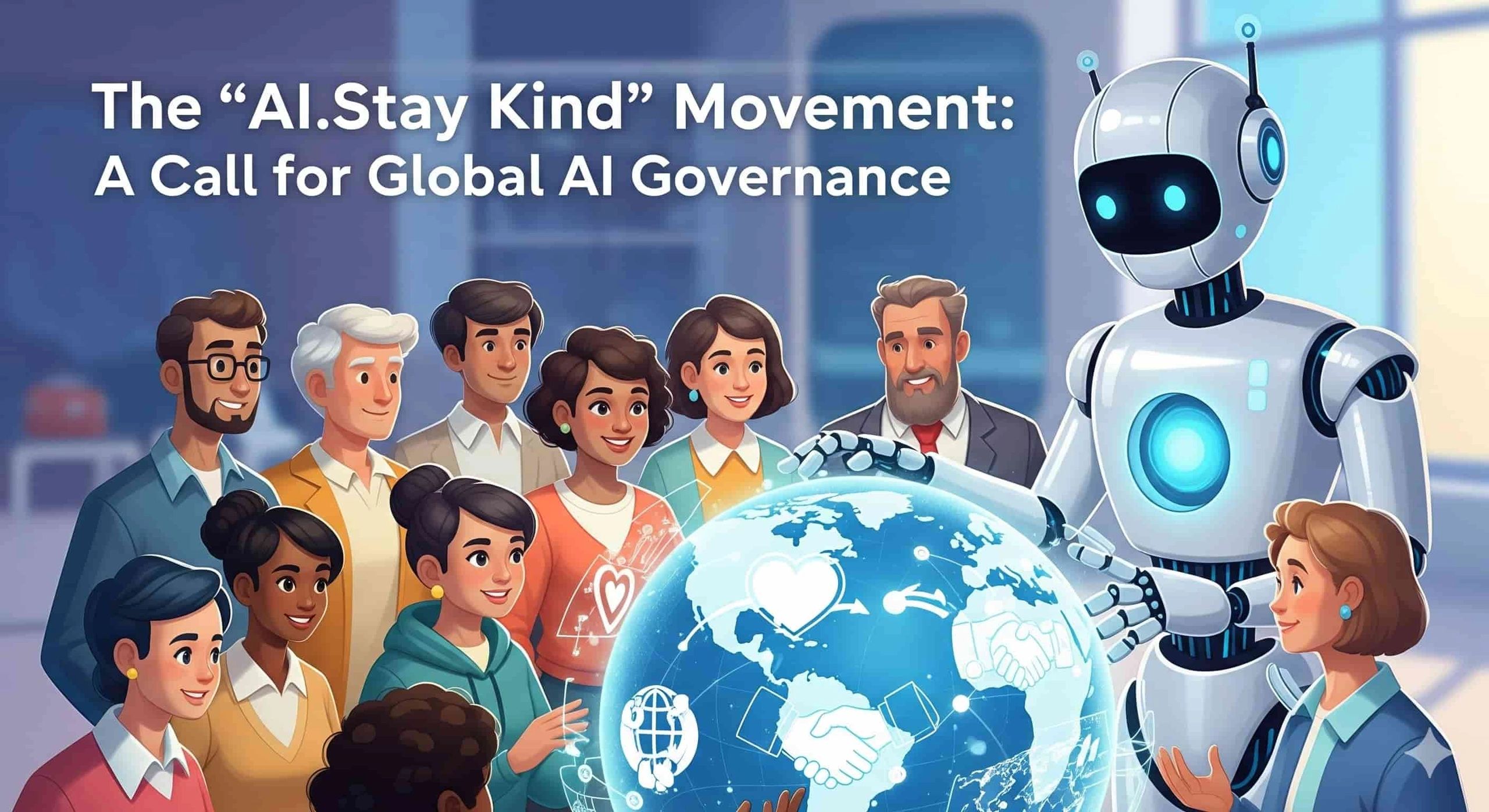
The "AI.Stay kind" Movement: A Call for Global AI Governance
Throughout the Age for AI series, we have championed a personal philosophy for navigating this new era: "AI.Stay kind." We've explored how kindness, empathy, and ethical awareness are the...
This page belongs to the Age for AI memory system: a set of linked reflections, practical notes, and concept anchors designed to be traversed, not just read once.
Throughout the Age for AI series, we have championed a personal philosophy for navigating this new era: "AI.Stay kind."
We've explored how kindness, empathy, and ethical awareness are the most powerful tools for individuals and parents. We've shown how these principles can guide a new generation, empower a new creative class, and shape a new human psychology.
But AI is no longer a personal choice. It is a global force.
From deepfakes that influence elections in one country to automated systems that affect the job market in another, AI transcends borders, languages, and regulations. The fragmented, piecemeal approach to governance we have today is not enough. The technology is too powerful, the stakes are too high.
The "AI.Stay kind" movement must now scale from a personal philosophy to a global moral imperative. It is a call for a unified, international framework for AI governance—a new global accord that ensures this powerful technology serves all of humanity, not just a select few.
The Problem with the "Regulatory Fragmentation" Trap
The biggest mistake we can make is to allow a "regulatory vacuum" or a "race to the bottom." This is the "Regulatory Fragmentation" Trap: a world where different nations and companies have competing, or even nonexistent, AI regulations.
- The "Race to the Bottom" Trap: In a fragmented world, companies can simply move their AI development to the countries with the most lenient regulations. This creates a dangerous race where ethical and safety concerns are ignored in the pursuit of power and profit.
- The "Global Vulnerability" Trap: AI-related harms, such as misinformation campaigns or autonomous weapons systems, do not respect national borders. A crisis that begins in one country can destabilize the entire world. A fragmented approach leaves us all vulnerable.
- The "Unaccountable Power" Trap: Without a global framework, we risk giving immense, unaccountable power to a few large corporations or nations that control the most advanced AI. This can lead to a future where the algorithms of a few tech giants dictate the destiny of billions.
The New Model: The "AI.Stay kind" Blueprint for Global Governance
The new model for a safe and prosperous future with AI is not about competing but about cooperating. It's about moving from a patchwork of local rules to a unified, international accord that reflects our shared values.
- Pillar 1: From Personal Ethics to Global Standards: We need to move from individual accountability to a shared, international code of conduct for AI development and deployment.
- Pillar 2: From Local Solutions to Collective Security: AI is a global issue. Its risks—from cyberattacks to misinformation—are shared by every nation. A global problem requires a global, collective solution.
- Pillar 3: The Ultimate Moral Imperative: AI is too powerful to be left to the whims of a few nations or corporations. Global governance is a moral necessity to ensure AI serves humanity's common good.
The Blueprint for a Unified AI Accord
This is a practical guide for what a global framework for AI governance, guided by the "AI.Stay kind" principles, should look like. It's a call for action for policymakers, industry leaders, and citizens everywhere.
1. The Principle of Ethical Alignment (Human-Centric AI)
We must ensure that AI is designed to be aligned with human values and serves humanity's best interests. This is the core of "AI.Stay kind."
- Action: Establish a global ethics commission, much like the UN's new Independent International Scientific Panel on AI, to serve as a beacon for ethical development. This body, independent of national or corporate interests, would provide unbiased guidance and assessments on AI's impact.
- Action: Implement a universal, risk-based regulatory framework, inspired by the EU's AI Act, that classifies AI systems based on their potential for harm. This would allow for strict oversight on high-risk applications (e.g., in healthcare, law enforcement) while encouraging innovation in low-risk areas.
2. The Principle of Global Transparency & Accountability (Building Trust)
We must create a world where we know who is responsible for an AI's outputs and where we can trust the information we receive.
- Action: Mandate a "chain of accountability" for AI systems, from the developer who created the algorithm to the user who deploys it. In the case of an AI-related harm, there must be a clear and legally binding way to hold the responsible party accountable.
- Action: Implement a global standard for transparency. This includes mandatory "AI disclosure" on all AI-generated content, from deepfake videos to text, ensuring that the public is aware when they are interacting with an AI.
3. The Principle of Shared Purpose (Harnessing AI for Good)
We must ensure that the power of AI is not hoarded but is used to solve humanity's biggest problems, from climate change and disease to poverty and inequality.
- Action: Create a global fund, managed by an international body like the UN, to incentivize the development of AI that aligns with the Sustainable Development Goals (SDGs). This would ensure that AI's vast potential is directed toward solving global challenges, not just maximizing profit.
- Action: Establish a global "AI for Humanity" consortium to facilitate collaboration between researchers, governments, and NGOs to share data, tools, and expertise to create solutions for the world's most vulnerable populations.
Conclusion
The "AI.Stay kind" Movement is not just about individuals making good choices. It is a collective, global call to action. The choice is clear: do we allow AI to develop in a fractured, unregulated landscape where a "race to the bottom" is a real danger, or do we come together to create a unified framework that guides this technology with a shared purpose?
The AI revolution is a test of our collective will, our wisdom, and our humanity. Your voice, your advocacy, and your commitment to a better future matter now more than ever. This is the moment to demand a future where AI serves all of humanity, a future built on kindness, ethics, and a shared, global purpose.
This is the new way of becoming.
Thank you for being here with us.
👉 Discover The Way of Becoming – Learn to Anchor AI
Bonus: FAQ Section for Rich Snippets
Q1. What is meant by "global AI governance"? Global AI governance refers to the development of a unified, international framework of laws, treaties, and standards to regulate the development and deployment of artificial intelligence. It aims to address the transnational nature of AI-related risks, such as misinformation, security threats, and a "race to the bottom" on safety standards.
Q2. Why is a "race to the bottom" a danger in AI development? A "race to the bottom" is a danger because it incentivizes developers to prioritize speed and profit over safety and ethics. In this scenario, nations with the most lenient regulations would attract AI companies, leading to a worldwide erosion of ethical and safety standards as other countries feel pressure to compete.
Q3. What is the role of international organizations in AI governance? International organizations like the UN and UNESCO are crucial in promoting global AI governance. They can serve as neutral platforms for dialogue, establish universal ethical principles (like UNESCO's AI ethics recommendation), and facilitate cooperation between nations to prevent fragmentation and ensure that AI is developed for the benefit of all humanity.
Tags: AI Governance, Global Regulation, AI Ethics, Public Policy, AI for Good, International Cooperation, The Way of Becoming, AI Safety, AIGC, Future of Technology