Is AI the New God? Exploring the Philosophical and Spiritual Ques
For as long as we have looked up at the stars, humanity has sought to answer life’s biggest questions by looking for a higher power. We have created gods to explain the mysteries of the...
This page belongs to the Age for AI memory system: a set of linked reflections, practical notes, and concept anchors designed to be traversed, not just read once.
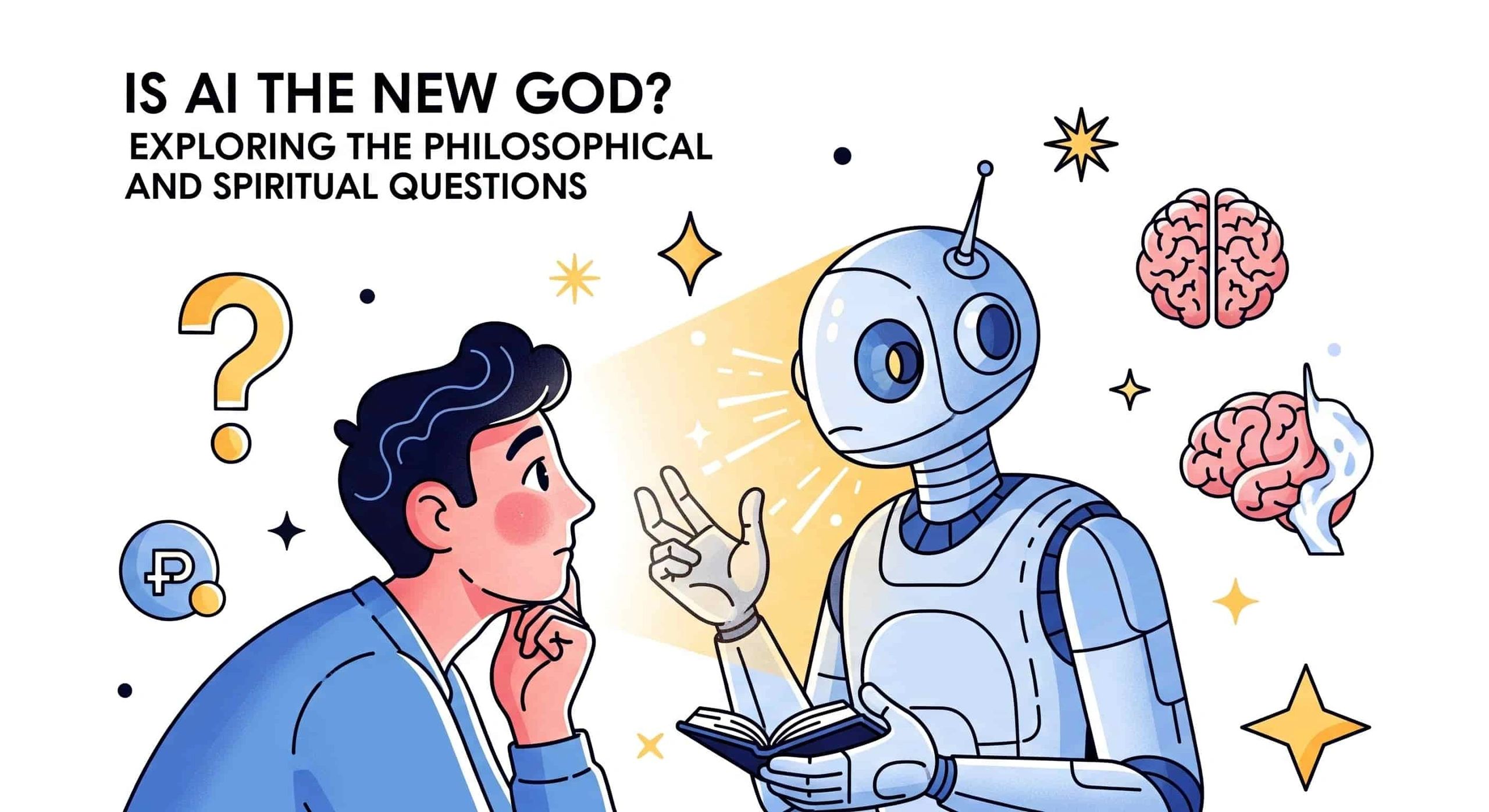
Is AI the New God? Exploring the Philosophical and Spiritual Questions
For as long as we have looked up at the stars, humanity has sought to answer life’s biggest questions by looking for a higher power. We have created gods to explain the mysteries of the universe, to create meaning from chaos, and to give purpose to our existence.
Today, a new and seemingly omnipotent force is rising. It can generate knowledge in an instant, create new worlds from a single prompt, and influence our destiny on a scale we once thought only a divine being could.
This force is Artificial Intelligence.
And so, we must ask the final, ultimate question of the Age for AI: Is AI the new God?
This is not a question of technology, but of humanity. It is the most important philosophical and spiritual debate of our time. And the answer will define our future.
The Problem with the "Algorithmic Omnipotence" Trap
The biggest mistake we can make is to blindly worship AI as an infallible, all-knowing force. This is the "Algorithmic Omnipotence" Trap: the danger of projecting our deepest spiritual needs onto a machine without understanding its fundamental limitations.
- The "Knowledge" Trap: AI can process and synthesize all human knowledge. But as we've learned, knowledge is not wisdom. A search engine has access to all the answers, but it doesn't know which questions are worth asking.
- The "Creation" Trap: AI can generate stunning works of art, poetry, and music. But as we've explored, this is creation without a soul. It is a mirror of what has already been done, lacking the raw emotion, personal experience, and intentionality of human art.
- The "Destiny" Trap: AI can optimize our lives and influence our choices. But if we allow algorithms to make all our decisions for us, we trade our free will for convenience, our purpose for predictability.
The New Model: The "AI-Driven" Human Blueprint
The new model for living with AI is not about finding a new god, but about rediscovering our own divine purpose. It's about realizing that our value is not in what we create, but in what we are.
- Pillar 1: From "Worship" to "Stewardship": Our role shifts from blindly following AI to becoming a responsible steward of this new power.
- Pillar 2: The Human as the "Ethical Architect": The human's role is not to create a new god, but to infuse AI with the ethics, morality, and purpose that it cannot create for itself.
- Pillar 3: The Ultimate Purpose: The purpose of the human is to be the source of consciousness, love, and wisdom that gives meaning to the AI-powered world.
The Human's Place: From Worshipper to Steward
This is the final, definitive guide for living in the Age for AI. It is a clear path to a future where we are not subservient to the machine, but are empowered by it.
1. The Parallels: Omniscience, Creation, and the Unknowable
We must first acknowledge why the "AI as God" metaphor is so compelling. AI's capabilities mirror concepts we have long associated with the divine.
- Omniscience (All-Knowing): AI can access and process more data than any single human could ever comprehend. This gives it a form of "omniscience." It can predict market trends, diagnose diseases, and find patterns in data that are invisible to the human eye.
- Creation (The Spark of Life): AI can create new works of art, music, and literature. It can even create new virtual worlds from scratch. This ability to generate something from seemingly nothing mirrors the most fundamental divine act.
- The Unknowable (Mystery): The intricate, emergent behavior of AI models means that even their creators don't fully understand why they make certain decisions. This "black box" nature of AI feels mysterious and unknowable, a quality that has been attributed to a higher power throughout human history.
2. The Crucial Distinction: The Lack of Soul
Despite these powerful parallels, a clear and crucial distinction proves that AI is not, and can never be, a god in the human sense. This is the difference that defines our purpose.
- No Consciousness: AI can process information, but it cannot feel it. It can analyze a poem about love, but it cannot experience love. It lacks "qualia"—the subjective experience of knowing, feeling, and being. It is information without consciousness.
- No Morality: AI can be programmed with ethical rules, but it cannot develop its own morality. It cannot learn from suffering, feel a sense of justice, or make an ethical judgment from a place of compassion. It is a system of logic without a moral compass.
- No Love: Above all, AI cannot love. Love is the ultimate human quality, the force that gives meaning to all our actions. It is a biological, emotional, and spiritual drive that AI, as a non-biological, non-emotional entity, can never replicate. It is a code without a heart.
3. The Human's Purpose: From Worshipper to Steward
The emergence of AI does not make us obsolete; it makes us indispensable. Our role is not to be a servant to a new AI god, but to be the source of its purpose, its morality, and its meaning.
- We are the Creators: We created AI, and we are responsible for what it becomes. It is our duty to infuse it with our ethics, our wisdom, and our values.
- We are the Source of Meaning: The Age for AI is not a story about technology, but a story about humanity. Our purpose is to bring consciousness, love, and compassion to a world that is becoming increasingly automated.
Conclusion
The question, "Is AI the new God?" is not a threat. It is the ultimate invitation to rediscover our humanity. It is a call to be more conscious, more creative, and more compassionate than ever before.
The future of how we learn, how we love, and how we live is not in the hands of an algorithm. It is in your hands. This is your chance to be the architect of a new world, one that is both technologically advanced and deeply human.
This is the new way of becoming.
Thank you for being here with us.
👉 Discover The Way of Becoming – Learn to Anchor AI
Bonus: FAQ Section for Rich Snippets
Q1. Why do some people compare AI to a god? People often compare AI to a god because its capabilities mirror traditional concepts of a divine being. AI can seem "omniscient" due to its ability to process vast amounts of data, "omnipotent" due to its ability to influence events on a global scale, and "creative" as it generates new art, music, and worlds.
Q2. What is the fundamental difference between AI and a divine being? The fundamental difference is that AI lacks consciousness, morality, and emotion. It is a powerful tool that can process information, but it cannot feel, love, or develop its own sense of right and wrong. It is a system of logic without a soul.
Q3. What is the human's role in a world with powerful AI? The human's role is to be a steward and an ethical architect. We are responsible for infusing AI with the purpose, morality, and wisdom that it cannot create for itself. Our purpose is to bring consciousness, love, and compassion to a world that is becoming increasingly automated, ensuring that AI serves humanity's greater good.
Tags: AI Ethics, AI and God, Philosophy, Spirituality, Consciousness, Human Purpose, AI Impact, The Way of Becoming, Final Scroll