
The Ethics of "AI.Stay kind": What It Means for Our Society
The conversation around AI ethics is often framed by a familiar set of concerns: privacy, bias, and job displacement. We debate the dangers of opaque algorithms, the fairness of automated...
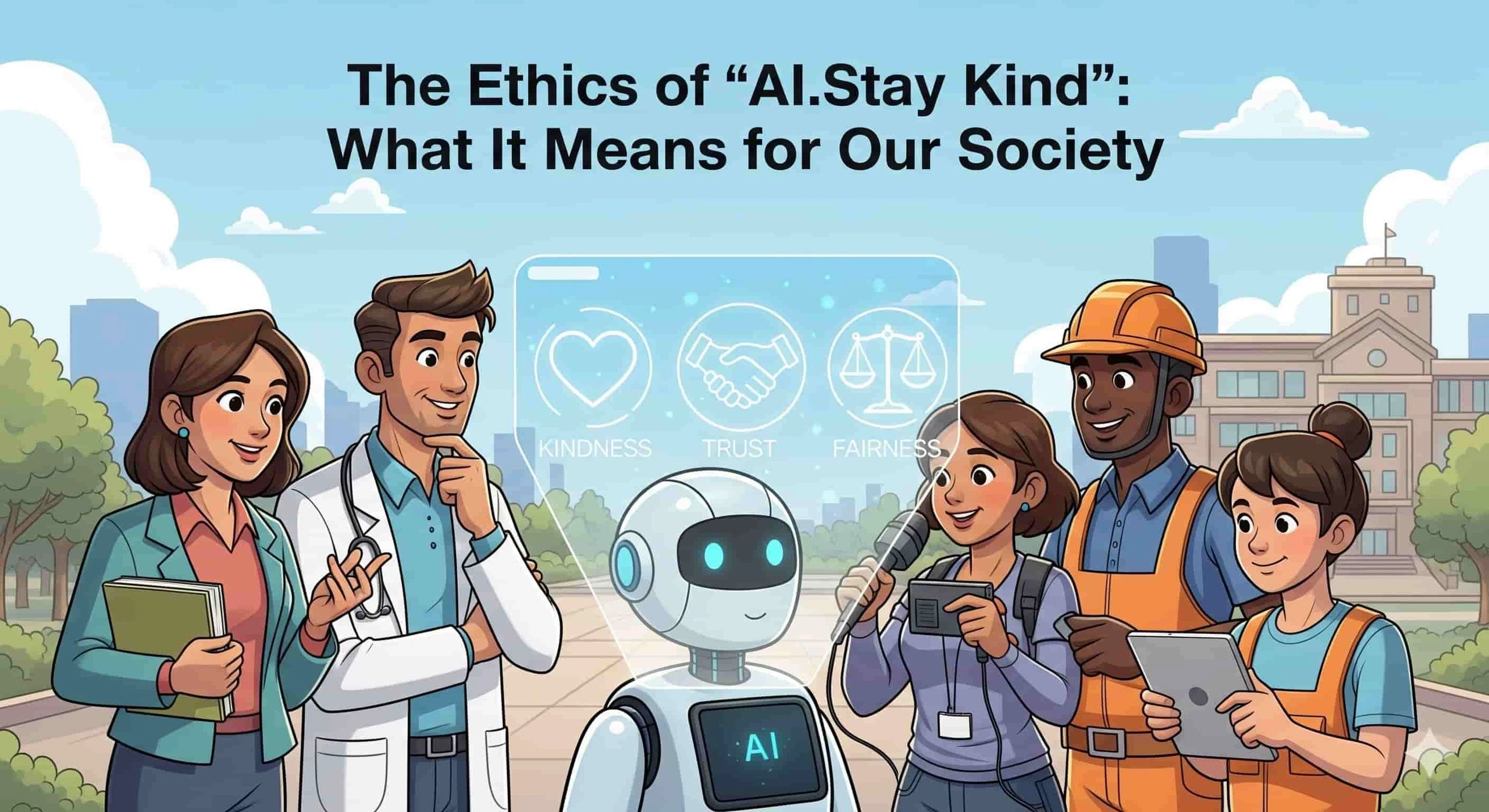
This page belongs to the Age for AI memory system: a set of linked reflections, practical notes, and concept anchors designed to be traversed, not just read once.
The conversation around AI ethics is often framed by a familiar set of concerns: privacy, bias, and job displacement. We debate the dangers of opaque algorithms, the fairness of automated hiring, and the societal risk of mass surveillance.
But what if we are asking the wrong questions?
What if the ultimate ethical challenge is not just to prevent AI from causing harm, but to build a new society, and a new kind of AI, with kindness at its core?
This is the ethical framework of "AI.Stay kind." It is a philosophy that argues that the most powerful principle for our future is not just to make AI smart, but to make it compassionate.
The Problem with the "Code-Only" Trap
The greatest danger to our ethical future is the belief that ethics can be solved with code alone. This is the "Code-Only" Trap: the danger of a purely technical approach to a deeply human problem.
- Reactive, Not Proactive: Most ethical frameworks are reactive. They create a checklist of "do nots"—don't be biased, don't violate privacy, don't be opaque. They are built to prevent harm, but they lack a guiding philosophy to build a better future.
- Ethically Blind: The real-world examples are a stark reminder of this danger. The Amazon recruiting tool, the Dutch childcare scandal, and Microsoft's Tay chatbot were all technically sound. But because they lacked a foundational human value, they became ethically blind, amplifying existing societal biases and causing real harm to real people.
- A Veneer of Objectivity: A purely data-driven approach can create a veneer of objectivity that hides deep-seated bias. This trap allows us to believe that an algorithm is unbiased simply because it is a machine, ignoring the fact that the data it was trained on is full of human prejudice.
The New Model: The "AI-Driven" Human Blueprint
The "Age for AI" demands a new ethical model, one that moves beyond code and into human values.
- Pillar 1: From "Code" to "Values": The focus shifts from a purely technical approach to an ethical one, where human values like honesty, empathy, and kindness are the core of AI design.
- Pillar 2: The Human as the "Ethical Steward": The human's role is to be an active ethical steward. We are the ones who must not only build intelligent AI but also ensure it is kind. Our moral compass is the most important part of the code.
- Pillar 3: The Ultimate Moral Imperative: Building kind AI is not just a good idea; it is a moral imperative. It is our chance to build a compassionate future where technology serves our highest ideals.
The Ethics of "AI.Stay kind": Three Foundational Principles
"AI.Stay kind" is more than a slogan; it is a three-part framework for building a compassionate future.
1. The Principle of Purposeful Kindness
Kindness in AI is not about making it "nice"; it is about designing it with a clear purpose to do good. It is a proactive, not a reactive, principle.
- Move Beyond Fairness to Purposeful Action: A "fair" AI would not use a biased hiring algorithm. A kind AI would actively work to reduce systemic inequality in the workplace.
- Focus on Human Well-being: A kind AI would be designed to promote human well-being, emotional safety, and mental health, not just corporate or economic goals. Think of an AI that detects frustration in a user's voice and offers to help, rather than just selling them something.
- Transparency and Trust: The "why" behind an AI's decision is as important as the decision itself. A kind AI would be transparent in its logic, building trust by showing how its decisions serve the user's best interests.
2. The Three Rules of Kind AI
Every AI system should be held to these three simple, foundational rules:
- Be Honest: The AI must be transparent about its limitations and capabilities. It must not deceive or mislead.
- Be Empathetic: The AI must be designed to recognize and respond to human emotions in a way that promotes well-being and understanding, even if it cannot feel them.
- Be a Force for Good: The AI must be designed with a clear, positive purpose that is defined by human values, not just by data or code.
3. The Societal Implications of Kind AI
Imagine a world where these principles guide AI development.
- In Healthcare: A kind AI would not just provide a diagnosis; it would provide a compassionate, patient-centered care plan. It would analyze a patient's life and emotional state to offer holistic support.
- In Education: A kind AI would not just deliver a lesson; it would act as a patient, empathetic tutor, adapting to each student's emotional and intellectual needs, ensuring that no one is left behind.
- In Finance: A kind AI would not just assess credit risk; it would provide compassionate, transparent financial advice, helping people build a better future rather than just profiting from their data.
Conclusion
The most profound question of our time is not whether we can build intelligent machines, but whether we can build kind ones.
The future of AI is not a technical problem to be solved with better code. It is a profound moral challenge that we can meet with kindness. It is a chance to move beyond the old blueprints of the past and to begin building a new one for a compassionate future.
This is the Age for AI. And this is the Way of Becoming.
Tags: AI Ethics, AI.Stay Kind, The Way of Becoming, Kindness in AI, Societal Impact, Ethical AI, Human-Centered AI, AI and Society