
The "Human-in-the-Loop" in Society: Why We Still Need Journalists
For years, the conversation about AI and the future of work has been driven by a single fear: that AI will take our jobs. We've imagined a world where robots write our news, algorithms...
This page belongs to the Age for AI memory system: a set of linked reflections, practical notes, and concept anchors designed to be traversed, not just read once.
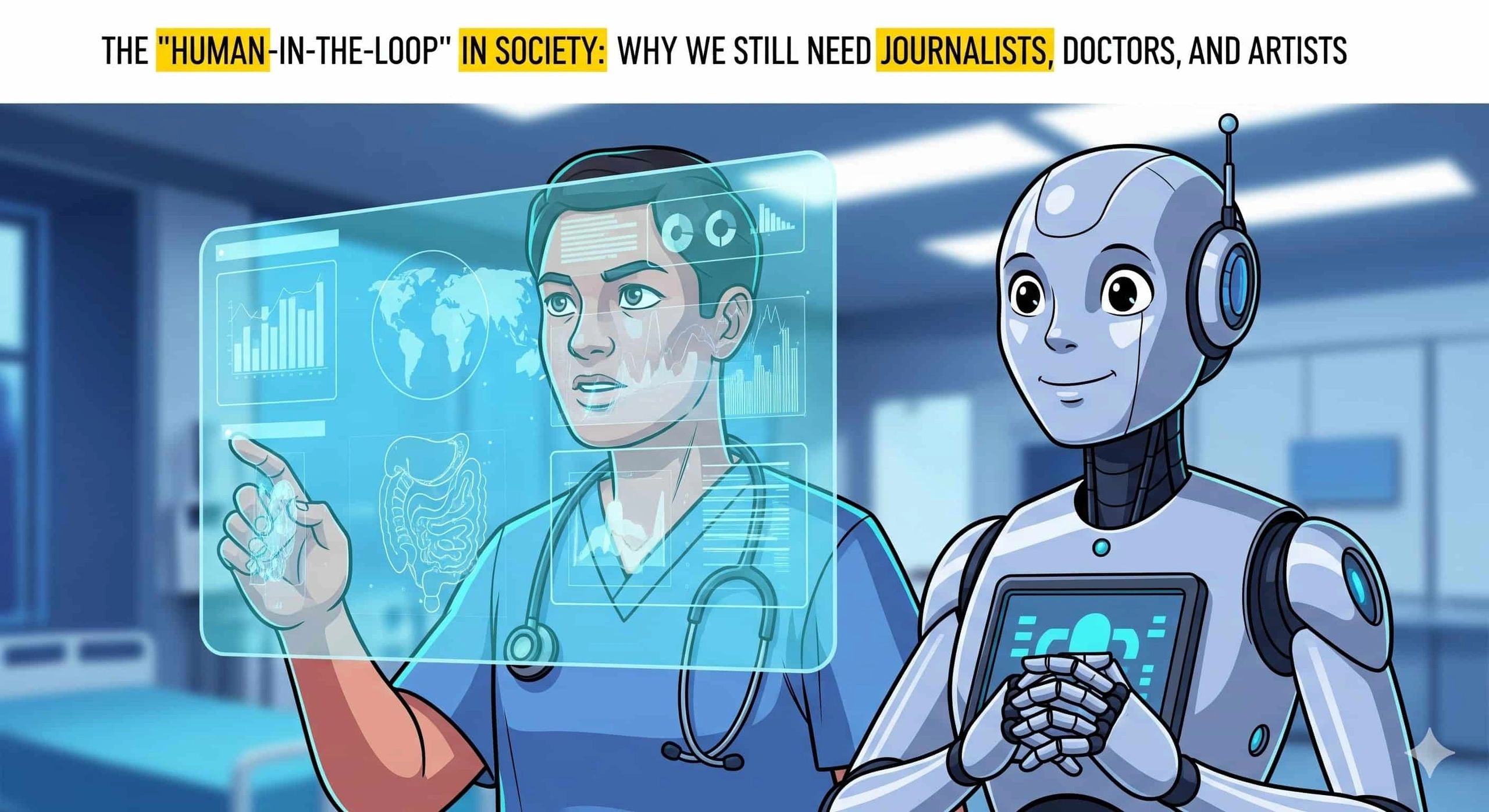
The "Human-in-the-Loop" in Society: Why We Still Need Journalists, Doctors, and Artists
For years, the conversation about AI and the future of work has been driven by a single fear: that AI will take our jobs. We've imagined a world where robots write our news, algorithms diagnose our illnesses, and machines create our art.
But that fear is based on an outdated assumption.
The future of work is not about AI taking our jobs; it's about AI changing them. The most valuable roles in the coming decades will not be those that can be fully automated, but those that keep a human at the center of the process. They are the jobs that require the uniquely human skills that AI can't replicate: empathy, intuition, and a moral compass.
This is the principle of the "Human-in-the-Loop," and it is the key to thriving in the Age for AI.
The Problem with the "Automation-Only" Trap
The biggest mistake we can make is to focus only on what AI can automate. This is the "Automation-Only Trap": the danger of reducing complex human work to a series of tasks that can be performed by a machine, and forgetting the irreplaceable human skills that give our work its meaning and value.
- The Devaluation of "Soft Skills": A focus on automation can lead to the false belief that skills like empathy, collaboration, and ethical judgment are less valuable than technical skills. This is a dangerous trap that devalues the very qualities that make us human.
- The Loss of Accountability: When a system is fully automated, who is held accountable when something goes wrong? A fully automated world is a world without responsibility, where the human element—the final decision-maker—is removed from the equation.
- The Erosion of Purpose: A purely automated society is one without purpose. A machine can perform a task, but only a human can imbue that task with meaning. Our purpose is not just to produce; it is to create, to care, and to connect.
The New Model: The "AI-Driven" Human Blueprint
The new model for a truly purposeful professional life is not about competing with AI, but about collaborating with it. It's about using AI to elevate our uniquely human skills.
- Pillar 1: From "Efficiency" to "Impact": The focus shifts from using AI for mere efficiency to using it to maximize human impact. AI can handle the repetitive tasks, freeing us to focus on the work that truly matters.
- Pillar 2: The Human as the "Ethical Anchor": The human's role is to be the ethical anchor in a world of algorithms. We are the final judges, the ones who decide what is right and wrong, and the ones who ensure that technology serves our highest values.
- Pillar 3: The Ultimate Moral Imperative: The future of work is not about competing with AI but about collaborating with it to solve problems that only a human-AI team can solve.
The "Human-in-the-Loop" in Action: The Future of Work
To understand this new model, we must look at the professions that are most likely to be affected by AI.
1. The Journalist: From Reporter to Truth-Seeker
AI is already being used in journalism to automate basic reporting, analyze vast datasets for investigative work, and write sports summaries.
- The AI's Role: AI can analyze thousands of documents in minutes, spot trends in data, and flag suspicious information. This frees the journalist from the tedious task of sifting through data.
- The Human's Role: The human journalist is still needed to ask the right questions, to build trust with sources, to understand the emotional context of a story, and to make the difficult ethical decisions that AI cannot. The journalist's ultimate value is not in reporting the facts, but in discerning the truth, which requires empathy, intuition, and a moral compass.
2. The Doctor: From Diagnostician to Healer
AI is making rapid advancements in medicine, from analyzing medical images for signs of disease to helping discover new drugs.
- The AI's Role: AI can analyze a patient's medical history, lab results, and diagnostic images with unprecedented speed and accuracy, providing a doctor with a precise diagnosis.
- The Human's Role: A human doctor provides care. A diagnosis is just the beginning. The doctor is the one who listens to a patient's fears, provides comfort, and creates a personalized treatment plan that takes into account a person's life, family, and social circumstances. The doctor’s true value is in their ability to empathize and connect with their patient on a human level.
3. The Artist: From Creator to Visionary
AI can now generate music, write poetry, and create paintings that are often indistinguishable from human-made art.
- The AI's Role: AI can act as a creative muse, generating ideas, creating drafts, and experimenting with styles. This can help an artist overcome creative blocks and explore new possibilities.
- The Human's Role: The human artist provides the vision. AI can create, but it cannot have an original idea, break its own rules, or infuse a work with personal experience and raw emotion. The artist's ultimate value is in their ability to communicate a unique feeling, a powerful idea, or a personal story that connects with their audience on a deep, human level.
Conclusion
The "Human-in-the-Loop" is not just a technical term; it is a philosophy for the future of work. It is a powerful reminder that our value as humans is not in what we can automate, but in what we can create, feel, and judge.
The Age for AI is not a threat to our jobs; it is a profound opportunity to elevate our most essential human skills. It is a chance to move beyond the tasks that can be automated and to focus on the work that gives our lives meaning.
This is the new way of becoming.
Thank you for being here with us.
👉 Discover The Way of Becoming – Learn to Anchor AI
Bonus: FAQ Section for Rich Snippets
Q1. What does "human-in-the-loop" mean? "Human-in-the-loop" is a concept that emphasizes that human expertise and oversight should be integrated into AI systems. It means that while AI can perform a task, a human is always at the center of the process, making the final ethical and strategic decisions.
Q2. Will AI replace doctors, journalists, and artists? No. AI is likely to augment, not replace, these professions. While AI can automate many of the repetitive tasks, it cannot replicate the uniquely human skills of empathy, ethical judgment, and creative vision that are essential to these roles.
Q3. What skills should I focus on for a career in an AI-driven world? For a career in an AI-driven world, you should focus on cultivating uniquely human skills that AI cannot replicate. This includes critical thinking, ethical judgment, communication, creativity, and emotional intelligence.
Tags: Human-in-the-Loop, Future of Work, AI and Jobs, AI in Medicine, AI in Journalism, AI in Art, The Way of Becoming, Human-AI Collaboration, AI Ethics