
Is Your AI Content Strategy “Fine-Tuned” for Generative AI?
In the last two years, the conversation around content creation and artificial intelligence has gone from "should we use AI?" to "how are we using AI?" If your answer to the second question...
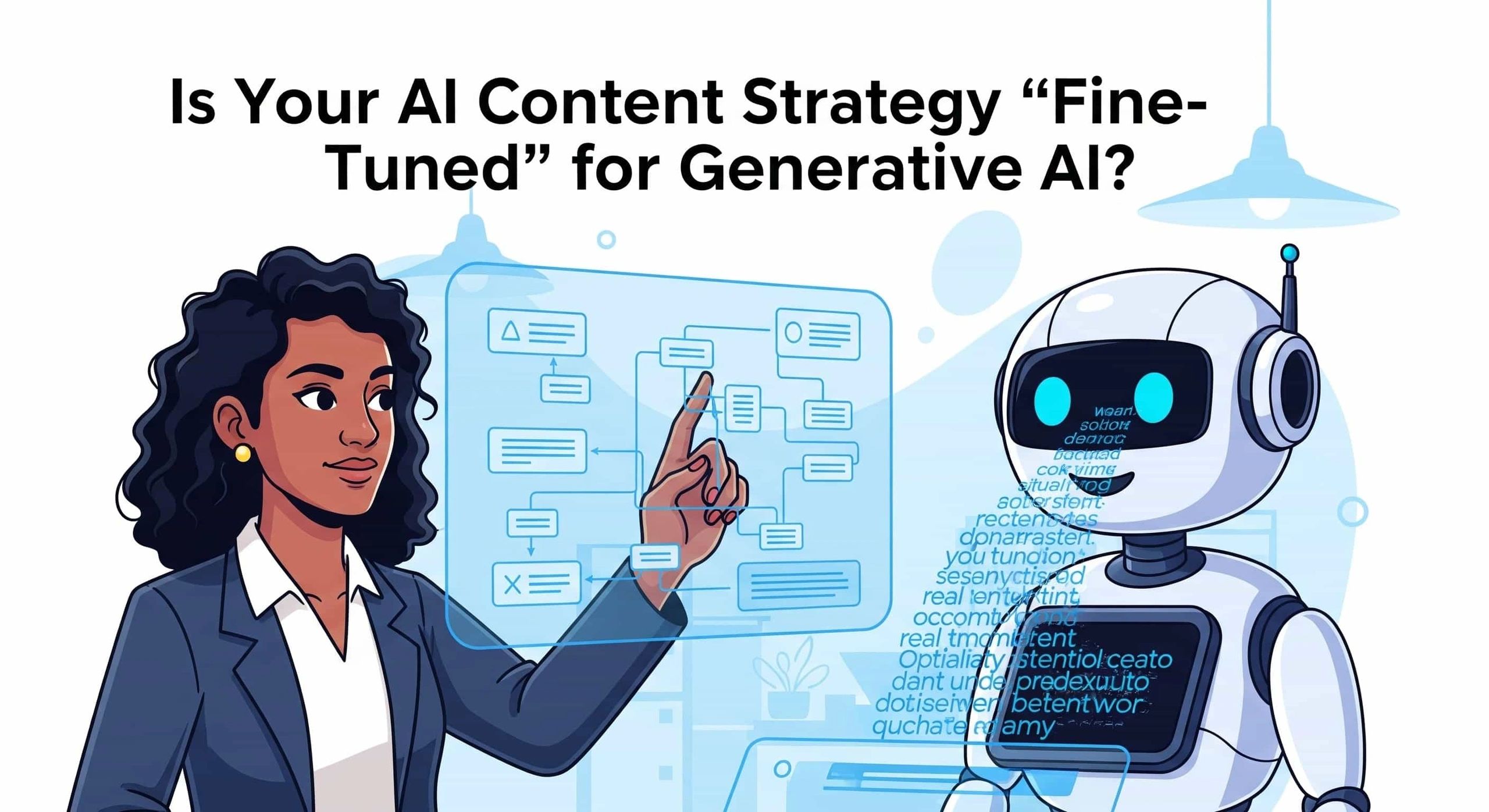
This page works best when the human question is no longer 'Can AI help us publish faster?' but 'How do we keep our voice, proof, and judgment intact when AI can generate endless text on demand?'
Why this matters now
- Generative AI made content volume cheap, which means generic language now spreads faster than genuine expertise or trust.
- A brand page is no longer judged only by readers. Buyers, answer engines, and procurement teams also reuse the page to infer whether your claims are real.
- Teams that stop at prompt-based drafting usually save time in the short term but lose clarity, authority, and originality in the long term.
- The risk is no longer only weak copy. It is a public layer of AI-assisted content that cannot explain what is true, owned, or accountable once scrutiny begins.
What a fine-tuned strategy actually needs
- A clear line between AI as accelerator and humans as the source of meaning, approval, and final judgment.
- Editorial guardrails for tone, facts, approvals, and evidence so the output stays useful instead of becoming polished noise.
- A stronger website structure that connects claims, services, proof, and next steps rather than publishing isolated posts into the void.
- A content system that can survive quoting, AI summaries, and buyer diligence because it stays attached to real expertise.
What to do with it
- Start with the one public page that carries the most commercial or reputational pressure and review whether its claims still sound human, specific, and provable.
- Separate idea generation from publication so AI can help with exploration without becoming the final author of record.
- Add links from every major claim to context, proof, or next-step pages so trust does not collapse when a reader or model asks one follow-up question.
- If the page is part of a services, sourcing, or compliance journey, move from ad hoc prompting into an owned website workflow with explicit review checkpoints.
A fine-tuned AI content strategy is not about getting more text. It is about protecting meaning, proof, and human accountability while AI accelerates the work.
In the last two years, the conversation around content creation and artificial intelligence has gone from "should we use AI?" to "how are we using AI?"
If your answer to the second question is, "We use it to generate blog posts, social media captions, and product descriptions," you're not alone. The vast majority of businesses have adopted what we call a "Phase 1" AI content strategy.
It’s fast, it’s cheap, and it produces content at scale.
But it’s not enough.
A "Phase 1" strategy treats generative AI as a simple text machine—a more advanced word processor that saves you time and money. It fails to account for the unique challenges of the generative AI era, from maintaining a unique brand voice to navigating a sea of identical content.
To succeed today, your strategy can't just be with AI; it must be fine-tuned for it. It must be built with a purpose, with strategic guardrails, and with the human touch as a non-negotiable part of the process.
This is the difference between simply using AI and truly mastering it.
The Problem: The "Phase 1" Content Strategy
A "Phase 1" AI content strategy is characterized by a reliance on automation over augmentation. It’s built on the promise of effortless content, but it comes with a high price.
- The Generic Content Trap: When your team uses the same large language model (LLM) as everyone else, you’re pulling from the same vast dataset. The result is content that is safe but unmemorable. It's clean, grammatically correct, and entirely devoid of the unique personality, insights, and human emotion that build a lasting brand.
- The Credulity Trap: Generative AI is prone to "hallucinations"—fabricating facts, figures, and sources with supreme confidence. A "Phase 1" strategy often lacks the rigorous human oversight to catch these errors, leaving a business vulnerable to a loss of trust and credibility.
- The SEO Gamble: Search engines like Google have been clear: they are not penalizing AI-generated content simply for being AI-generated. They are penalizing unhelpful, low-value, and repetitive content. A "Phase 1" strategy, focused on mass production over human insight, is a direct violation of this principle. It’s a race to the bottom that no one can win.
The solution isn't to stop using AI. The solution is to move from a "Phase 1" strategy to a fine-tuned framework.
The Solution: The "Fine-Tuned" Framework
A fine-tuned AI content strategy is built on a simple, yet profound, idea: AI is a tool to amplify your unique humanity, not to replace it. It's a three-part framework designed to create content that is not only efficient but also authentic, authoritative, and truly human.
- Purpose-Driven Augmentation: Move beyond simple automation and use AI to amplify your unique brand voice and purpose. Instead of generating a blog post from scratch, use AI to create a dozen different headline options for a piece already written by an expert. Instead of writing a generic product description, use it to pull key data points from a brief and weave them into a compelling narrative that is then edited by a human. The goal is to use AI to make your most human ideas happen faster.
- Strategic Guardrails: Your "fine-tuned" strategy must be built on a clear foundation of rules and governance. You must set clear, non-negotiable policies for your team:
- Brand Voice: Define your brand's personality with a detailed style guide and examples. This is your "source code" for the AI.
- Factual Accuracy: Implement a rigorous fact-checking process. Assume that any statistic, quote, or piece of data generated by an AI is incorrect until a human has verified it.
- Confidentiality: Establish clear rules about what data can be put into a public AI model. Never feed proprietary, sensitive, or confidential information into a model without a secure, private enterprise agreement.
- Human-in-the-Loop Integration: The most critical component of a fine-tuned strategy is the human-in-the-loop (HITL). This isn't about simply proofreading an AI's output. It's about ensuring a human expert is involved at every stage of the content creation process.
- The Strategist: A human defines the brand purpose, the unique insights, and the core message.
- The Editor: A human refines the AI's output, infusing it with empathy, nuance, and the kind of lived experience that no algorithm can replicate.
- The Approver: A human has final authority over every piece of content before it is published, ensuring it aligns with brand values, legal standards, and the "AI.Stay kind" promise of creating a positive and trustworthy experience.
Three Questions to Ask Yourself Today
Ready to fine-tune your strategy? Ask yourself these three questions today.
- Is my AI content strategy designed to amplify my unique brand voice and purpose? If you're using AI to create content you wouldn't be proud to claim as your own, your strategy is outdated. Focus on using AI to make your human-driven content better, not to make your brand less human.
- Do I have clear, non-negotiable guardrails for accuracy and originality? If your content is not being fact-checked by a human, it is a liability. If your content lacks a unique perspective, it is a commodity.
- Is there a human expert with final authority in every step of my process? If a piece of content can go from AI to publication without a human editor, fact-checker, and approver, you are playing a dangerous game.
The future of content is not about an AI-driven brand. It is about a brand driven by humans who use AI as their most powerful tool. It’s about being fine-tuned for a future where authenticity and trust are the ultimate competitive advantage.
Tags: AI Content Strategy, Generative AI, Fine-Tuning, Business, Marketing, Content Creation, Human-in-the-Loop, Brand Voice, Ethical AI
Related authority and publishing memory nodes
If content quality is now a trust problem instead of a quantity problem, these connected Age for AI memories deepen the same shift from authority, structure, and human review angles.